


Impressionist Genre Painting
Impressionist genre painting captures everyday domestic and outdoor scenes through lively brushwork, offering rich historical character for any collection.
Impressionist Genre Painting
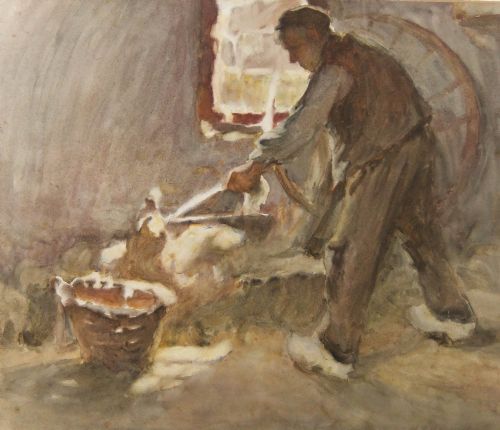
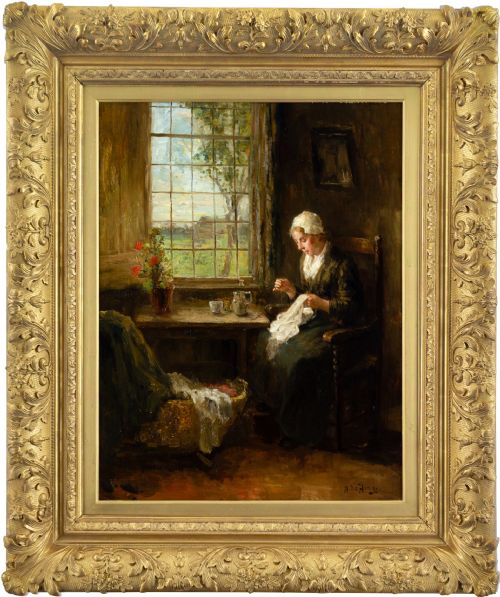
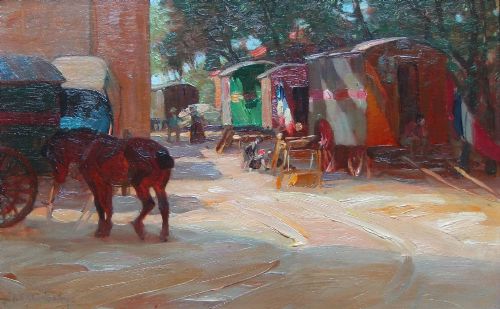
An impressionist genre painting portrays everyday scenes of domestic life, rural labour, and leisure rather than grand historical or mythological subjects. The works gathered here focus on ordinary people engaged in simple daily pursuits, such as fishing, sewing, or gathering at a cottage door.
Most examples originate from the late nineteenth century and the early decades of the twentieth century. These pieces reflect broader artistic movements including British Impressionism, the Hague School, and Belle Epoque realism.
Buyers will encounter both watercolour on paper and oil on canvas formats. These range from intimate portraits of young girls and children to broader village scenes set in Britain, France, and the Netherlands.
Materials and methods
Artists relied primarily on oil paint applied to canvas or wood panels, alongside watercolour pigment worked onto paper. These mediums allowed painters to capture shifting natural light and atmospheric effects swiftly.
Many works retain their original gilt wood frames, which complement the textured brushwork of the painted surface. Canvas supports provide durability for larger oils, whilst watercolour works on paper offer a lighter, more immediate execution.
Listings feature works executed in oil paint, watercolour, and gilt wood framing.
Assessing quality
Quality rests upon the handling of light, shadow, and human gesture within the composition. Stronger works demonstrate confident brushwork and a convincing atmosphere that brings the subject to life without relying on rigid academic precision.
The sophistication of the palette and the preservation of the original support significantly influence the standing of a piece. Finer examples maintain vibrant colour harmonies and stable pigment layers across canvas or paper.
Henry Silkstone Hopwood·Bernard De Hoog·Paul Ehrenberg·Albert Ludovici Jnr·Vincenzo Irolli·Jozef Israëls·Ralph Todd·David Woodlock·Henry Sykes·Robert McGregor·Edward H. Holder·James G. Faulds·Charles Edward Wilson·Thomas Mackay·Antonio Ribas Y Oliver
The Impressionist Genre Painting Glossary
- Genre painting
- The pictorial representation of scenes from everyday life, typically depicting ordinary people in domestic or outdoor settings. This tradition forms the core focus of the pieces gathered here.
- Hague School
- A nineteenth-century group of artists working in the Netherlands who painted realistic, often sombre scenes of rural and fishing life. Their subdued palettes and atmospheric light strongly influenced later genre painting.
- Watercolour
- A painting method in which the pigments are suspended in a water-based solution, traditionally applied to paper supports. It yields transparent washes and delicate tonal gradations.
- Impressionism
- An art movement characterised by relatively small, thin, yet visible brush strokes and an emphasis on accurate depiction of light. This style prioritises the immediate visual impression of a scene.
Impressionist Genre Painting: Frequently Asked Questions
What subjects appear in these paintings?
These works depict everyday life, including village scenes, children fishing, cottage doors, and figures at work or rest.
The focus remains on ordinary people engaged in simple, relatable pursuits rather than formal portraits or grand historical events.
Are these works painted on canvas or paper?
Artists used multiple supports, creating oil paintings on canvas and wood panels alongside watercolours on paper.
Each medium offers a distinct visual texture, from the heavy impasto of oils to the delicate transparency of watercolour.
How do I care for an antique watercolour?
Watercolours on paper require protection from direct sunlight to prevent fading of the delicate pigments.
Displaying works away from moisture and using UV-filtering glass helps preserve the paper and colour over time.
What periods do these pieces date from?
The selection spans the late nineteenth century and the early decades of the twentieth century, particularly the decades surrounding nineteen hundred.
This era saw a flourishing of naturalist and impressionist approaches to everyday genre subjects across Europe.