
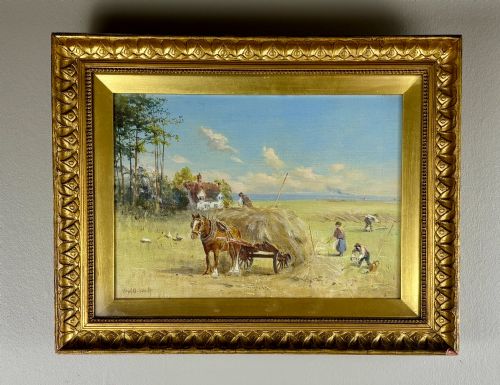


Impressionist Agricultural Painting
Impressionist agricultural painting captures rural labour and harvest scenes through loose brushwork, originating primarily in the early twentieth century.
Impressionist Agricultural Painting
Impressionist agricultural painting depicts rural scenes of haymaking, ploughing, and farm labourers at work in the fields. These works date predominantly from the early twentieth century, spanning decades such as nineteen ten and nineteen twenty.
Subjects range from working horses at watering troughs to bustling harvest fields and quiet pastoral landscapes. The pieces appear primarily as oil paintings on canvas and watercolours on paper.
Regional British and French provincial settings dominate these works, reflecting local agricultural traditions of the era. Painters record the changing light of the countryside using distinct brush techniques.
Materials and Technique
Artists build these compositions using oil paint applied to stretched canvas or watercolour pigments on paper. Wood also appears as a structural base for framing and support.
The application relies on visible, rapid brushstrokes to capture fleeting effects of light and atmosphere in rural settings. Painters handle colour to convey the texture of hayricks, soil, and working attire.
Listings feature works created across several decades, spanning from the nineteenth century through the nineteen thirties.
Judgments of Quality
Quality rests in the handling of light and the vitality of the brushwork across the canvas or paper. Stronger examples convey motion and atmosphere with economy of line.
The articulation of human figures and working animals marks the division between standard and superior output. Compositional balance within the pastoral landscape further elevates the standing of a piece.
Raimond Louis Lecourt·Herbert Royle·John Atkinson·James William Booth·George Soper·Arthur Winter Shaw·Rowland Henry Hill·Frederick William Jackson·Ernest Higgins Rigg·Owen Bowen·George Graham·William Kay Blacklock
The Impressionist Agricultural Painting Glossary
- Oil painting
- A work executed with pigments bound in a drying oil, typically applied to canvas or wood. This medium allows for rich texture and layered colour depth.
- Watercolour
- A painting method where fine pigment is suspended in a water-based solution, usually worked on paper. It produces transparent washes of light and tone.
- Impressionism
- A nineteenth and twentieth century art style focusing on accurate depiction of light in its changing qualities. Practitioners prefer loose brushwork over rigid academic finish.
- Pastoral
- A genre of art depicting rural life and landscapes in a romanticised or idealised manner. These scenes often feature shepherds, farm hands, and agricultural labour.
- Framed
- Enclosed within a protective and decorative border, usually of wood, to finish the artwork for display. Period frames complement the aesthetic of early twentieth century canvases.
Impressionist Agricultural Painting: Frequently Asked Questions
What subjects appear in these paintings?
These works depict rural agricultural labour, including hay cutting, harvesting, ploughing, and farm hands at rest. Scenes capture everyday rural activities across British and French provincial settings.
Common motifs involve working horses, hayricks, and milking time against pastoral landscapes. Artists focus on outdoor labour during the Edwardian era and subsequent decades.
How do I care for an oil painting?
Protect canvas works from direct sunlight and extreme temperature fluctuations to prevent cracking in the paint layer. Keep the surface clean using a soft, dry brush to remove dust gently.
Avoid hanging pieces in damp environments like unventilated kitchens or bathrooms. Proper framing also shields the edges of the canvas from physical damage.
How do I care for watercolour on paper?
Display watercolour paintings away from direct sunlight to prevent the pigments from fading over time. Glazing the work behind glass protects the delicate paper surface from moisture and atmospheric pollutants.
Mount the paper away from direct contact with the glass using archival spacers. This prevents humidity from causing the paper to adhere to the protective glazing.
How can I tell the period of a painting?
Examine the materials, stretcher frames, and stylistic markers to determine the likely era of production. Works from the early twentieth century often display Impressionist brushwork paired with Edwardian pastoral themes.
Signatures, dates inscribed by the artist, and framing techniques offer additional clues to age. Catalogues and artist records help verify the active working years of the painter.