
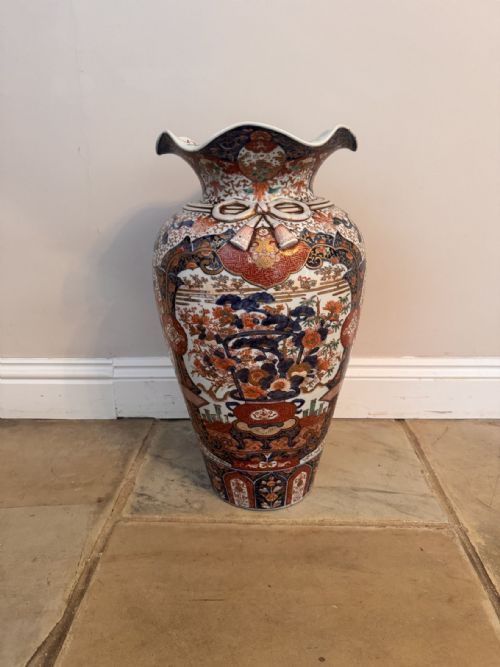


Imari Floral Baluster Vase
These imari floral baluster vase examples bring centuries of Japanese and British ceramic artistry straight into a room.
Imari Floral Baluster Vase
An imari floral baluster vase represents a distinct intersection of traditional ceramic forms and decorative styles spanning the eighteenth, nineteenth, and early twentieth centuries. When searching for an imari floral baluster vase, collectors encounter both Japanese imports and British interpretations shaped by distinct historical periods.
The selections on this page predominantly feature nineteenth-century Japanese Meiji period examples alongside Edwardian pieces and eighteenth-century Arita porcelain. Forms range from large floor-standing vessels and lidded jars to paired decorative items and converted table lamps.
Buyers frequently find traditional Japanese Imari alongside related Chinoiserie and ironstone variations. Each imari floral baluster vase exhibits the characteristic profiles and motifs recorded across these diverse periods of manufacture.
How they were made
The construction of an imari floral baluster vase relies primarily on porcelain and ceramic bodies shaped into swelling baluster silhouettes. Artisans applied complex underglaze and overglaze techniques utilising enamel and gold leaf to build up intricate surface patterns.
Certain pieces incorporate additional structural elements such as brass mounts or silk components, particularly when adapted for lighting purposes or fitted with lids. Ironstone china also appears among the material evidence for British interpretations of the style.
Current listings feature porcelain, enamel, gold leaf, brass, silk, ironstone, and ceramic across Japanese Imari, Meiji period, and 18th century Arita forms.
What varies in quality
The division between standard and superior pieces rests upon the precision of the hand-painted detailing and the richness of the enamel and gold leaf application. Finer examples display remarkable control over intricate floral and pictorial motifs across the porcelain surface.
Scale and proportion also define the range, with large floor-standing vessels and matched pairs commanding greater presence than smaller single vases. The integrity of the ceramic body and the preservation of original lids or mounts further influence the standing of any given piece.
The Imari Floral Baluster Vase Glossary
- Baluster vase
- A tall vessel shape characterised by a rounded body that tapers toward the base and swells near the lower centre before rising to a narrower neck. This classic silhouette provides a stable foundation for complex decorative schemes.
- Imari
- A traditional Japanese style of porcelain decoration originating from Arita, typically defined by a palette of cobalt blue, iron red, and gold. British potteries frequently imitated this distinctive aesthetic during the nineteenth century.
- Meiji Period
- The era in Japanese history spanning from 1868 to 1912, noted for a surge in export ceramics destined for Western markets. Pieces from this time often exhibit highly intricate hand-painted floral and pictorial designs.
- Arita porcelain
- Ceramic wares produced in the town of Arita in Hizen province, Japan, recognised as the birthplace of Japanese porcelain production. These early wares laid the technical foundations for subsequent imari styles.
- Ironstone
- A type of durable heavy earthenware patented in nineteenth-century Britain as a tougher alternative to porcelain. Mason's ironstone examples frequently adopted Eastern decorative motifs.
Imari Floral Baluster Vase: Frequently Asked Questions
How do I date an imari vase?
Dating relies on examining the characteristics of the porcelain body, the specific pigments used in the enamel, and stylistic markers tied to periods such as the Meiji era or the eighteenth century.
Changes in export regulations and manufacturing techniques across the nineteenth and early twentieth centuries also help narrow down the period of production.
Were these vases made in Japan or Britain?
The evidence shows production originating both from Japan, particularly during the Meiji period and earlier Edo times, and from British makers producing ironstone alternatives.
Japanese pieces typically feature traditional export porcelain and Arita roots, while British interpretations reflect domestic adaptations like Mason's ironstone.
How should I display a baluster vase?
The swelling baluster form and detailed floral motifs make these vessels well-suited as focal points on sturdy tables, sideboards, or dedicated floor stands.
Some examples arrive fitted as table lamps, combining traditional ceramic bodies with functional household lighting.
What is the difference between an Imari vase and a Kutani vase?
Imari wares traditionally rely on a specific palette dominated by cobalt blue, iron red, and gold leaf arranged in dense floral or geometric patterns.
Kutani wares, also originating from Japan during the nineteenth century, often employ a different range of enamels and pictorial compositions.