


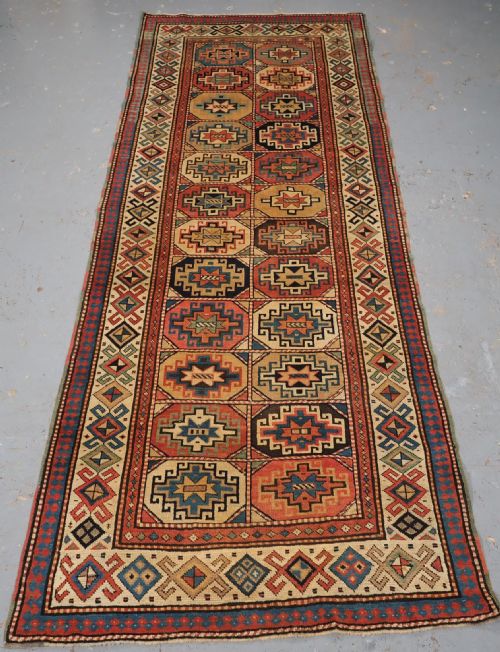
Hooked Medallion Tribal Rug
A hooked medallion tribal rug brings geometric energy and rich historic character to a room through centuries-old nomadic weaving traditions.
Hooked Medallion Tribal Rug
A hooked medallion tribal rug is a floor covering defined by central geometric motifs featuring characteristic latch hooks or stepped edges. These pieces emerge from Caucasian, Kurdish, and Persian weaving traditions, spanning the late nineteenth and early twentieth centuries. The primary forms range from square area rugs to elongated runners suited for hallways.
The most common variety encountered on this page is the Caucasian Moghan Kazak rug, frequently dated between 1880 and 1900. These specific rugs present repeating hooked medallion designs along the central axis, often accompanied by classic tribal borders. Other variations include Dagestan and Bordjalou pieces, alongside Kurdish runners utilising latch hook patterns.
Weavers constructed these carpets for nomadic or village use rather than formal urban production, resulting in robust structures and spirited regional designs. The palette typically combines deep saturated tones with softer aged hues developed over generations of light and wear. Each piece functions as a direct record of nineteenth-century tribal aesthetics.
How they were made
These textiles rely on hand-spun wool for both the pile and the foundational warp and weft threads. Certain regional examples incorporate camel hair into the ground or foundation, providing a distinctive natural warmth and varied texture. Spinners worked by hand to create irregular yarns that absorb natural dyes with subtle tonal shifts.
Weavers knotted the wool pile by hand onto vertical looms using traditional symmetrical or asymmetrical knotting techniques. The resulting dense weave creates a durable surface capable of enduring decades of heavy foot traffic. Natural dye sources yielded the blues, reds, and ivory tones seen across the Caucasian and Kurdish groups.
Hooked Medallion Tribal Rug Retail Price Guide 2026
Typical asking prices for hooked medallion tribal rug among the pieces listed under this phrase on Sellingantiques today, from the lower quarter to the upper quarter. They describe what is for sale here now, not the wider market.
Listings feature Caucasian and Kurdish tribal rugs dating from the 1870s to the 1920s, utilising hand-spun wool and camel hair.
What varies in quality
Quality in these textiles rests upon the precision of the tribal geometry and the clarity of the hooked medallion outlines. Better examples maintain crisp drawing within the motifs and balanced proportions across the entire field. Weavers who exercised greater control over their knot density achieved sharper lines and longer-lasting pile integrity.
The choice of wool and the depth of the dye colours further separate individual pieces. Superior specimens display rich, saturated hues that have mellowed harmoniously over time without muddying the underlying design. The integration of secondary motifs and border proportions completes the aesthetic success of the piece.
The Hooked Medallion Tribal Rug Glossary
- Kazak
- A term applied to rugs woven in the southern Caucasus region, known for bold geometric patterns and strong primary colours. These pieces often date to the nineteenth century.
- Moghan
- A specific Caucasian design group associated with Kazak rugs, characterised by rows of repeating octagonal or hooked medallions. The name derives from the Moghan steppe.
- Memlinc gul
- A distinct octagonal or gabled medallion shape containing hooked appendages, named after fifteenth-century Flemish painter Hans Memlinc who depicted similar rugs in his art.
- Runner
- A long, narrow carpet format designed specifically for hallways, corridors, or bedside placement. These pieces balance repeated central medallions with compressed side borders.
Hooked Medallion Tribal Rug: Frequently Asked Questions
How do I style a tribal runner in a modern home?
A tribal runner works effectively in high-traffic transition spaces like hallways, kitchens, or entryways where the linear format complements architectural dimensions. The geometric patterns provide a strong visual anchor against timber floors or neutral flagstones.
Allowing sufficient surrounding floor space lets the antique design read clearly without competing with contemporary furnishings. The natural wool pile also provides comfortable cushioning underfoot in daily use.
How do I date a nineteenth-century Kazak rug?
Dating a nineteenth-century Kazak rug relies on examining the wool quality, the natural dye palette, and the structural characteristics of the foundation. Pieces from the 1880s and 1890s typically exhibit hand-spun wool with specific abrash variations where dye batches shifted subtly.
Structural clues such as wool warp threads and selvedge construction help narrow down the period of production. Comparing the specific drawing of the hooked medallions against documented regional types confirms the approximate decade.
What is the difference between Kazak and Kurdish rugs?
Kazak rugs originate from the Caucasus region and are celebrated for large-scale geometric medallions executed in vivid primary colours. Their designs emphasise bold octagons, stars, and stark contrasting borders.
Kurdish rugs stem from Kurdish weaving groups and often feature a denser arrangement of repeating motifs, including Memlinc guls and latch hook details. Their colour palette can incorporate camel hair grounds and more earthy, subdued tones.