


Hinged Silver Cuff
These hinged silver cuff pieces offer wrist adornment that fastens securely, uniting period craft with wearable history.
Hinged Silver Cuff
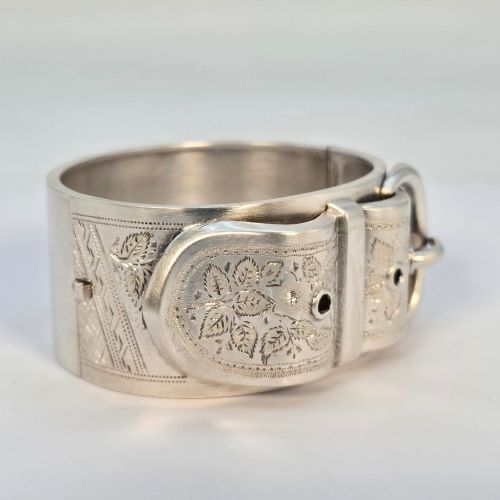
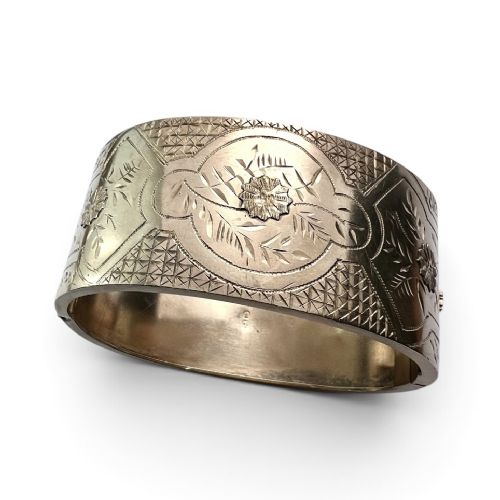
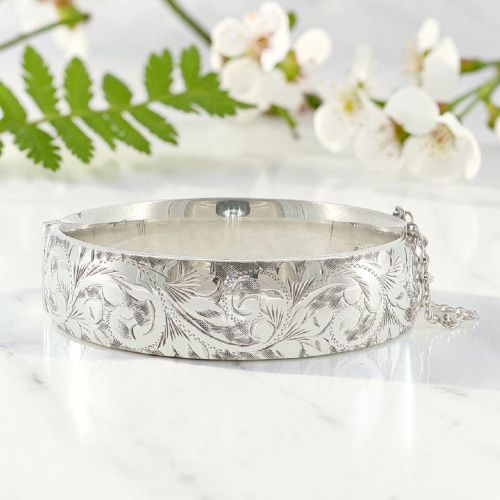
A hinged silver cuff provides a rigid wrist ornament that opens on a pin hinge and secures with a clasp, often encountered in substantial Victorian or mid-century designs. You will frequently find wide sterling silver examples from the Victorian period alongside later vintage iterations from the twentieth century.
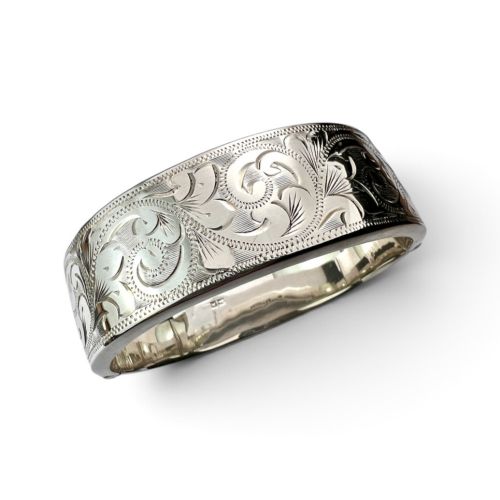
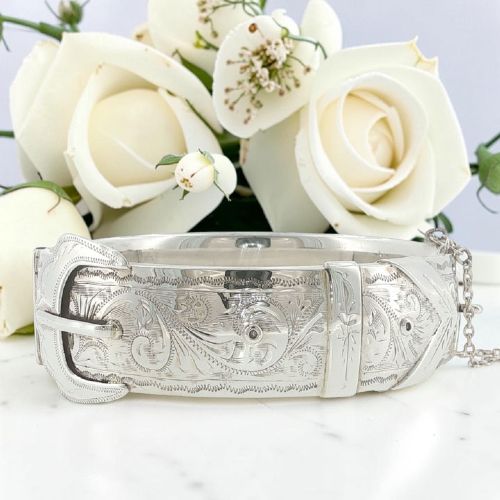
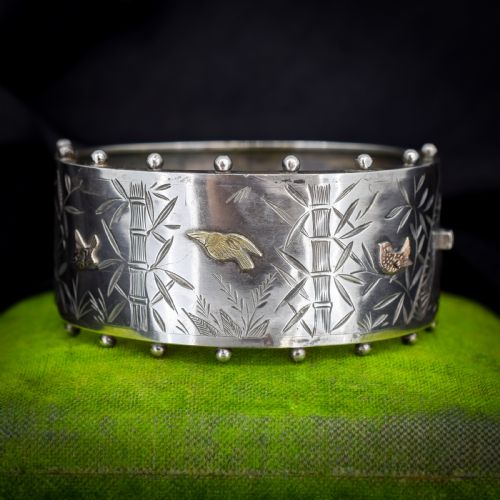
The form spans various distinct aesthetic movements, taking shape as plain polished metal, heavy engraved bands, or embellished pieces featuring applied gold birds and floral motifs. Some versions incorporate buckles, bamboo textures, or Etruscan revival details.
Origin points range from British workshops in Birmingham and London to continental European makers such as Georg Jensen, Topazio, and Austro-Hungarian studios. Buyers select these items for their secure hinged construction and strong wrist presence.
Materials and construction methods
Makers utilised sterling silver and solid silver as the primary body material, frequently combining it with gold, notably fifteen-carat gold, to create contrasting two-tone decorative elements. Surface decoration involved hand engraving, chasing, and the application of dimensional motifs like birds and floral clusters.
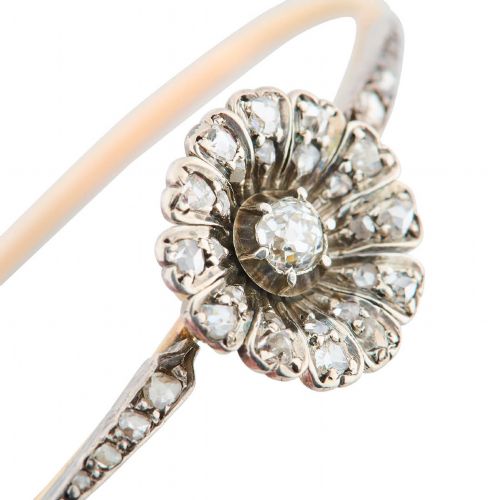
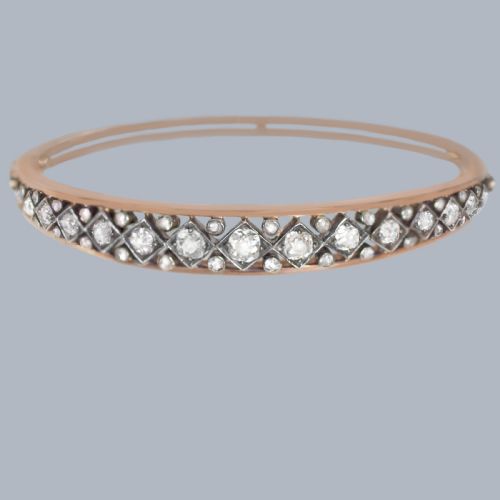
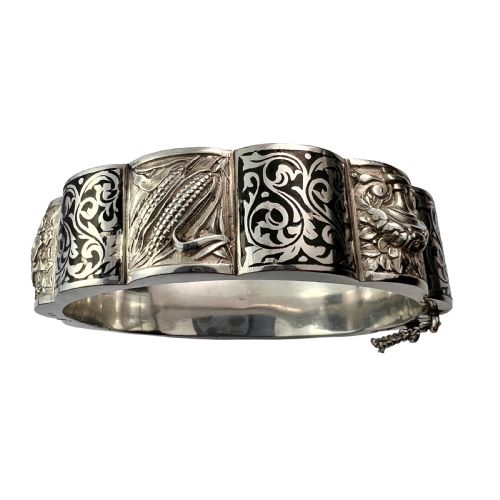
Many examples incorporate contrasting textures through niello work, polychrome enamel, or set gemstones including diamonds, pearls, and amber. The structural integrity relies on an integrated hinge and clasp mechanism allowing the rigid band to open and fit snugly around the wrist.
Distinctions in quality and execution
The calibre of a hinged silver cuff depends heavily on the weight of the metal and the precision of the hinge mechanism, where superior pieces maintain a tight closure and flush alignment when shut. Substantial gauge silver and heavy casting elevate the tactile presence of the bangle.
Artistic execution distinguishes standard production from exceptional work, seen in the depth and crispness of hand engraving, the delicacy of applied gold bird or floral details, and the preservation of intricate enamel or niello. Hallmarks and maker marks add documentary clarity and confirm origin.
Georg Jensen·Walker & Hall·TOPAZIO
The Hinged Silver Cuff Glossary
- Sterling silver
- A silver alloy containing ninety-two point five percent pure silver by mass, with the remainder consisting of other metals like copper. This standard alloy provides durability for daily wear while maintaining a bright metallic lustre.
- Hinge
- A mechanical joint that allows the rigid bangle to open into two semi-circular halves for easy placement on the wrist. It functions alongside a secure clasp to lock the cuff in place.
- Niello
- A black metallic alloy of sulphur with silver, lead, or copper used as an inlay on engraved metal. It creates striking dark contrasts against the bright silver background.
- Old mine cut
- An antique diamond cut characterised by a roughly square or cushion shape with a high crown and small table. This cut predates modern brilliant stones and appears frequently in nineteenth-century jewellery.
- Etruscan revival
- A nineteenth-century design style inspired by ancient archaeological discoveries from Etruscan tombs. It typically employs granulation, wirework, and classical geometric motifs on silver and gold.
Hinged Silver Cuff: Frequently Asked Questions
How do I secure a hinged silver cuff?
Most pieces operate with a concealed or visible side hinge that swings open, allowing the wrist to slip through before clicking shut into a secure box clasp or snap lock.
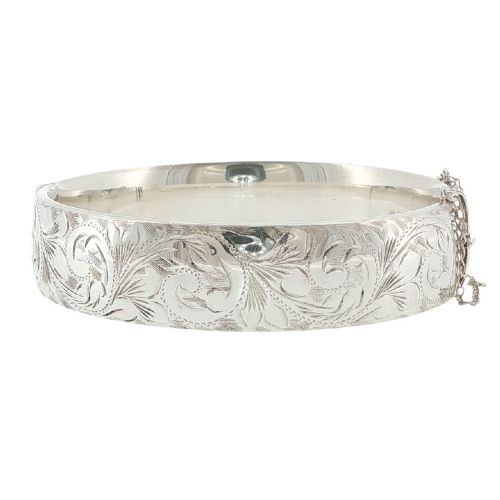
Some designs incorporate a safety chain attached to the band, providing extra security against accidental loss during wear.
Are these cuffs suitable for daily wear?
Many solid sterling silver and twentieth-century examples are robust enough for regular rotation if handled with care, though heavily decorated or gem-set pieces require gentleness.
Checking the tension of the hinge and the reliability of the clasp prior to extended wear helps prevent accidental damage.
How do I distinguish Victorian from mid-century pieces?
Victorian examples frequently display heavy hand engraving, Etruscan revival motifs, or applied gold bird and floral details on substantial silver gauges. Mid-century modernist pieces tend toward cleaner lines, Scandinavian minimalism, or distinct engraved patterns from the nineteen-fifties and sixties.
Assay office marks and date letters stamped inside the band provide definitive chronological reference points.
What metals are typically used alongside silver?
Many nineteenth-century examples combine sterling silver with yellow or rose gold, often in fifteen-carat purity, to highlight applied decorative elements like birds and leaves.
Enamel, pearls, diamonds, and amber also appear as complementary materials accentuating the primary silver structure.