
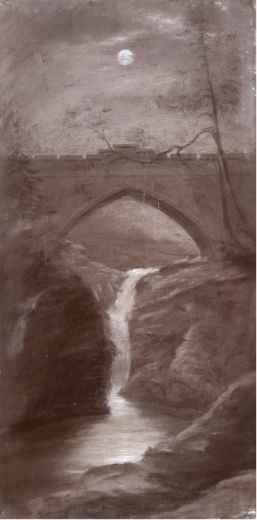


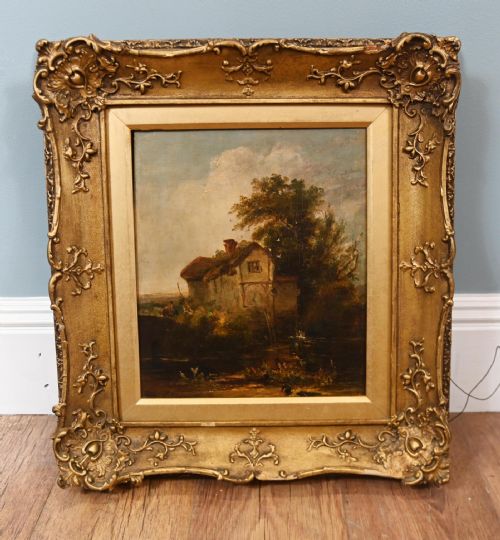

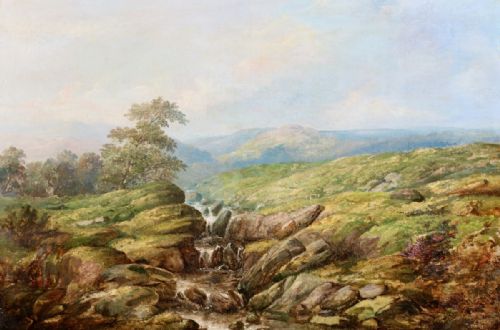


Highland River Landscape Painting
A highland river landscape painting captures the rugged topography and moving water of Scotland through the sustained traditions of the British and Scottish schools.
Highland River Landscape Painting
A highland river landscape painting presents rural valleys, remote waterways, and mountainous terrain executed in oil or watercolour across the eighteenth, nineteenth, and early twentieth centuries.
The versions most frequently met on this page belong to the Victorian period, spanning framed canvases, wood panels, and paper supports.
Works range from intimate pastoral watercolours to large oil paintings recording specific locations such as Skye, Arran, and Braemar.
Materials and methods
Artists painted primarily with oil paint or watercolour applied to woven canvas stretched over wooden frames, sturdy wood panels, or heavy paper.
Many historical works retain their original giltwood frames featuring moulded gesso ornamentation, which protected the edges of the canvas and panel.
Pigments were worked with brushes and sometimes palette knives to build depth in the depiction of rocky riverbanks, mountains, and turbulent water.
The listings combine oil paintings and watercolours on canvas, wood, and paper, spanning the Georgian, Victorian, and early twentieth-century periods.
Gradations of quality
Quality rests upon the artist's command of light, shadow, and atmospheric perspective in rendering water and high terrain.
Finer examples demonstrate confident brushwork and accurate topographical proportion rather than formulaic studio composition.
The preservation of the original paint surface and the condition of the accompanying gilt frame contribute significantly to the standing of a piece.
Archibald Kay·Sidney Richard Percy·Benjamin Williams Leader·Louis Bosworth Hurt·William Langley
The Highland River Landscape Painting Glossary
- Canvas
- A heavy woven fabric stretched across a wooden frame to serve as a painting support. It provides the principal ground for nineteenth-century oil paintings.
- Gesso
- A plaster mixture applied to wooden frames before gilding. It forms the smooth base for moulded decorative relief.
- Panel
- A flat piece of wood used as a rigid painting support. Panels were frequently utilised for smaller landscapes.
- Watercolour
- A paint consisting of pigment suspended in a water-based solution applied to paper. It was often employed for lighter topographical views.
- Scottish School
- A collective term for artists working in Scotland or within Scottish traditions. These painters focused on local geography and atmospheric conditions.
Highland River Landscape Painting: Frequently Asked Questions
How do I identify a Victorian highland landscape?
Victorian highland landscapes are identified through stylistic markers such as romanticised mountainous backdrops, cattle watering by rivers, and atmospheric lighting characteristic of nineteenth-century British art.
Support materials like coarse canvas, stretcher construction, and period framing inscriptions also assist in dating these works accurately.
How should I care for an oil painting on canvas?
Protect oil paintings from direct sunlight, extreme temperature fluctuations, and high humidity to prevent canvas slackening and paint cracking.
Dust surfaces gently with a soft, dry brush and avoid using liquid cleaners on the paint or the gilt frame.
What is the difference between oil and watercolour works?
Oil paintings utilise pigment bound in drying oils on canvas or wood panels, allowing for thick impasto application and deep colour saturation.
Watercolours use water-soluble pigments on paper under glass, producing lighter, translucent effects suited for delicate topographical studies.