



Highland Mountain Scene Painting
A highland mountain scene painting brings the sweeping mists, rugged peaks, and quiet lochs of Scotland directly into your room.
Highland Mountain Scene Painting
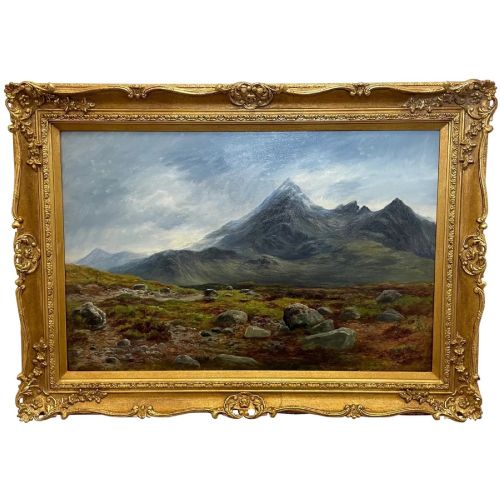
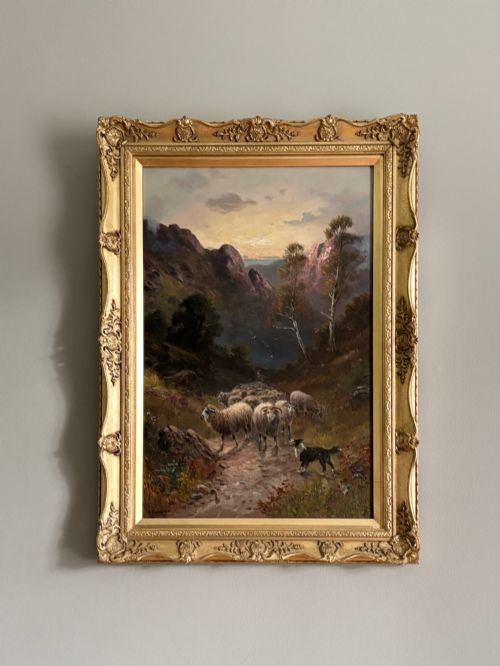
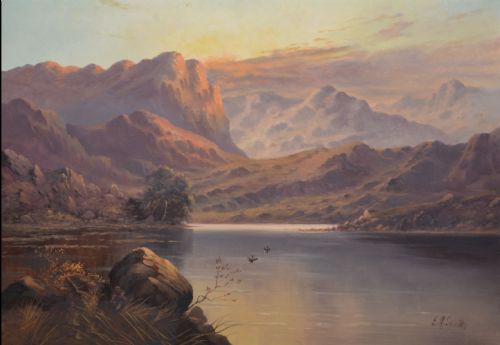
A highland mountain scene painting captures the dramatic topography of Scotland, frequently depicting named peaks alongside cattle, sheep, or solitary figures. These works emerge primarily from the Victorian and Edwardian periods, reflecting a nineteenth-century fascination with untamed British landscapes.
You will encounter these works executed on canvas, board, or paper, often housed within substantial gilt wood frames. The compositions range from expansive vistas featuring calm lochs to intimate studies of morning mist rolling over high ridges.
The creators of these works worked within traditional British landscape traditions, recording specific geographical locations such as Ben Lawers, Loch Tay, and Skye. Unsigned examples appear alongside signed works by noted artists of the period, all sharing a distinct regional focus.
Materials and technique
Artists working on these landscapes relied primarily on oil paint applied to canvas or wood, building up rich textures to describe rocky terrain and heavy skies. Others employed gouache or watercolour on paper, capturing the translucent quality of highland light and drifting weather.
The finished works were typically set into heavy wood frames, frequently finished in gilt, which provided a formal architectural boundary for the wild scenery within. Canvas supports were stretched over wooden bars, while boards offered a rigid surface for smaller plein-air studies.
Several sheep and highland cattle appear to have spent the nineteenth century standing patiently in the mist while artists painted them.
Factors of quality
Quality in a highland mountain scene painting rests upon the confidence of the brushwork and the artist's ability to render the atmospheric weight of mountain weather. Stronger works balance the monumental scale of peaks and crags with precise details in the foreground vegetation and livestock.
The handling of light distinguishes the finest examples, where morning mist or low sunlight creates genuine depth across the canvas. Frame construction and the preservation of the original paint surface also influence the overall character of the piece.
William Beattie-Brown RSA·Douglas Cameron·Frederick Richard Lee·Thomas Sidney Cooper·AJ Thornton·Alfred de Breanski Sr·Benjamin Williams Leader·Milton Drinkwater·Alfred Graham·E M Seaton·Charles W Oswald
The Highland Mountain Scene Painting Glossary
- Canvas
- A heavy woven fabric stretched across a wooden frame to serve as a support for oil painting. It provides a flexible yet durable surface that accepts layered pigment.
- Gilt Wood
- Wood carved and coated with a thin layer of gold leaf or metallic paint. This material is standard for traditional framing, adding brightness around dark landscape scenes.
- Gouche
- An opaque water-based medium that dries to a matte finish. It allows artists to build solid areas of colour with high opacity on paper supports.
- Oil Paint
- A slow-drying medium composed of pigments suspended in a drying oil such as linseed. It permits smooth blending and the creation of rich surface textures.
Highland Mountain Scene Painting: Frequently Asked Questions
What is a highland mountain scene painting?
These artworks are nineteenth and early twentieth-century depictions of Scottish terrain, featuring mountains, lochs, and pastoral elements like cattle or sheep.
They serve as traditional wall art that brings a sense of nineteenth-century romanticism and topography into domestic interiors.
How were these paintings displayed?
Period works were hung in principal rooms, framed in heavy wood and gilt surrounds designed to complement domestic interiors of the era.
Today, they suit traditional wall placements, requiring simple hook fixings capable of supporting the weight of a framed canvas.
How do I identify a Victorian landscape?
Look for specific material indicators such as canvas supports, traditional stretchers, and nineteenth-century framing techniques characteristic of the period.
Subject matter focusing on named Scottish peaks alongside cattle, sheep, or fishermen provides further context for dating the piece.
What mediums were used?
The listings show artists working in oil paint on canvas or wood panels, alongside works executed in gouache and watercolour on paper.
Each medium creates a distinct surface texture, from the heavy impasto of oil on canvas to the flat matte finish of gouache.