
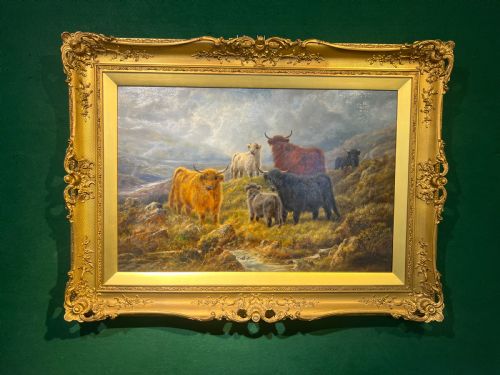
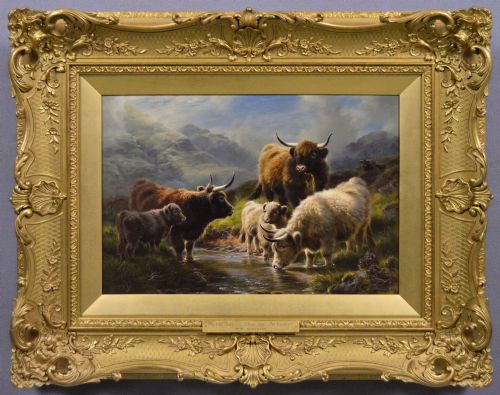


Highland Cow Artwork
These highland cow artwork pieces are Victorian oil paintings depicting cattle in Scottish landscapes, capturing the atmospheric pastoral mood collectors seek.
Highland Cow Artwork
When you search for highland cow artwork, you encounter 19th-century oil paintings originating from the Victorian period, specifically dating between 1870 and 1920. These canvases generally portray Scottish scenes featuring cattle near lochs, streams, or mountainous terrain.
The dominant aesthetic centres on Victorian Pastoral and Victorian Fine Art styles, depicting animals within expansive landscapes. You are most likely to meet framed pieces attributed to known artists working during the late Victorian and Edwardian eras.
How They Were Made
These works utilise oil paint applied to canvas, mounted within wooden frames often embellished with plaster, gold leaf, and giltwood. Artists built up the surface through layered brushwork to render the texture of the cattle coats and the atmospheric mist over Scottish water.
The framing methods rely on traditional joinery and heavy gilding typical of the period, which complements the substantial scale of large antique oil paintings from this tradition.
Several cattle appear to pause indefinitely by streams, seemingly unfazed by Victorian painters standing in the Highland mist.
What Varies in Quality
Quality rests upon the artist's ability to render the anatomy and hair of the cattle with precision while managing the depth of the Scottish landscape background. Superior examples display confident brushwork in the depiction of water, mist, and distant hills.
The preservation of the original oil paint and the integrity of the giltwood or gold leaf frame significantly influence the overall character of the piece. Finer works maintain clear artist signatures and distinct provenance connected to the recognised painters of the genre.
Robert Watson·William Watson Jnr·Henry Robinson Hall·George Turner·John W Morris·Gustave De Brianski·Charles Jones
The Highland Cow Artwork Glossary
- Oil on Canvas
- Pigment mixed with drying oil applied to a woven fabric support. This was the standard medium for fine art landscape painting throughout the nineteenth century.
- Giltwood
- Wood that has been coated with a thin layer of gold leaf or gold paint. Frames utilising this technique provide a reflective border that enhances the dark tones of oil paintings.
- Victorian Pastoral
- An artistic style focusing on idealized rural or agricultural scenes. It emphasises tranquil landscapes populated by livestock and figures in pastoral settings.
- Gilt Wood
- Timber ornamented with gold leaf applied over a prepared gesso and plaster base. It forms the heavy decorative frames typical of large nineteenth-century salon paintings.
Highland Cow Artwork: Frequently Asked Questions
What periods do these paintings date from?
The available works date predominantly from the nineteenth century, spanning from the 1870s through to the 1920s during the Victorian and Edwardian eras.
Artists working in this period recorded traditional Scottish landscapes featuring cattle within specific regional topographies like Loch Tay and Glen Tay.
How were these paintings originally displayed?
These large oil paintings were housed in heavy giltwood and gold leaf frames designed to be hung in prominent rooms of Victorian homes.
The substantial frames served to isolate the expansive pastoral scene from the domestic wall covering, mirroring salon presentation methods.
How do I identify a Scottish landscape painting?
Key indicators include the depiction of Highland cattle, mountainous backgrounds, and atmospheric weather conditions such as morning mist over lochs.
Signatures or attribution to artists known for pastoral scenes help confirm the specific origin and context of the work.
What materials make up the frames?
Frames are constructed from wood, often finished with plaster mouldings and covered in gold leaf or giltwood.
This construction method provides the weight and decorative detail expected of authentic nineteenth-century picture frames.