


Highland Cattle Artwork
Highland cattle artwork brings the atmospheric landscape and rural romance of Scotland into a room through historic British painting.
Highland Cattle Artwork
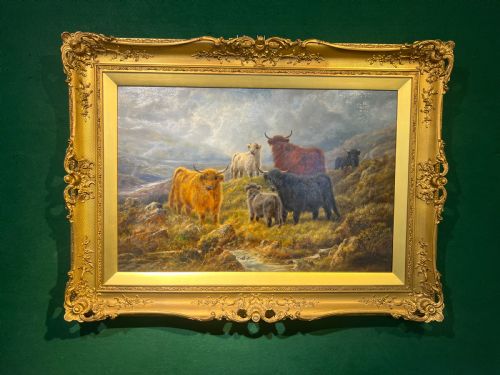
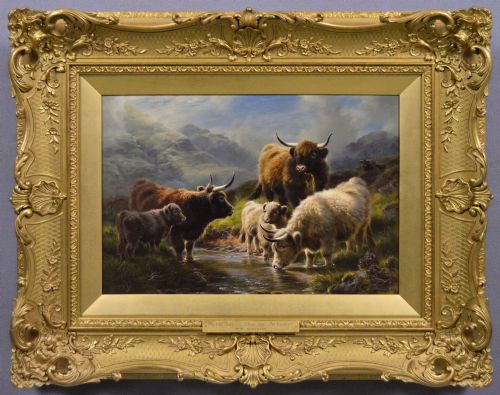
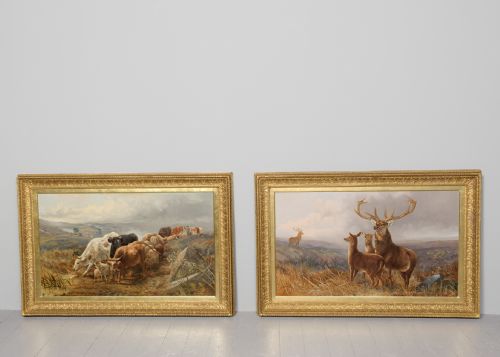
Highland cattle artwork captures the majestic scenery of the Scottish hills, glens and lochs populated by longhorned cattle, sheep and herdsmen. When you search for highland cattle artwork, you encounter nineteenth and early twentieth century British paintings that celebrate the dramatic topography and weather of Scotland. These works bridge the genres of landscape and animal painting, reflecting a Victorian appetite for pastoral realism and the romantic wilderness.
The pieces appearing here are predominantly oil paintings on canvas, frequently housed within heavy giltwood and gesso frames. You also encounter works executed in gouache and watercolour on paper, representing the broader output of Victorian fine art. Scenes often depict specific locations such as Loch Tay, Glen Tay and Ben Lawers, capturing misty mornings, golden sunsets and snowy winter conditions.
Dated examples span from the mid-nineteenth century through the Edwardian era, showing the enduring appeal of the Highland school and Scottish landscape realism. These traditional British paintings range from intimate cabinet pieces to large, imposing works designed to dominate a formal wall. The focus remains steadfastly on the quiet dignity of the cattle against vast, mountainous horizons.
How these pieces were made
Artists built these compositions using oil paint on stretched canvas, layering pigments to capture the dense, shaggy coats of the cattle and the shifting light over water and heather. The technique relies on a mastery of naturalism, balancing the detailed rendering of livestock with the loose, atmospheric handling of distant mountain ranges and brooding skies.
Surviving canvases sit within elaborate frames constructed from wood, plaster and gold leaf. These giltwood and gesso surrounds often feature ornate moulded decoration that complements the grand scale and romantic subject matter of the Victorian interior.
Canvas, oil paint, giltwood and gesso are the predominant materials recorded across these nineteenth-century Scottish landscape works.
What separates the finest works
Quality in these pastoral scenes rests upon the artist's command of light, atmosphere and anatomical proportion. The finest paintings capture the distinct texture of the cattle's hair and the humidity of the Highland air with confident brushwork, avoiding the stiff or formulaic rendering seen in lesser studio output.
The relationship between the animals and their surrounding landscape determines the visual success of the piece. Superior examples integrate the cattle harmoniously into a convincing topographical view, whereas weaker works treat the animals as isolated cut-outs pasted onto a generic background.
Robert Watson·William Watson Jnr·Robert Cleminson·Henry Robinson Hall·Henry Hillier Parker·Sidney Yates Johnson·Sidney Pike·Charles Jones·George Turner·John W Morris·Daniel Sherrin·Alfred de Breanski Snr·Gustave De Brianski·Henry Birtles·Milton Drinkwater·Louis Bosworth Hurt·Aster Richard Chilton Corbould·Sidney Richard Percy·James Kay
The Highland Cattle Artwork Glossary
- Oil on Canvas
- A traditional painting medium where coloured pigments suspended in drying oil are applied to a stretched woven fabric support. This combination allows for rich colour depth and subtle blending.
- Giltwood
- Timber that has been decorated with a thin layer of gold leaf or powder. It provides a luminous, reflective border that enhances the colours within the painting.
- Gesso
- A traditional plaster-like mixture used to coat wood before gilding or painting. Artisans carve and mould this surface to create ornate relief decoration on picture frames.
- Highland School
- A loose grouping of nineteenth-century artists who painted the landscapes, wildlife and rural life of Scotland. Their work emphasises romantic realism and topographical accuracy.
- Gouache
- An opaque water-based paint mixed with a fine white pigment. It produces a flat, matte finish that allows for sharp detail in works on paper.
Highland Cattle Artwork: Frequently Asked Questions
Where were these paintings created?
Many artists travelled directly to Scotland to sketch and paint landscapes from observation, visiting locations such as Loch Tay, Glen Tay and Ben Lawers.
Other works were completed in English studios based on field sketches and studies accumulated during northern tours.
How do I care for an oil painting?
Keep the canvas away from direct sunlight, high humidity and sudden temperature fluctuations to prevent the paint and canvas from cracking.
Dust the giltwood frame gently with a dry, soft brush and avoid using chemical cleaning products on the painted surface.
What subjects accompany the cattle?
Paintings frequently include figures such as herdsmen, drovers or local inhabitants tending to livestock in the open landscape.
Sheep, deer and working dogs also appear alongside the longhorn cattle, adding to the rural narrative of the Scottish glens.
How can I tell the period of a frame?
Victorian and Edwardian frames typically feature heavy composition or gesso ornamentation over a wooden carcass, finished with gold leaf.
Examining the construction joints, corner mitres and the backing boards provides further clues to the age of the housing.