

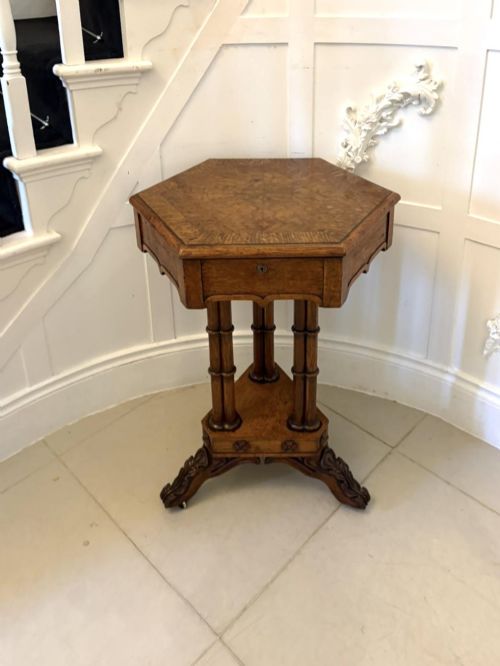
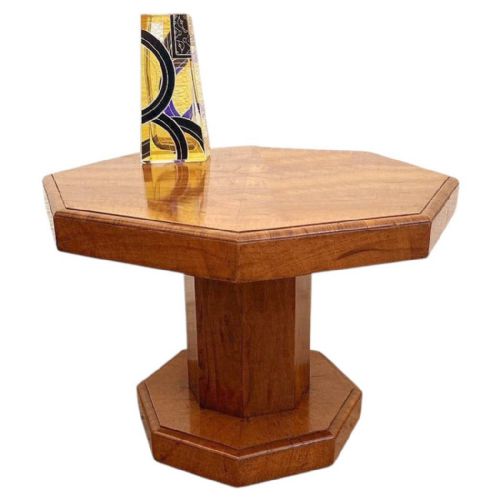
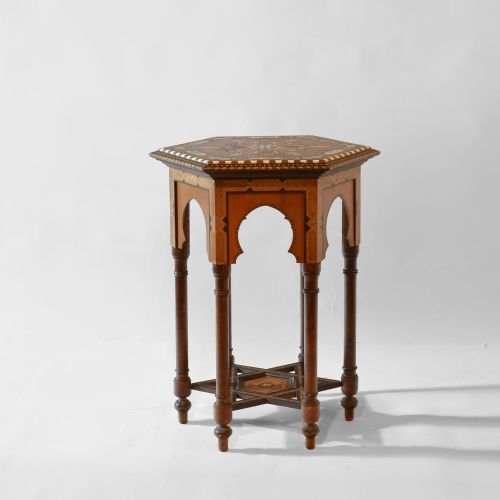


Hexagonal Tea Table
A hexagonal tea table brings geometry and history to a room, offering six-sided tops shaped by diverse global influences and historic British eras.
Hexagonal Tea Table
A hexagonal tea table presents a distinctive six-sided top supported by various leg configurations, functioning as a side, occasional, or centre table. When you search for a hexagonal tea table, you encounter diverse forms ranging from British revival styles to imported Eastern pieces.
The pieces on this page span the Georgian period, the nineteenth century, and twentieth-century movements like Art Deco and Arts & Crafts. Oak and mahogany examples sit alongside walnut, teak, and pollard oak creations.
Moorish Revival, Anglo-Indian, and Jacoquean Revival designs appear frequently, alongside simpler Edwardian and Victorian forms. These tables served as tea tables, lamp tables, or drinks tables in historic interiors.
How they were made
Maker construction relies on timbers such as oak, walnut, mahogany, and teak, often finished with veneer or marquetry inlay. Skilled hands utilised brass, bone, and mother-of-pearl to embellish surfaces.
Carved bases, turned legs, and lift tops appear across the selection, reflecting both British cabinetmaking traditions and intricate international woodworking techniques. Inlaid details demonstrate precise geometric placement on six-sided tops.
Hexagonal Tea Table Retail Price Guide 2026
Typical asking prices for hexagonal tea table among the pieces listed under this phrase on Sellingantiques today, from the lower quarter to the upper quarter. They describe what is for sale here now, not the wider market.
Several tables arrive ready for tea and diplomacy, featuring six sides of inlaid geometry to keep the conversation rolling.
What varies in quality
Quality reveals itself in the choice of timber, from plain oak to figured pollard oak or rich mahogany. The precision of marquetry and the delicacy of mother-of-pearl or bone inlay separate standard production from finer examples.
Construction details such as turned legs, carved bases, and fold-over mechanisms show the maker's hand. Well-executed joints and balanced proportions define superior pieces.
Liberty and Co
The Hexagonal Tea Table Glossary
- Marquetry
- Decorative veneer applied to a wooden structure in patterns or pictures. It uses contrasting woods and materials to create visual depth on table tops.
- Pollard oak
- Timber taken from trees that have been pollarded, producing a highly figured grain with clustered knots. Cabinetmakers prized this wood for distinctive occasional tables.
- Moorish Revival
- A nineteenth-century design style incorporating geometric patterns and arches inspired by Islamic architecture. Tables in this style often feature complex inlay.
- Lift top
- A hinged table surface that opens to reveal storage beneath. This mechanism appears on select occasional and tea tables.
- Occasional table
- A small, versatile table designed for specific, intermittent use in a room. These pieces function easily as side or lamp tables.
Hexagonal Tea Table: Frequently Asked Questions
What is a hexagonal tea table used for?
These six-sided tables serve primarily as occasional, side, or lamp tables within a living space. Historically, they held tea services, drinks, or decorative lamps.
Their compact shape allows them to fit easily beside seating while offering more surface interest than a standard square or round table.
How do I identify the period of my table?
Dating relies on timber choices, construction techniques, and decorative styles. Georgian and Regency pieces display traditional British cabinetmaking, while later Victorian and Edwardian examples show revival influences or Arts & Crafts simplicity.
Export pieces from India and the Ottoman regions exhibit distinct regional carving and inlay methods tied to nineteenth and early twentieth-century trade.
Are all hexagonal tables meant for tea?
Not all tables with six-sided tops function as tea tables. Listings categorize these forms as side tables, coffee tables, drinks tables, and centre tables depending on their height and build.
Some feature fold-over tops or lift mechanisms, while others remain fixed for display and general use.