
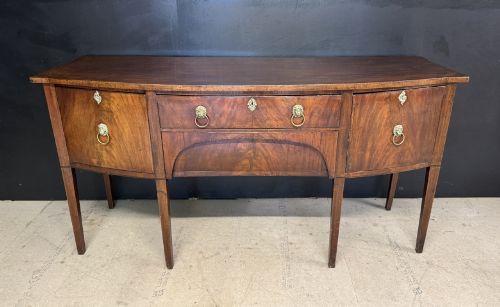
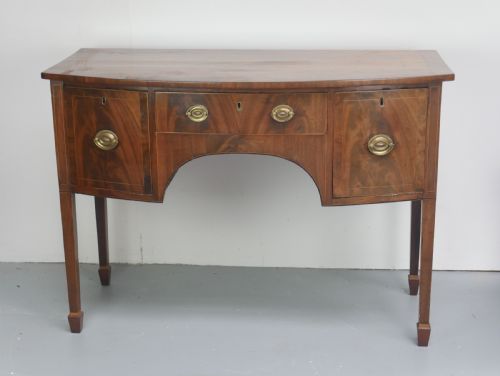
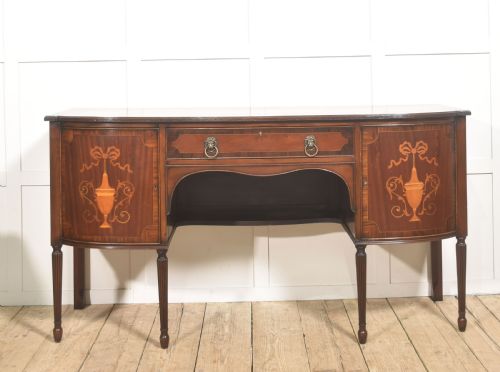

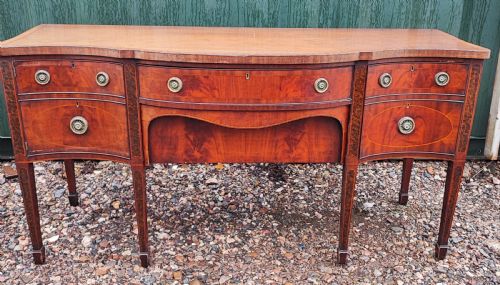


Hepplewhite Style Credenza
A hepplewhite style credenza brings refined elegance to a room, offering both practical storage and the graceful curves characteristic of eighteenth-century design.
Hepplewhite Style Credenza
When searching for a hepplewhite style credenza, buyers encounter elegant mahogany sideboards, side cabinets, and sideboards and buffets dating from the Georgian period through to the early twentieth century. The selection spans authentic eighteenth-century George III pieces as well as later revivals from the nineteenth and early twentieth centuries, including Hepplewhite Revival and Grand Regency interpretations.
Origins stretch across Georgian craftsmanship and subsequent revival periods up to nineteen-twenty, encompassing both grand proportions and smaller scale designs. Buyers meet everything from austere mahogany surfaces to elaborately decorated examples bearing detailed marquetry.
How they were made
Cabinetmakers relied primarily on solid mahogany and constructed carcasses with meticulous attention to grain direction and structural stability. Selected timber formed the main body, whilst specialised woods provided contrast and texture.
Decorative surface work incorporated satinwood inlay, boxwood details, and complex marquetry inlay to accentuate the sweeping curves of serpentine and bowfront structures. Brass hardware provided functional mounts, and occasional examples featured marble tops for increased durability.
Some nineteenth-century makers were so enthusiastic about serpentine shapes they curved parts of the sideboard that nobody would ever actually see.
What varies in quality
Quality rests upon the precision of the cabinetmaker's joinery and the fluidity of the serpentine or bowfront outline. Superior examples display harmonious proportions where the curvature of the timber flows naturally without compromising the internal integrity of the cupboards and cabinets.
The refinement of the inlay work marks the distinction between standard production and master craftsmanship. Delicate satinwood and boxwood motifs integrated smoothly into the mahogany distinguish the higher end of the range from simpler executed surfaces.
The Hepplewhite Style Credenza Glossary
- Serpentine
- A front outline that curves outward in the centre and inward at the sides, creating a dynamic undulating shape. This contour requires immense skill from the woodworker to shape accurately.
- Bowfront
- A convex curved front that projects outward in a smooth arc. It appears frequently on sideboards and side cabinets to soften rigid room angles.
- Marquetry
- The art of applying small pieces of veneer to a structure to form decorative patterns and pictures. Craftsmen utilise contrasting woods like satinwood and boxwood for visual depth.
Hepplewhite Style Credenza: Frequently Asked Questions
What is a hepplewhite style credenza?
These items are primarily Georgian and revival sideboards or side cabinets characterised by curved fronts and refined woodwork.
They offer storage solutions whilst displaying the distinct aesthetic principles associated with eighteenth-century cabinet design.
How were these sideboards used?
Historically, dining rooms utilised these large cabinets for storing cutlery, linen, and serving dishes during meals.
Today, they function as versatile storage and display units in living spaces, hallways, and dining areas.
How do I tell periods apart?
Eighteenth-century pieces display period joinery techniques and natural patina developed over centuries of use.
Revival pieces from nineteen-hundred or nineteen-twenty often emulate these Georgian characteristics while exhibiting twentieth-century manufacturing signatures.
How do I live with mahogany furniture?
Mahogany requires stable room temperatures away from direct heat sources to prevent the timber from warping or drying out.
Regular polishing with appropriate wax maintains the natural lustre and protects the wood grain over time.