
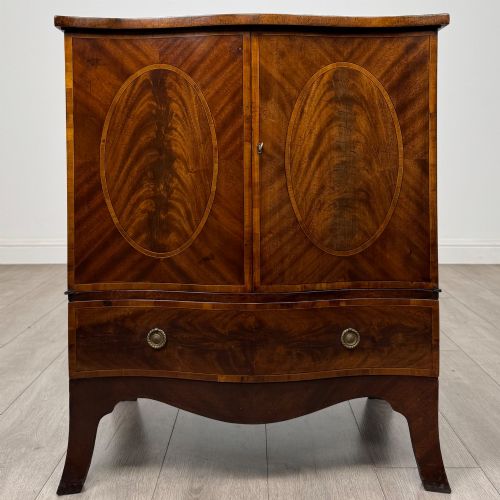
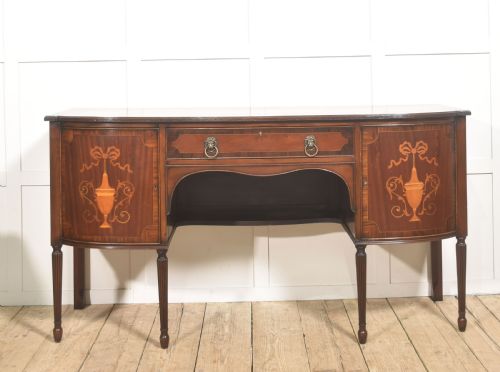


Hepplewhite Sideboard Cabinet
These hepplewhite sideboard cabinet pieces are refined dining room servers offering timeless storage and crisp neoclassical lines.
Hepplewhite Sideboard Cabinet
When you search for a hepplewhite sideboard cabinet, you encounter elegant dining room servers originating primarily from the Georgian and George III periods, alongside later Edwardian and Georgian Revival interpretations. The forms vary from straight bowfront and serpentine shapes to demi-lune commodes and writing cabinets.
You are most likely to meet mahogany examples on this page, often finished with delicate boxwood and satinwood inlay. These functional serving pieces provide ample interior capacity while maintaining slender, tapered legs characteristic of the style.
What varies in quality
The sophistication of the wood inlay and the precision of the serpentine or bowfront shaping distinguish finer examples from simpler provincial pieces. Figured mahogany grain patterns with rich natural depth elevate the visual appeal of a cabinet.
Proportion and leg configuration also dictate quality, with six-legged variations and finely tapered spade feet demonstrating superior craftsmanship. Original brass mounts and intact internal dividers further enhance the desirability of a piece.
Mahogany serves as the primary timber across the inventory, frequently embellished with boxwood, satinwood, and marquetry inlay.
The Hepplewhite Sideboard Cabinet Glossary
- Bowfront
- A convex curved furniture front that projects outward in a smooth arc. This shape gained popularity during the late eighteenth century to soften room angles.
- Serpentine
- A furniture front featuring a concave centre flanked by two convex ends, creating a wave-like contour. It requires advanced woodworking skill to execute properly.
- Demi-lune
- A half-moon shape used for table and commode tops designed to sit flat against a wall. These pieces suit smaller dining spaces or hallway settings.
- Inlay
- A decorative technique where contrasting woods or materials are embedded into recessed portions of a timber surface. Satinwood and boxwood were frequent choices for this work.
- Commode
- A low cabinet with doors or drawers, serving both decorative and practical storage functions. In eighteenth-century usage, the term often denoted a sophisticated living room or bedroom chest.
Hepplewhite Sideboard Cabinet: Frequently Asked Questions
What is a Hepplewhite sideboard?
A Hepplewhite sideboard is a dining room serving piece defined by light proportions, tapered legs, and delicate neoclassical ornamentation.
These cabinets usually feature mahogany construction accented with contrasting stringing and inlay work.
How do I date an antique sideboard?
Dating relies on examining timber species, construction methods, and secondary woods used inside drawer boxes.
Stylistic shifts from strict George III designs to Edwardian revivals also provide clear chronological markers.
Where were these cabinets placed?
These servers stood against dining room walls to hold tableware, cutlery, and serving dishes during formal meals.
Smaller bowfront or demi-lune versions also functioned as display surfaces in hallways and parlours.
How do I care for mahogany furniture?
Keep wooden cabinets away from direct heat sources and strong sunlight to prevent the timber and veneers from drying out.
Apply a traditional beeswax polish sparingly to maintain the natural lustre of the polished surface.