
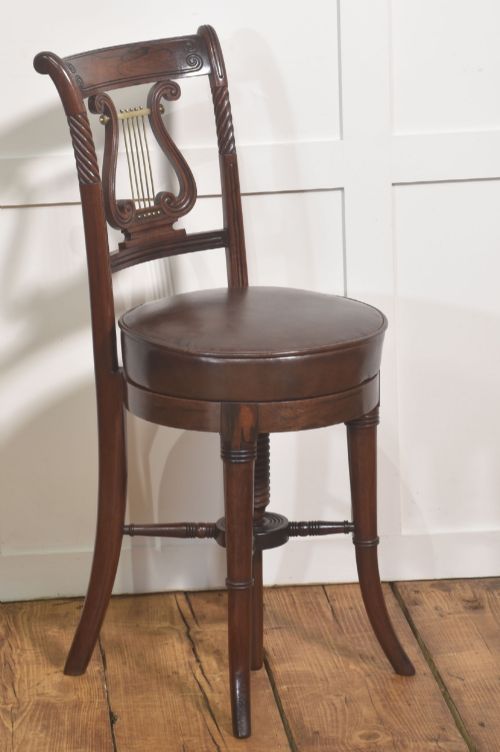
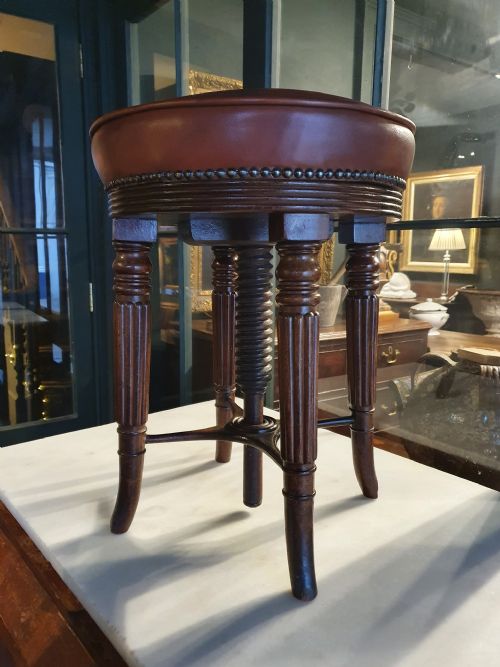


Height Adjustable Music Chair
A height adjustable music chair offers precise seating for the keyboard, combining mechanical ingenuity with period cabinet-making.
Height Adjustable Music Chair
A height adjustable music chair is designed for the piano or dressing table, allowing the player to set their exact seating level using a swivel top, screw mechanism, or rise and fall action. These pieces take the form of piano stools, revolving stools, and music chairs with backs, appearing across Georgian, Regency, William IV, Victorian, and Edwardian periods.
The mahogany and rosewood versions dominate the selection, often accompanied by walnut, satinwood, and ebonised timber. Buyers encounter circular revolving seats, square upholstered tops, and designs featuring backs upholstered in green leather or velvet.
Origins span British workshops of the nineteenth century alongside Canadian examples from the early twentieth century. Stylistic influences range from Sheraton Revival and Empire to Victorian Arts and Crafts.
Assessing quality in adjustable seating
The sophistication of the mechanical adjustment mechanism dictates the primary tier of quality, from simple wooden threads to intricate brass screw actions and rise and fall levers. Pieces bearing maker attributions demonstrate superior joinery and finishing.
Timber selection and decorative detail separate standard examples from finer works, visible in brass inlay, carved hardwood details, and gilt painted empire styling. The integrity of the revolving action and the stability of the central column remain central to the construction standard.
Listings span the Georgian, Regency, and Victorian periods, utilising mahogany, rosewood, and walnut with brass and leather.
Gillows·James Shoolbred
The Height Adjustable Music Chair Glossary
- Rise and fall
- A mechanical system using a central screw or ratchet to alter the seating height. This mechanism allows the user to adjust the seat level with a turn.
- Swivel base
- A pivoting platform enabling the seat to rotate fully around the central support. This rotation helps musicians turn towards sheet music cabinets.
- Revolving piano stool
- A circular or square seat mounted on a threaded spindle that raises as it turns. It represents the standard form for nineteenth-century keyboard seating.
- Brass inlay
- Strips or motifs of brass embedded flush into the wooden surface for decoration. This technique appears on finer Regency examples.
- Ebonised
- Timber treated with a dark finish to imitate ebony. This treatment creates a formal black surface popular on Victorian seating.
Height Adjustable Music Chair: Frequently Asked Questions
How do I adjust the height?
Most pieces operate by turning the padded seat clockwise or anticlockwise to raise or lower the screw mechanism. Some variants utilise a rise and fall lever system.
Users should turn the top gently to test the thread movement without forcing the mechanism beyond its natural limits.
Can I use it at a desk?
These pieces function well as desk seating or dressing table chairs due to the adjustable height feature. The compact footprint suits smaller writing tables.
Buyers often place swivel music chairs in studies or bedrooms where flexible seating proves practical.
How do I date the piece?
Dating relies on timber choices, turning styles, and the complexity of the adjustment hardware. Regency pieces often feature brass inlay, while Victorian examples lean towards heavy rosewood or walnut.
Patent stamps and maker signatures provide precise chronological markers when present on the underside.
Are the seats comfortable for daily use?
Original padding often consists of horsehair beneath leather or velvet, offering a firm sit rather than modern cushioning. Many retain their supportive structure after generations of use.
Regular users sometimes add discreet support or rely on the traditional upholstery where the firmness suits posture.