
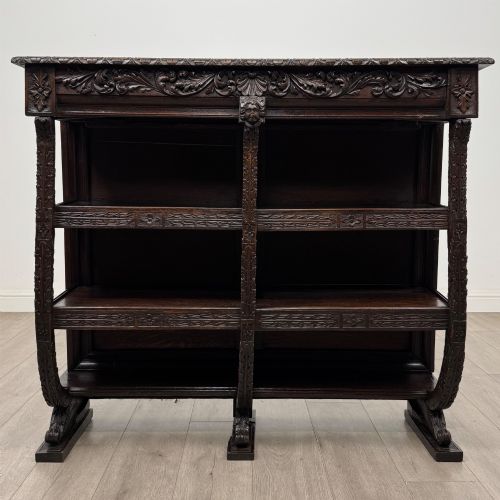


Heavy Carved Oak Shelving
Heavy carved oak shelving brings substantial timber and deep chisel work straight into a room, offering sturdy ledges for libraries and collections.
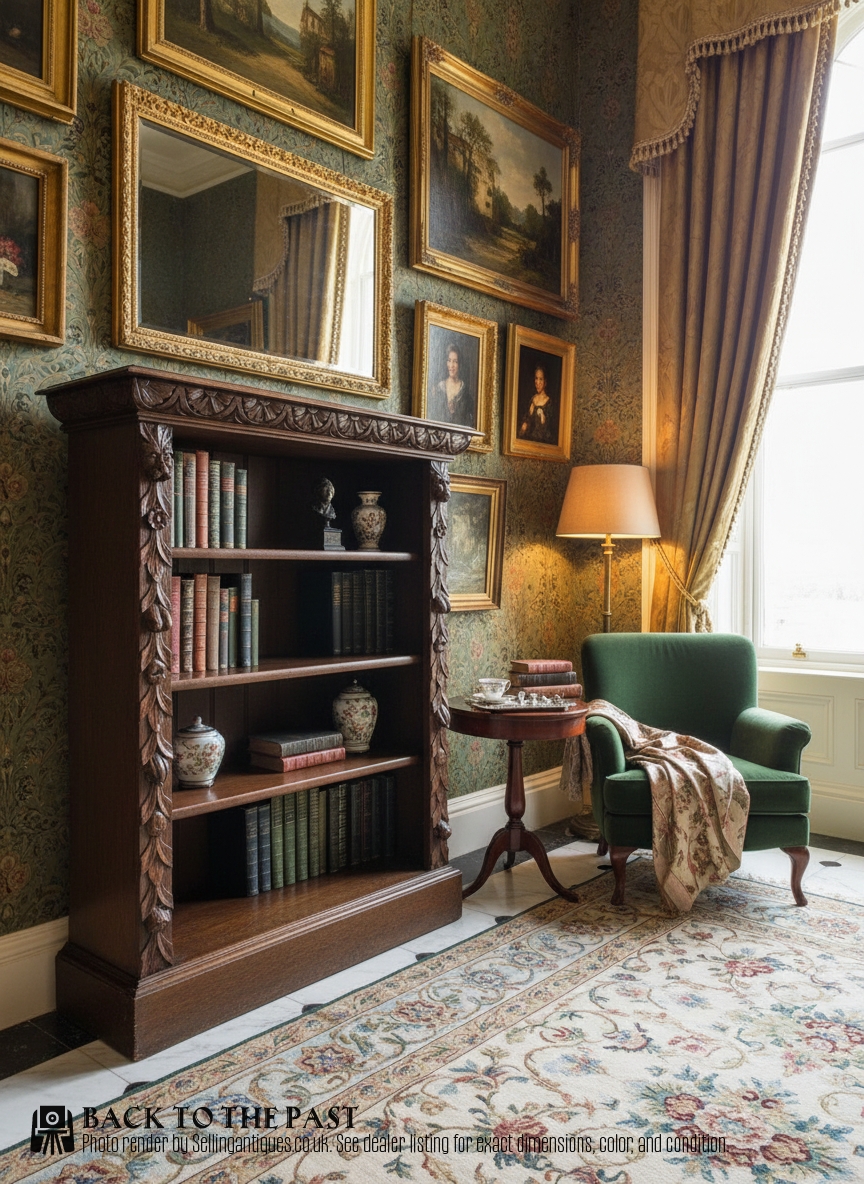
Heavy Carved Oak Shelving
When you search for heavy carved oak shelving, you encounter substantial bookcases, library furniture, and wall shelves built from timber during the seventeenth and nineteenth centuries. These pieces display robust proportions and elaborate chisel work, ranging from country house styles to formal Victorian Gothic Revival designs.
The versions most commonly met on this page are nineteenth-century bookcases, including open front designs, double bookcases, and breakfront library pieces alongside occasional seventeenth-century wall shelves. They provide deep ledges and sturdy uprights designed to bear the weight of large volumes and decorative porcelain.
How these pieces were made
Makers constructed these pieces using solid timber, relying on oak planks joined to form heavy uprights, sides, and shelves capable of supporting significant loads. Woodworkers shaped the material using hand chisels and planes, cutting joints that held fast under the weight of large books.
Carving was applied directly to the solid wood surface, creating relief patterns characteristic of Victorian, Renaissance Revival, and Gothic styles. Brass fittings and glass panels appear on select glazed or breakfront examples to secure cabinet sections.
Listings span seventeenth-century wall shelves to nineteenth-century Victorian breakfront bookcases, utilising oak alongside glass and brass.
What varies in quality
Depth and crispness of the carving distinguish finer examples from plain utilitarian furniture, showing where carvers spent hours shaping motifs rather than relying on shallow stamping. The architectural ambition of the piece also sets the standard, with breakfront forms and Renaissance Revival detailing demanding greater joinery skill.
The choice of timber grain and the integrity of the original construction dictate the upper tier of the range, where heavy oak remains stable and tight at the joints. Lesser pieces show simpler plank construction with minimal surface enrichment and simpler proportions.
The Heavy Carved Oak Shelving Glossary
- Breakfront
- A cabinet or bookcase whose central section projects forward from the flanking wings. This architectural arrangement creates a dynamic shadow line across the front of the furniture.
- Renaissance Revival
- A nineteenth-century design movement drawing inspiration from sixteenth-century classical architecture and ornament. Pieces in this style feature heavy classical motifs adapted for Victorian interiors.
- Gothic Revival
- A style echoing medieval ecclesiastical architecture through pointed arches, trefoils, and deep linenfold or geometric carvings. It gained immense popularity during the Victorian era for libraries and studies.
- Open bookcase
- A shelving unit without doors, providing direct access to the volumes stored within. This form allows the timber interior and book bindings to become part of the room's decor.
Heavy Carved Oak Shelving: Frequently Asked Questions
How do I care for heavy oak shelves?
Keep the timber away from direct heat sources and sudden humidity shifts to prevent the heavy oak boards from splitting. Apply a suitable wax polish occasionally to nourish the grain and maintain the finish.
Dust the carved recesses regularly using a soft brush to prevent dirt accumulation in the intricate woodwork.
Are these shelves strong enough for modern books?
These pieces were originally built to hold heavy calf-bound volumes and reference books in nineteenth-century libraries. Their solid oak construction makes them exceptionally sturdy for modern literature.
Adjustable shelves within Victorian designs allow you to configure the internal spacing to accommodate oversized volumes.
How do I distinguish seventeenth-century from Victorian oak?
Seventeenth-century pieces typically display simpler, hand-hewn construction methods with pegged joints and darker patination developed over centuries. Their carving tends to be more geometric and understated compared to later work.
Victorian interpretations often exhibit machine-assisted precision alongside revival styles like Renaissance or Gothic motifs, utilising different jointing techniques.
Where should I place a breakfront bookcase?
A breakfront bookcase requires a substantial wall with adequate clearance to showcase its projecting central section properly. Placing it in a study or principal reception room lets the architecture of the piece anchor the space.
Ensure the floor is level before loading the shelves with heavy books to maintain the alignment of the breakfront structure.