
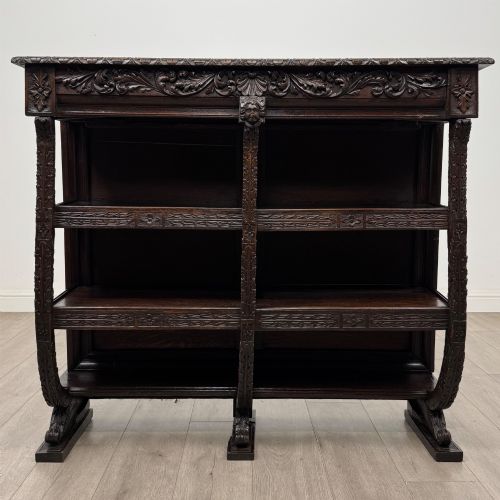


Heavy Carved Oak Shelves
Heavy carved oak shelves bring architectural weight and rich grain into a room, offering robust display space for heavy volumes.

Heavy Carved Oak Shelves
Heavy carved oak shelves encompass sturdy wall units and large bookcases originating from the seventeenth and nineteenth centuries. These pieces appear primarily as tall open bookcases, breakfront library furniture, and occasional wall-mounted shelves.
The nineteenth-century examples dominate the selection, heavily influenced by Victorian and Renaissance Revival tastes. Pieces range from country house styles to substantial library fixtures equipped with adjustable shelving.
How they were made
Construction relies entirely on solid oak timber, chosen for its strength and ability to take deep chisel work. Workshops utilised heavy boards to support large collections of books without sagging.
Decoration comes from manual carving directly into the wood, frequently incorporating Renaissance Revival and Gothic motifs. Selected pieces integrate brass hardware or glass elements to complement the dark, dense timber.
One recorded piece carries the provenance of Miskin Manor, proving that some shelves spent their early days among grand country house libraries.
What varies in quality
Quality rests in the depth and precision of the carving, alongside the architectural ambition of the overall frame. Finer examples display crisper chisel work and more complex breakfront proportions rather than simple rectilinear boards.
The integrity of the timber and the sophistication of the revival style separate standard utility pieces from grand library furnishings. The best items maintain structural harmony despite the heavy nature of the oak.
The Heavy Carved Oak Shelves Glossary
- Breakfront
- A piece of furniture where the centre section projects forward from the side sections. This layout creates visual depth and architectural presence in large bookcases.
- Renaissance Revival
- A nineteenth-century design movement drawing inspiration from sixteenth-century classical architecture and ornament. It manifests in heavy scrolls, robust columns, and dense relief carving.
- Adjustable shelving
- A system allowing shelf heights to alter via movable wooden supports or peg holes. This mechanism provides practical storage for books of varying heights.
Heavy Carved Oak Shelves: Frequently Asked Questions
How do I support heavy books on these shelves?
Solid oak construction provides inherent strength, allowing sturdy support for large volumes without extra reinforcement.
Ensure the wall fixings or floor placement are secure to bear the substantial weight of both the timber and the books.
Are these shelves suitable for modern walls?
Wall-mounted versions require solid masonry walls rather than standard plasterboard to safely hold the considerable weight.
Larger floor-standing bookcases bypass wall-mounting concerns entirely by resting directly on the floor.
How do I identify a Renaissance Revival piece?
Look for classical architectural motifs such as columns, pediments, and prominent relief carvings executed in dark oak. These nineteenth-century items borrow heavily from sixteenth-century forms.
The overall aesthetic prioritises symmetry, mass, and theatrical shadow over delicate ornamentation.
Can I adjust the shelf heights?
Many nineteenth-century library bookcases include adjustable shelving systems built into the interior uprights. This allows the configuration to accommodate folio volumes alongside standard octavos.
Simpler or older pieces often feature fixed shelves locked permanently into the carcass.