




Heavy Brass Door Fittings
Heavy brass door fittings are substantial architectural hardware pieces from the Georgian and Victorian eras, chosen to give an entryway immediate weight and presence.
Heavy Brass Door Fittings
When you search for heavy brass door fittings, you are looking at functional architectural hardware designed to endure daily domestic use. The items on this page span the Georgian and Victorian periods, showcasing the robust engineering typical of nineteenth-century manufacture.
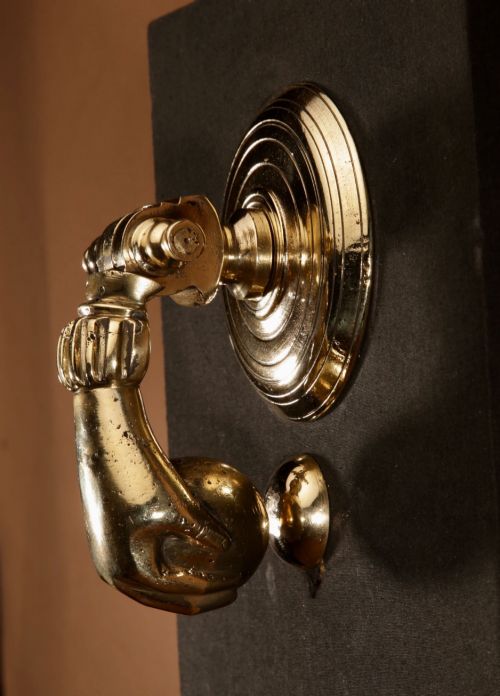
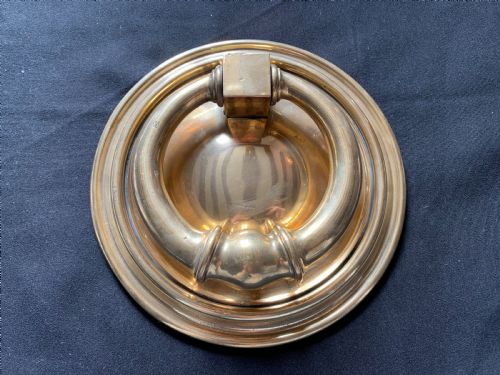
The selection centres primarily on door knockers, ranging in form from human hands to Maltese dolphins, alongside letterboxes, centre door knobs, and finial hinges. Solid brass and bronze predominate, offering both durability and a distinct tactile quality upon entry.
Victorian examples dominate the available forms, particularly large knockers and matched sets of hinges with acorn finials. Georgian pieces also appear, providing earlier architectural alternatives for period properties.
How they were made
These fittings rely on traditional casting techniques using solid brass and bronze, metals chosen for their resilience against constant handling and weather exposure. Molten metal was poured into sand or loam moulds to achieve the substantial forms seen in the heavy knockers and deep letterbox plates.
Finishing involved hand-polishing and detailing, evident in the sculptural quality of the hand-shaped knockers and the cast acorn finials on the hinges. Surface tooling and turned components like centre door knobs reflect the manual labour standard in Victorian and Georgian workshops.
Listings feature Victorian and Georgian pieces made from solid brass and bronze.
What varies in quality
Quality in these architectural pieces rests on the crispness of the casting and the weight of the metal used. Superior examples retain sharp detail in modelled forms like the Maltese dolphin or the hand motif, whereas lesser pieces show softened edges from worn moulds.
The integrity of the working parts also distinguishes the range, from robust hinge plates with intact finials to solid striking plates on knockers. The purity of the solid brass or bronze provides a deeper patina and lasting structural strength compared to thinner plated alternatives.
The Heavy Brass Door Fittings Glossary
- Finial
- A decorative terminal ornament placed at the end of an architectural object, such as the acorn finials found on the Victorian hinge sets.
- Centre door knob
- A prominent handle fixed to the middle of an exterior door rather than the edge, used for pulling the door closed.
- Letterbox plate
- A metal aperture fitted to an exterior door to receive post, often combined with a drop flap and heavy backing plate.
- Bronze
- An alloy consisting primarily of copper, traditionally used for high-durability casting in sculptural hardware like the hand-shaped door knocker.
Heavy Brass Door Fittings: Frequently Asked Questions
What periods do these fittings come from?
The pieces span the Georgian and Victorian eras, reflecting the architectural hardware standards of the nineteenth century.
Most items originate from the Victorian period, offering robust construction and distinct ornamental styles.
What materials are used in these items?
The selection consists of solid brass and bronze, chosen for their substantial weight and durability.
These metals develop a rich surface character through age and handling on exterior doors.
How were these door knockers mounted?
Door knockers were secured directly through the wood of the door using threaded bolts or screws.
Many examples include a matching strike plate to protect the timber surface from repeated impact.