


Haymaking Scene Painting
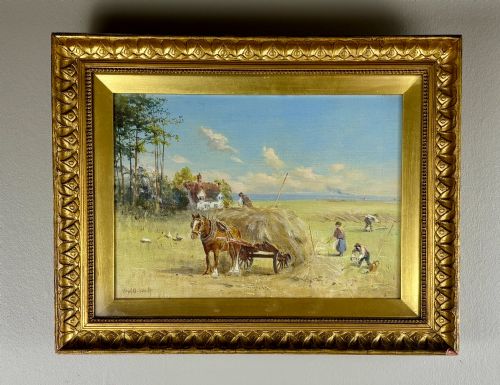
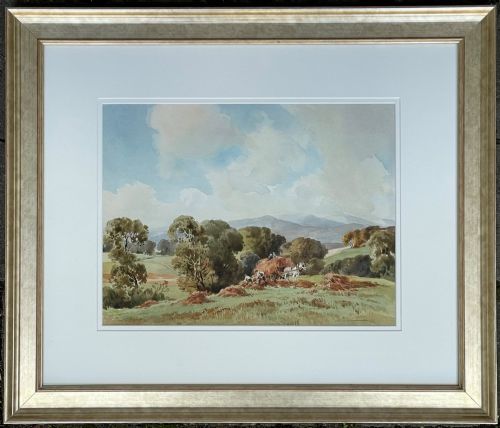
A haymaking scene painting captures the labour and light of the traditional harvest, bringing a rich sense of pastoral heritage into a room.
Haymaking Scene Painting
A haymaking scene painting depicts agricultural work in British landscapes, predominantly originating from the nineteenth and early twentieth centuries. These artworks record rural life through periods such as the Victorian and Edwardian eras, capturing fields, harvest times, and river valleys.
The pieces on this page appear in various mediums, most frequently as oil paintings on canvas and watercolours on paper. Artists render these pastoral subjects through traditional British styles, Victorian Rural Naturalism, and British Impressionism.
Buyers will encounter works attributed to specific named artists alongside pieces simply described as antique oil paintings. Formats range from framed oil paintings to watercolours under glass, each presenting a distinct window into historical farming landscapes.
Materials and construction
These works rely on traditional supports such as canvas stretched over wood frames and heavy paper for watercolours. Artists applied oil paint and watercolour pigments to build up depictions of skies, fields, and figures labouring outdoors.
Framing typically involves wood mouldings, sometimes protected behind glass in the case of watercolours. The combination of oil paints, canvas, paper, and wooden supports reflects the standard artist studio practices of the nineteenth and early twentieth centuries.
Listings feature works from the 1870s up through 1920, executed in oil and watercolour on canvas, paper, and wood.
Judging quality and execution
Quality in these works rests upon the artist's handling of light, atmosphere, and the movement of figures within the landscape. Finer examples demonstrate confident brushwork and a balanced composition that suggests depth and natural light rather than flat colour application.
The distinction between standard works and superior pieces lies in the precision of the draughtsmanship and the artist's ability to convey the textures of hay, stubble fields, and clouded skies. Provenance through a signed signature or attribution to a recorded painter elevates the standing of an individual work.
Percy Lancaster·Henry Bailey·John Atkinson·J.C. Grey·James William Booth·Herbert Royle·Arthur Walker Redgate·Frederick J. Knowles·William Greaves·John Clayton Adams
The Haymaking Scene Painting Glossary
- Watercolour painting
- A work executed with water-soluble pigments on paper. These pieces are typically displayed under glass to protect the paper from moisture and dust.
- Canvas
- A heavy woven fabric stretched across a wooden stretcher frame to serve as a sturdy support for oil paint. It forms the foundation for many traditional landscape and harvest works.
- British Impressionism
- An artistic approach focusing on light and spontaneous brushwork applied to domestic and rural subjects. Painters working in this style sought to capture transient atmospheric effects in the countryside.
- Victorian Rural Naturalism
- A late nineteenth-century movement depicting realistic scenes of agricultural labour and rural life. These works emphasise the genuine conditions of rural workers with sincerity and observational detail.
Haymaking Scene Painting: Frequently Asked Questions
How do I date a haymaking painting?
Dating relies on the style of clothing worn by figures in the field, the framing materials, and any signatures or inscriptions on the canvas or paper. Nineteenth-century and Edwardian works often carry distinct aesthetic markers tied to the period of their creation.
Examining the stretcher frame, canvas weave, and backend labels can also provide additional clues to the exact decade in which the artist painted the scene.
Where were these rural scenes painted?
Many of these works depict specific British countryside locations, such as Yorkshire, Essex, and Wharfedale. Artists travelled into rural districts to sketch and paint the harvest directly from nature.
Local landmarks, rivers like the Wharfe, and regional agricultural practices often ground these paintings in exact geographic territories across Britain.
How should I hang an oil painting?
Oil paintings on canvas require stable wall environments away from direct sunlight and excessive humidity. Proper picture wire and secure wall fixings ensure the wooden frame hangs evenly without straining the canvas.
Keeping the painting out of harsh temperature fluctuations protects both the oil paint layer and the underlying wooden stretcher frame from warping.
What is the difference between oil and watercolour?
Oil paint uses drying oils to bind pigments, resulting in a rich, textured surface that does not require glass for protection. Watercolour relies on water-soluble binders on paper, producing a luminous, transparent effect that must remain behind glass.
These different mediums dictate how the artwork is framed, displayed, and preserved over time.