

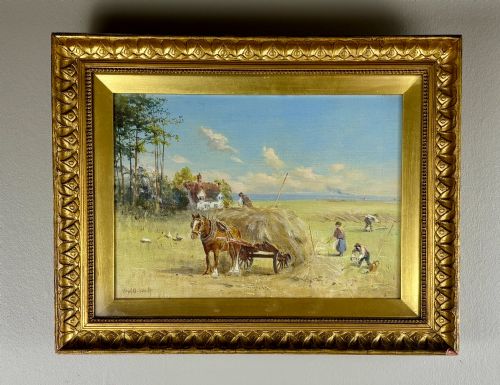


Hay Harvest Painting
A hay harvest painting captures the rhythmic toil of the countryside, offering a tangible link to traditional rural life.
Hay Harvest Painting
A hay harvest painting depicts the seasonal labour of gathering crops, predominantly originating from the nineteenth and early twentieth centuries. These works frequently record rural scenes involving hay stacks, carts, and farm workers across English landscapes.
The most common examples encountered in this category are watercolours on paper and oil paintings on canvas or board. They range from intimate Victorian studies to broader Edwardian and British Impressionist interpretations.
Materials and methods
Artists employed watercolour pigment on paper for delicate, luminous atmospheric effects, or oil paint on canvas and wood to build richer textures. Gilt framing often accompanied finished oils to complement the domestic interiors of the period.
Brushwork varies from the tight control seen in Victorian fine art to the looser, more immediate application characteristic of impressionist realism.
Hay Harvest Painting Retail Price Guide 2026
Typical asking prices for hay harvest painting among the pieces listed under this phrase on Sellingantiques today, from the lower quarter to the upper quarter. They describe what is for sale here now, not the wider market.
The archive and active listings show works dated across the nineteenth and twentieth centuries, executed in oil and watercolour.
Judging quality in rural art
Quality rests on the confidence of the draughtsmanship and the artist's ability to render light and atmospheric depth across the landscape. Stronger works convey the physical scale of the terrain and the natural movement of figures without stiffness.
The handling of materials distinguishes accomplished works, where oil paint or watercolour pigment is managed with distinct control over tone and colour harmony.
James William Booth·John Atkinson·Herbert Royle·Frederick William Jackson·John Clayton Adams
The Hay Harvest Painting Glossary
- Watercolour
- A paint consisting of colour suspended in a water-soluble vehicle, typically applied to paper. It creates transparent washes that allow the white of the paper to illuminate the pigment.
- Oil painting
- A medium made by embedding pigments in a drying oil, usually linseed. This technique permits deep blending of tones and rich surface textures.
- Impressionism
- A style focused on accurate depiction of light in its changing qualities. It prioritises open composition and visible brush marks.
- Naive art
- A classification for works produced by artists without formal training, often characterised by a childlike perspective and flat perspective.
- Gilt
- A thin layer of gold applied to wood or other surfaces to create a decorative frame border. It enhances the visual weight of the artwork.
Hay Harvest Painting: Frequently Asked Questions
What periods do these paintings date from?
The works span the nineteenth and twentieth centuries, with a strong representation from the Victorian and Edwardian eras. Painters of this subject worked actively through the decades up to the mid-twentieth century.
Dates are often established through signatures, stylistic clues, and framing materials typical of specific periods.
How were these rural scenes used?
These paintings were created primarily for domestic display in middle-class and country homes. They served to bring romanticised or realistic views of the English countryside indoors.
Many functioned as decorative wall art, framed in gilt wood to complement contemporary interior aesthetics.
Are they watercolour or oil?
Both mediums are prevalent in this category, each offering a distinct visual experience. Watercolours on paper provide lighter, translucent depictions of rural light.
Oil paintings on canvas or wood present heavier impasto and deeper colour saturation for landscape scenes.
How do I distinguish Victorian from Edwardian works?
Victorian examples often lean towards detailed realism and narrative clarity. Edwardian pieces sometimes incorporate broader brushwork influenced by impressionist approaches.
Subject matter remains similar, focusing on haystacks, carts, and harvest time, but the handling of paint shifts over time.