
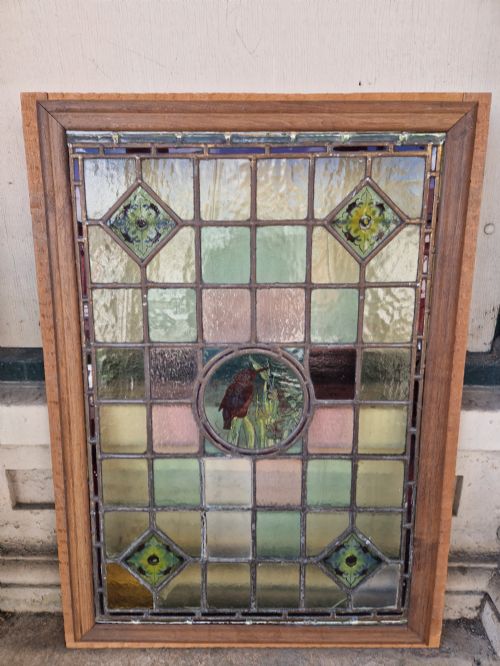


Hand Painted Window
A hand painted window brings daylight through historic pictorial scenes, landscapes and heraldic motifs.
Hand Painted Window
A hand painted window comprises architectural glass panels formed from leaded and painted sections, often originating from Victorian and Edwardian properties. These pieces display diverse pictorial subjects ranging from rural landscapes and pastoral scenes to birds, flowers and religious iconography.
The most common examples encountered on this page date from the late nineteenth and early twentieth centuries, particularly around nineteen hundred and the Edwardian period. Buyers frequently find leaded glass windows incorporating hand painted details alongside clear or amber bullseyes.
Beyond structural window panels, the selection occasionally encompasses architectural salvage and decorative glass designed for domestic interiors. Surviving examples demonstrate the lasting appeal of domestic stained and painted glass within period properties.
How they were made
Glaziers constructed these panels by joining pieces of glass within a framework of lead cames, soldering the joints to secure the composition. Artisans applied vitreous enamel paints to the glass surface, firing the pieces in a kiln so the pigment fused permanently with the material.
Listings incorporate timber frames in pine and satinwood alongside lead and stained glass panels.
What varies in quality
The sophistication of the painted detail marks the primary division between standard production and superior craftsmanship. Detailed brushwork depicting intricate subjects such as castles, knights in armour, or naturalistic wildlife commands greater artistic interest than simpler geometric or floral repeats.
The integrity of the lead matrix and the preservation of the painted enamel surface dictate the overall condition and visual impact. Intact leading and stable glass panels maintain the structural clarity of the original design.
The Hand Painted Window Glossary
- Lead came
- A slender rod of cast lead with a grooved channel used to hold pieces of glass together in a window panel.
- Bullseye
- A small, circular centre piece of blown glass featuring a prominent central pontil scar, often integrated into leaded windows for decorative effect.
- Architectural salvage
- Building components and decorative elements recovered from structures destined for demolition, including windows, panels and timber.
- Vitreous paint
- A pigmented glass paint containing powdered glass and metallic oxides that fuses permanently to the glass panel when fired in a kiln.
- Gothic Revival
- An architectural and decorative style popular during the nineteenth century that revived medieval forms, pointed arches and heraldic motifs.
Hand Painted Window: Frequently Asked Questions
How are antique painted windows installed?
These panels typically require professional fitting into existing timber frames or custom secondary glazing to support their weight.
Careful consideration of natural light placement ensures the painted and leaded details remain clearly visible within a modern room.
What periods do these windows date from?
The available pieces predominantly date from the Victorian and Edwardian eras, spanning the late nineteenth and early twentieth centuries.
Earlier examples from around eighteen fifty reflect Gothic Revival styles, while later pieces incorporate Art Nouveau and nineteen twenties design influences.
Can these windows be cleaned safely?
Gentle cleaning with a soft cloth and mild, non-abrasive solution preserves the delicate vitreous paint on the glass surface.
Harsh chemical cleaners and abrasive tools must be avoided to protect both the painted enamel and the surrounding lead cames.
What subjects appear on the glass?
Common pictorial themes include pastoral countryside scenes, farmhouses, winter landscapes, boats on lakes, and historical figures like knights.
Other frequent motifs feature birds on branches, floral swags, fruit designs, religious iconography, and traditional heraldic elements.