
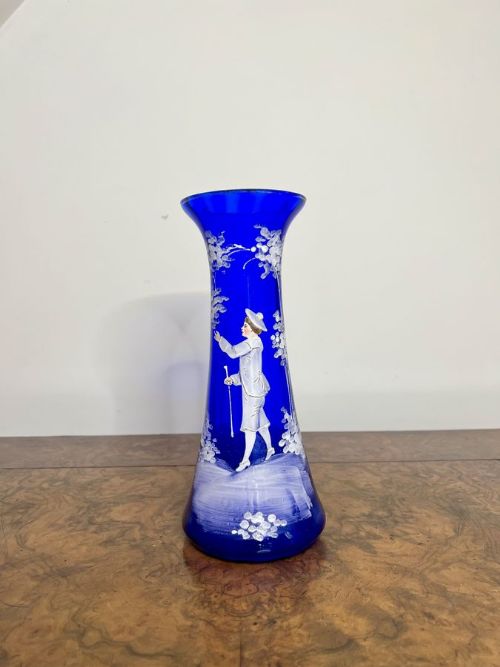
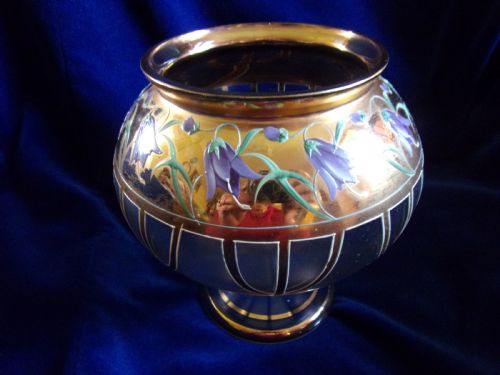


Hand Enamelled Glass Urn
These hand enamelled glass urn examples bring rich Victorian colour and meticulous painted detail into a room.
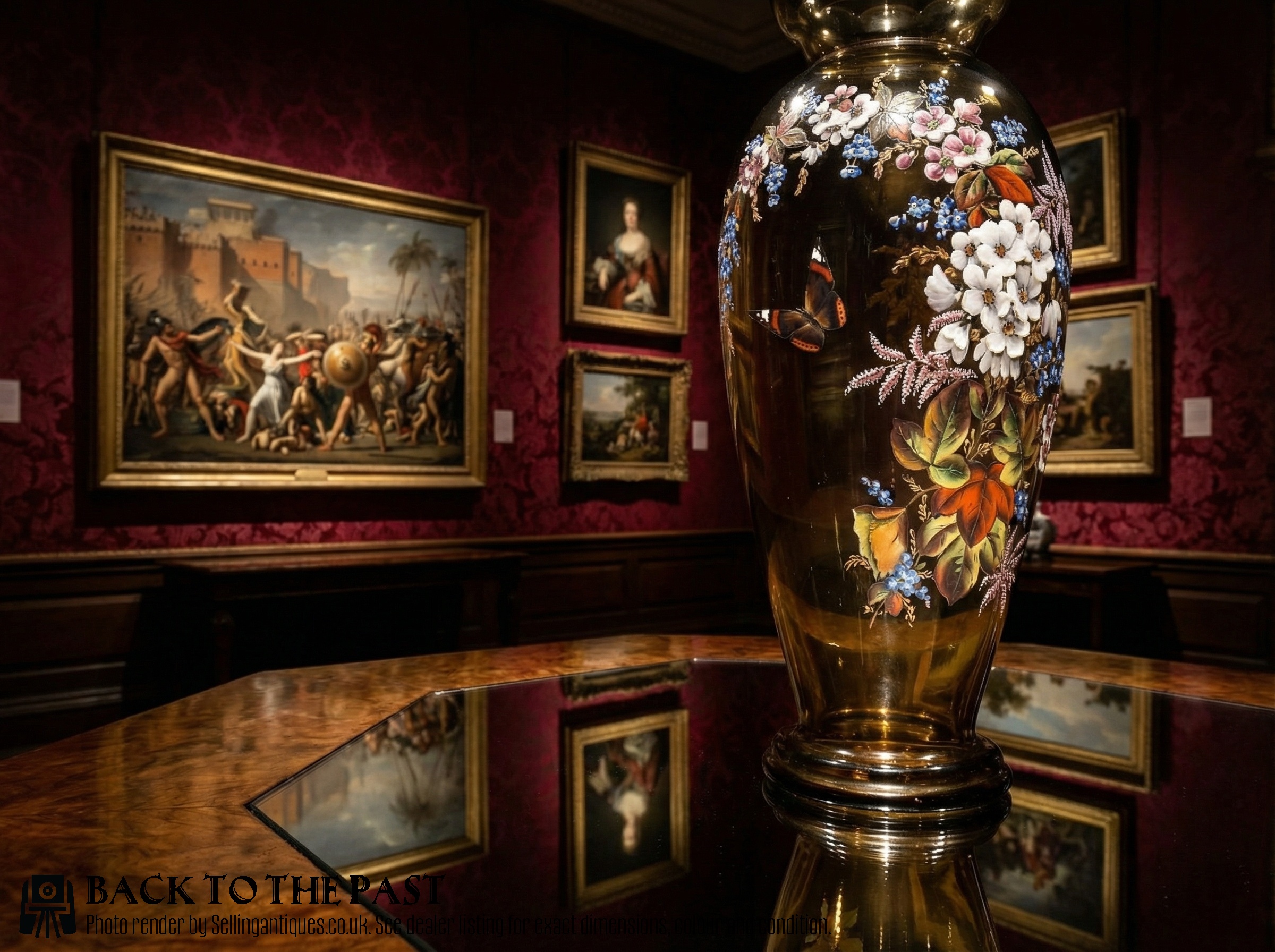
Hand Enamelled Glass Urn
When you search for hand enamelled glass urn, you encounter vessels produced primarily during the nineteenth century across Victorian Britain, Bohemia and beyond. The selection on this page relies heavily on Victorian production, featuring decorative vases, garniture sets and trios designed for formal display.
The forms span from small cabinet vessels to tall, imposing display pieces finished with applied pigments and metallic accents. You will frequently meet cranberry glass, amber glass, green glass and opaque white substrates painted with botanical motifs, figurative scenes or Japanese-inspired motifs.
Originating largely from the latter half of the nineteenth century, these objects bridge revivalist historicism and the flowing contours of early Art Nouveau. Their presence anchors a mantelpiece or side table with substantial nineteenth-century weight and vibrant polychromatic decoration.
Materials and construction methods
Glassmakers shaped these vessels by free-blowing or mould-blowing molten metal into rich coloured glass, including cranberry, amber, green and opaque or opal glass. Skilled hands then applied surface decoration using enamel paint, often enhanced with gold leaf gilding or heavy crystal overlay techniques.
The enamel work required precise kiln-firing to fuse the opaque and translucent pigments permanently to the glass body. Workshops such as Harrach and Moser employed specialised polychromatic enamelling and cameo layering to achieve deep relief and intricate surface detail.
Listings feature Victorian pieces spanning from eighteen-sixty to nineteen-hundred, utilising cranberry, green, amber, and opal glass.
Assessing quality in enamelled glass
Quality rests in the precision of the hand-painted brushwork and the depth of the glass colour itself. Pieces attributed to named makers like Moser or Harrach demonstrate superior control over polychromatic enamelling and gilding.
The harmony between the glass body and the applied enamel separates standard production from exceptional examples. Thick crystal overlays and finely detailed figurative scenes indicate greater artisanal skill during manufacture.
Mary Gregory·Moser·Harrach
The Hand Enamelled Glass Urn Glossary
- Mary Gregory glass
- A style of Victorian glass decorated with white enamel silhouettes, usually depicting children in natural settings. It is frequently found on cranberry, blue or green glass grounds.
- Cranberry glass
- A rich red-pink glass produced by adding gold chloride to the molten batch. It forms a vibrant base for contrasting white enamel painting.
- Garniture set
- A matching group of three ornamental vases or vessels designed to sit together on a mantelpiece. These sets balance interior displays through coordinated sizing and decoration.
- Opal glass
- A semi-translucent milky white glass that mimics porcelain. It provides a solid opaque background for detailed polychromatic enamel painting.
- Crystal overlay
- A technique where a layer of coloured glass is cased over a clear or contrasting inner layer and partially cut away. This exposes the underlayer to create striking visual contrast.
Hand Enamelled Glass Urn: Frequently Asked Questions
What is Mary Gregory glass?
Mary Gregory glass refers to Victorian glassware painted with distinctive white enamel silhouettes of children. These figures are usually shown outdoors amidst foliage or branches.
The style became immensely popular across Britain and Bohemia during the late nineteenth century. It appears most often on cranberry, blue, and green glass bodies.
How were these vases displayed?
These vases were designed as focal points for Victorian parlours and drawing rooms. They frequently formed part of matching garniture sets placed on mantelpieces.
Their bright enamels and gilded surfaces caught the flickering light of gas lamps and candles. This made them central decorative elements in formal nineteenth-century interiors.
How do I date these pieces?
Dating relies on stylistic clues, colour palettes, and manufacturing techniques recorded in nineteenth-century production. Pieces showing Victorian aesthetic movement or early Art Nouveau motifs generally point toward the final decades of the era.
Heavier gilding and specific colour combinations like cranberry and opaque white help narrow the window to the Victorian period. Maker attributions also provide firm chronological markers.
Are these pieces fragile?
Like all antique glass, these vessels require careful handling to protect both the glass body and the surface enamel. The fired pigments are reasonably durable but can be worn down by abrasive cleaning.
Displaying them away from high-traffic edges ensures they remain safe. Gentle dusting with a soft cloth preserves the original gilding and painted details.