



Hand Dyed Leather Armchairs
These hand dyed leather armchairs bring deep colour and rich texture into a room, offering both sturdy comfort and enduring presence.
Hand Dyed Leather Armchairs
When you search for hand dyed leather armchairs, you encounter substantial seating options designed for libraries, studies, and drawing rooms across multiple eras.
The selections span grand wing backs, low club chairs, and sturdy carvers originating from Georgian, Victorian, and Edwardian periods.
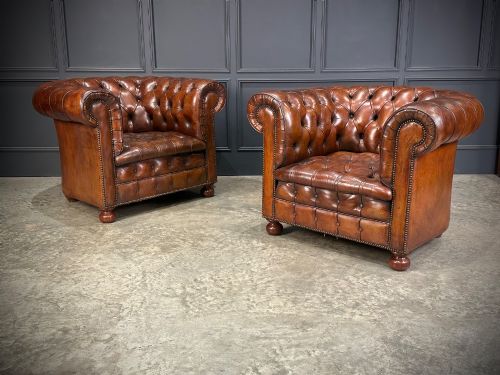
Most pieces you meet on this page lean towards traditional English forms, often featuring deep buttoning and robust wooden frames.
How they were made
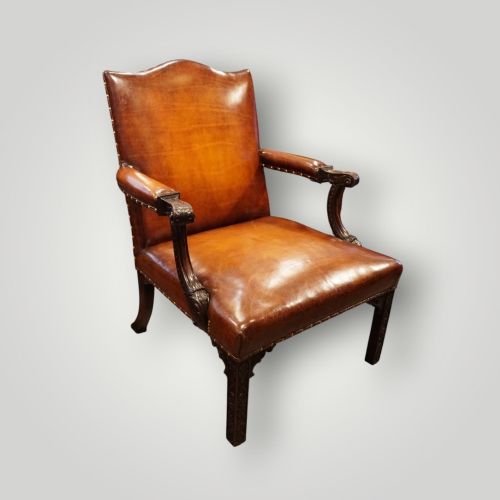
Maker workshops built the structural frames from dense hardwoods such as mahogany, sometimes embellishing them with blind carving along the rails.
Upholsterers fitted English hide leather across the seating areas and secured the edges using rows of brass tacks.
Artisans applied hand-dyed finishes to the leather surfaces, achieving rich brown, green, and deep ocean navy blue tones.
Hand Dyed Leather Armchairs Retail Price Guide 2026
Typical asking prices for hand dyed leather armchairs among the pieces listed under this phrase on Sellingantiques today, from the lower quarter to the upper quarter. They describe what is for sale here now, not the wider market.
Listings feature hard wood, brass, and English hide leather applied across Victorian, Edwardian, and Georgian periods.
What varies in quality
The distinction between standard seating and superior items rests upon the depth of the timber carving and the weight of the frame.
Leather treatment alters the overall character, where skilful hand-dyeing creates subtle tonal variations across the hide rather than a flat, uniform colour.
Frame integrity and historical joinery determine whether an armchair remains firm for daily use or requires structural intervention.
Gillows
The Hand Dyed Leather Armchairs Glossary
- Chesterfield
- A traditional upholstered seating style characterised by deep tufting and rolled arms of equal height to the back. This form appears frequently in club and porter chair designs.
- Gainsborough armchair
- A wide, open-armed seat with a padded back and seat, typically standing on square mahogany legs. These date back to the Georgian era and often feature blind carving.
- Carver chair
- A sturdy armchair designed to sit at the head of a dining table or function as a desk seat. They share stylistic traits with matching dining chair sets.
- Hide leather
- Untreated or lightly finished animal skin used for heavy upholstery. English variants provide the thick, durable surface required for traditional club chairs.
- Blind carving
- Decorative relief work carved directly into the surface of the mahogany framework without piercing the wood. This detail signals higher workshop skill during the Georgian period.
Hand Dyed Leather Armchairs: Frequently Asked Questions
What periods do these armchairs represent?
The listings encompass items spanning the eighteenth century through to the Edwardian era, including Georgian and Victorian examples.
Each period brings distinct stylistic traits, from the carved mahogany of earlier centuries to the rolled tufted arms of later club designs.
What materials make up the frames?
Workshops constructed the foundational frames using hardwoods, with mahogany appearing frequently among the formal seating.
Secondary materials include brass tacks used for securing the upholstery and sturdy interior wooden bracing.
How do hand dyed finishes differ?
Hand-dyed treatments impart varied pigmentation across the English hide leather, producing rich brown, green, and deep navy blue tones.
This method allows the natural grain of the hide to show through rather than masking it beneath a flat, synthetic coating.
Are these chairs suitable for daily use?
These seating options were originally built for libraries, gentlemen's studies, and principal rooms, utilising robust joinery and thick leather.
Their substantial construction makes them practical for regular seating provided the underlying frame and webbing remain stable.