
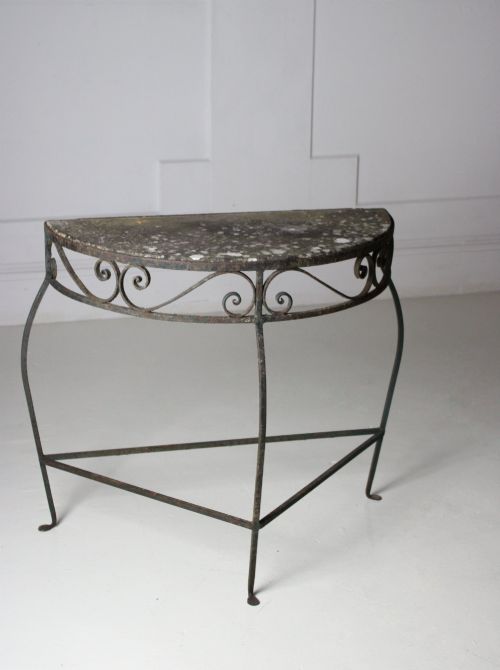
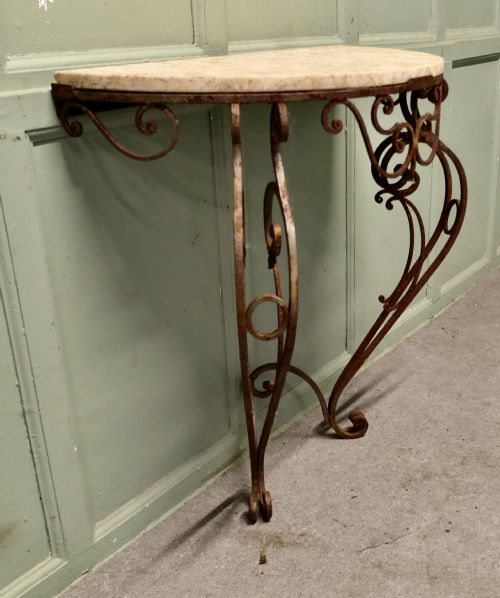
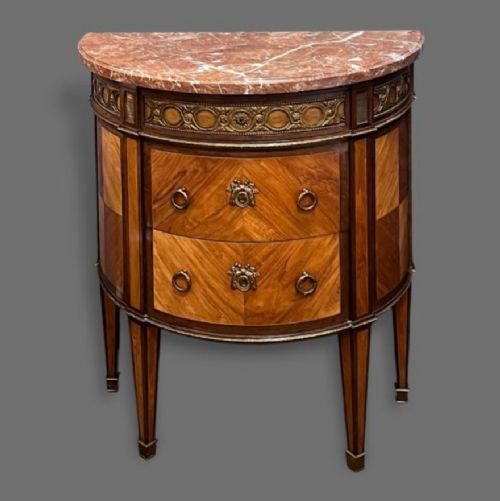


Half Moon Marble Table
A half moon marble table provides a flat wall-hugging surface with a stone top, offering practical elegance for narrow hallways and compact reception rooms.
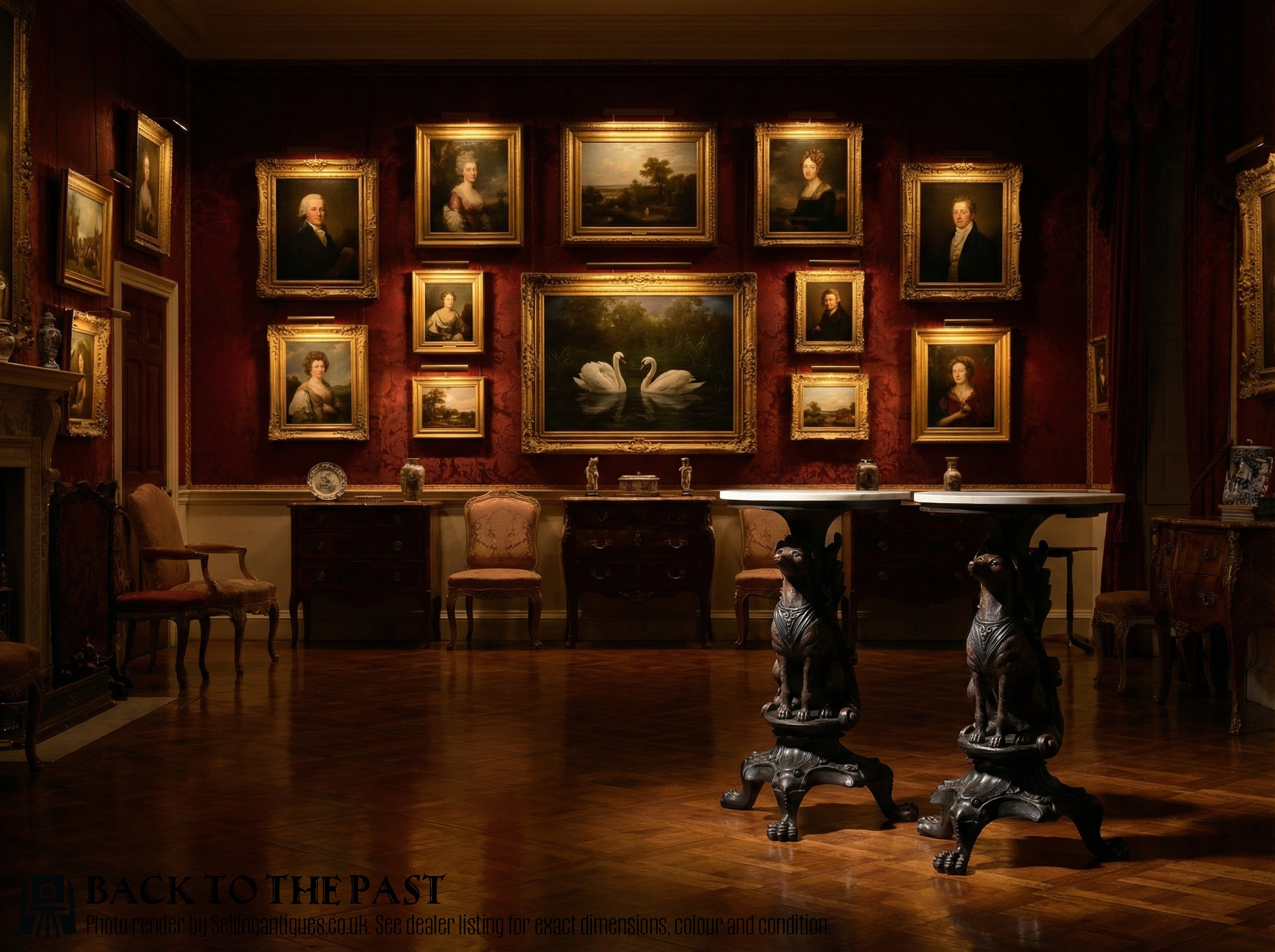
Half Moon Marble Table
A half moon marble table sits flush against a wall, taking up minimal floor space while delivering a solid stone top for displaying decorative objects. These semicircular forms appear most frequently as console or hall tables from the nineteenth century, often supported by wrought iron or carved wood frames.
The selection ranges from rustic French wrought iron examples to refined Georgian style pieces and carved Italian neoclassical designs. Alongside standard console formats, buyers encounter occasional washstands, chests of drawers, and pairs of bedside tables sharing the distinctive demi-lune silhouette.
Origin and period vary widely across the inventory, spanning from eighteenth century Italian works to Edwardian pairs and items dated around nineteen twenty. Materials combine natural stone tops with walnut, mahogany, tulipwood, and painted or gilded wood structures.
Materials and construction
Makers combined heavy stone surfaces with supporting frames of wrought iron, walnut, mahogany, and assorted hardwoods. Rouge marble and plain marble slabs rested upon structural bases of varying weight, secured by wooden framing or metal brackets.
Decoration relied upon marquetry inlay, detailed carving, and painted or gilt bronze finishes. Craftsmen shaped timber into curved demi-lune rails and legs, frequently employing styles from the Rococo Revival, Louis XVI, and Neoclassical repertoires.
Listings feature marble combined with wrought iron, walnut, mahogany, tulipwood, and gilt bronze across eighteenth, nineteenth, and early twentieth-century periods.
Distinctions in quality
Quality reveals itself in the weight and figuring of the stone top and the precision of the underlying woodwork or ironwork. Finer examples display crisp carving, balanced proportions, and sophisticated decorative techniques such as marquetry.
Simpler pieces rely on utility and rustic charm, whereas important items incorporate specialised materials like rouge marble, gilt bronze mounts, or intricate figural carving. The integrity of the semicircular frame determines how well the piece supports its heavy stone surface.
The Half Moon Marble Table Glossary
- Demi-lune
- A half-moon or semicircular shape utilised in furniture design. This profile allows tables to sit flat against a wall.
- Console table
- A table designed to stand against a wall, typically secured or supported by brackets or legs at the front. These pieces serve decorative and functional roles in hallways.
- Marquetry
- The art and craft of applying small pieces of veneer to a structure to form decorative patterns. Craftsmen use various coloured woods to create intricate surface designs.
- Rouge marble
- A deep red variety of limestone marble often featuring white or grey veins. It appears frequently on decorative table tops from the eighteenth and nineteenth centuries.
Half Moon Marble Table: Frequently Asked Questions
Where should I place a half moon table?
These tables suit narrow hallways, entryways, and landings where floor space is limited. Their flat back allows them to sit securely against a wall without protruding into walkways.
They also function effectively in reception rooms as display surfaces for lamps, vases, or ornaments. The stone top provides a durable surface that handles everyday items easily.
How do I care for the marble top?
Clean the stone surface with a damp cloth and mild, pH-neutral soap. Avoid acidic cleaners, vinegar, or citrus products that can etch the polished finish.
Using coasters and placemats helps prevent stains and scratches from liquids or heavy objects. Periodic sealing can provide additional protection against spills.
Are these tables sturdy enough for daily use?
The structural stability depends on the base material, with wrought iron and solid hardwood frames offering robust support for the heavy stone tops. Properly anchored or balanced tables handle standard decorative displays securely.
Because marble adds significant weight, placement on level flooring ensures the frame remains stable. Avoid placing excessive weight near unsupported edges.
How do I identify the period of the table?
Dating relies on stylistic clues, construction methods, and the specific materials used in the frame and top. Neoclassical and Rococo Revival details point towards nineteenth-century production, while cleaner lines often suggest later dates.
Examining the underside and joinery reveals hand-tooling or mechanical marks that help establish age. Comparing the carved motifs to documented historical styles confirms the era of manufacture.