


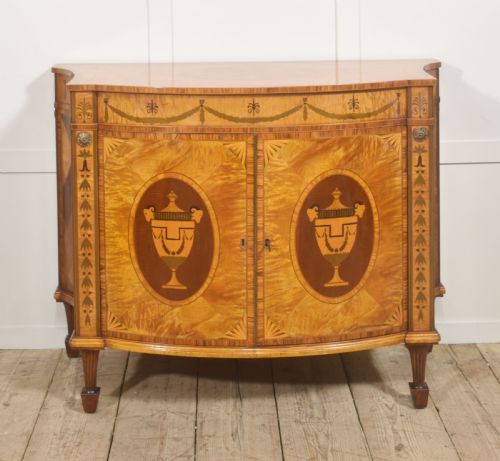


Half Moon Cupboard
A half moon cupboard brings together curved timber fronts and refined neoclassical lines, offering a clever wall-hugging profile that suits narrow rooms.
Half Moon Cupboard
A half moon cupboard is a semicircular piece of furniture designed to fit flush against a wall, appearing as side cabinets, commodes, and console tables. These items span periods from the eighteenth century through to the Edwardian era and the 1930s, reflecting shifts in taste across English, French, Italian, and Dutch workshops.
The version most commonly encountered on this page combines a flat back with a curved front, frequently executed in the Sheraton Revival or Neoclassical style. Makers often utilised mahogany, walnut, or satinwood to construct these compact storage pieces, which function effectively as sideboards or bedside tables.
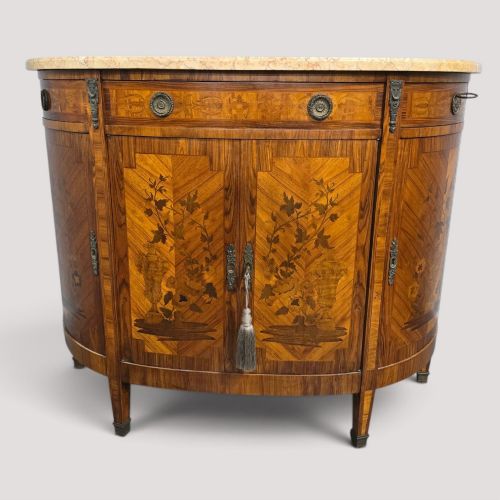
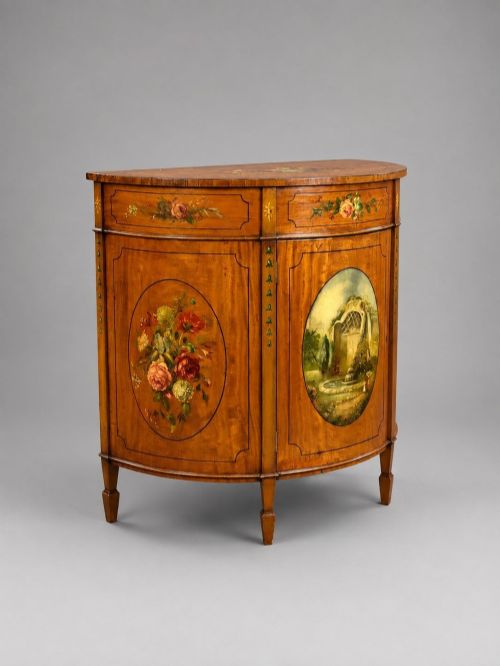
Surviving examples range from George III commodes to early twentieth-century painted satinwood cabinets and ebonised French pieces. Buyers will find that the category encompasses both utilitarian side cabinets and decorative marble-top consoles featuring intricate marquetry.
Materials and construction
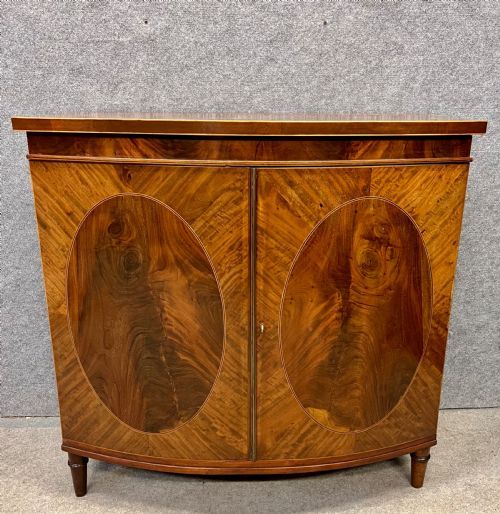
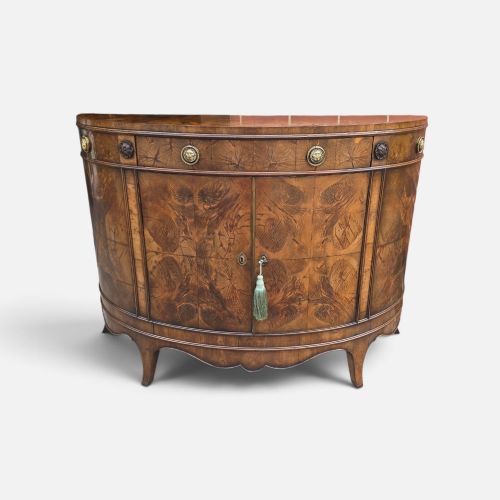
Cabinet makers built these curved carcasses using dense timbers such as mahogany and walnut, frequently applying fine veneers of satinwood, burr elm, and burr yew wood to the exterior. Boxwood and satinwood inlay create crisp geometric or floral patterns across the curved door panels and drawer fronts.
Surface decoration often involves hand-painted panels or elaborate marquetry, alongside applied brass feet and hardware. Marble tops appear on several French and Italian iterations, providing a durable and decorative upper surface that contrasts with the timber frame.
Side cabinets and commodes dominate the selection, accompanied by console tables, bedside tables, and tambour front cupboards.
Assessments of quality
The distinction between standard production and top tier pieces rests on the precision of the veneer work and the complexity of the inlay. Artisans who aligned intricate satinwood and marquetry smoothly around a tight curve achieved a standard far above those using simple painted decoration.
Proportion and material selection dictate the standing of an item, with burr woods and matched timber grains commanding greater visual weight. The integration of structural elements like tambour fronts or heavy marble tops also separates simpler bedside tables from exhibition quality cabinets.
Pietro Ferrario·Kaufman
The Half Moon Cupboard Glossary
- Demi-lune
- A half-moon shape used to describe furniture with a flat back and a curved front edge. This configuration allows the piece to sit tightly against a wall while saving floor space.
- Marquetry
- The art of applying decorative veneer pieces of different woods, metals, or shells to form intricate patterns on a structural surface. It appears frequently on satinwood and mahogany cabinets.
- Commode
- A low piece of furniture with drawers or doors, functioning historically as a storage cabinet. In these listings, the term often refers to decorative semicircular reception room pieces.
- Tambour
- A flexible sliding shutter formed from narrow vertical strips of wood glued to a canvas backing. This mechanism allows cupboard doors to glide smoothly around curved corners.
- Neoclassical
- A style originating in the mid eighteenth century that draws inspiration from the classical art and architecture of ancient Greece and Rome. It manifests in these cabinets through symmetrical layouts and restrained ornamentation.
Half Moon Cupboard: Frequently Asked Questions
Where should I place a half moon cupboard?
These cabinets suit hallways, landings, and dining rooms where floor space is limited. Their flat backs allow them to stand securely against a wall without projecting too far into the walkway.
They also function well in bedrooms as side tables or compact storage units, providing surface area for lamps and decorative objects while holding small items within their cupboards.
How do I date a half moon cupboard?
Dating relies on observing timber choices, construction techniques, and stylistic markers such as Sheraton Revival or Neoclassical details. Eighteenth-century pieces frequently employ solid mahogany, burr elm, or heavy oak carcases with hand-cut dovetails.
Later Edwardian and early twentieth-century interpretations often utilise lighter satinwood veneers, painted panels, and machine-made fixings. Comparing the secondary woods inside the drawers provides further clues to the manufacturing era.
What is the difference between a commode and a side cabinet?
A commode typically refers to a low storage unit featuring multiple drawers or doors designed for formal rooms. They often display higher levels of decorative veneer work and marquetry.
A side cabinet encompasses a broader category of storage furniture that may include shelving behind doors or open compartments. Both share the curved demi-lune profile but serve slightly different storage needs.
Are marble top cabinets delicate?
The marble slabs fitted to these consoles and cabinets provide a heavy and durable surface that resists stains better than polished wood. They are secured to the timber frame to distribute the weight evenly.
Care involves wiping the stone with a damp cloth and avoiding acidic liquids that can etch the surface. The underlying wooden structure requires standard polishing to maintain the timber condition.