


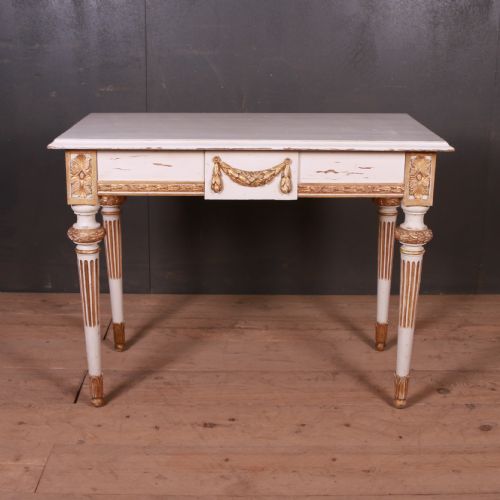


Gustavian Style Writing Desk
These gustavian style writing desk pieces offer the muted elegance of Scandinavian country interiors, bringing historic painted pine forms into modern rooms.
Gustavian Style Writing Desk
A gustavian style writing desk draws upon Scandinavian country traditions, appearing in forms such as writing tables, writing desks, and bureau bookcases. These items originate predominantly from the nineteenth century, with examples spanning from the eighteenth century up to the early twentieth century.
The most frequent variations encountered on this page are painted pine and softwood side tables or writing desks, finished in scraped paint or traditional rustic palettes. Swedish origins dominate the selections, alongside occasional Danish influences and French chateau styles.
How they were made
Construction relies primarily on pine and softwood timbers, shaped into utilitarian forms suited to nineteenth-century domestic use. Workshops utilised simple joinery appropriate for painted furniture, allowing the wood to receive successive layers of decorative paint.
Surfaces feature painted finishes, ranging from scraped paint effects to traditional rustic coatings, occasionally accented with brass hardware and gilt wood details.
Gustavian Style Writing Desk Retail Price Guide 2026
Typical asking prices for gustavian style writing desk among the pieces listed under this phrase on Sellingantiques today, from the lower quarter to the upper quarter. They describe what is for sale here now, not the wider market.
Listings span from the 18th century to 1910, focusing on pine, painted softwood, and brass materials.
What varies in quality
Quality rests in the character of the painted finish and the integrity of the pine timber beneath. Original or scraped paint surfaces that show honest weathering stand apart from heavy modern repainting.
Proportion and decorative restraint dictate the distinction between simple utilitarian country items and more refined Scandinavian pieces. The subtlety of the painted wood tone alters the overall visual weight of the desk.
The Gustavian Style Writing Desk Glossary
- Gustavian
- A Swedish neoclassical style originating in the late eighteenth century, characterised by restrained ornamentation and lighter colour palettes. It adapts French Louis XVI motifs into simpler, more functional Scandinavian forms.
- Escritoire
- A small writing desk fitted with drawers or pigeonholes behind a sloping or folding front. This term often describes compact writing furniture designed for domestic studies.
- Pine
- A softwood commonly utilised throughout Scandinavian cabinetmaking for both structural carcasses and visible painted surfaces. Its accessible nature made it the default material for regional furniture production.
- Scraped paint
- A finish revealing multiple historic layers of pigment through intentional distressing or wear. This technique highlights the age and decorative history of painted softwood furniture.
Gustavian Style Writing Desk: Frequently Asked Questions
What is a gustavian style writing desk?
These items are nineteenth-century Scandinavian tables and desks fashioned from pine, reflecting regional adaptations of neoclassical design. They provide functional workspace while retaining a distinct painted aesthetic.
Most examples employ softwood construction finished in historic painted surfaces, ranging from rustic side tables to bureau bookcases.
How do I date these desks?
Dating relies on construction methods, timber choice, and the evolution of the painted finish across the eighteenth, nineteenth, and early twentieth centuries. Earlier pieces often display hand-planed pine and traditional joinery.
Examining the layers of paint and the wear on softwood surfaces helps distinguish eighteenth-century examples from later nineteenth-century or 1910 pieces.
Where were these pieces made?
The listings on this page are primarily of Swedish origin, representing Scandinavian country craftsmanship from workshops producing regional furniture. Occasional pieces connect to Danish traditions or French chateau styles.
These pieces reflect local material availability, utilising native pine and softwood painted to brighten darker northern interiors.
How should I care for painted pine?
Maintenance requires protecting the historical painted surface from excessive moisture and direct sunlight. Soft dusting preserves the delicate finish of scraped pine without abrasive cleaning.
Keeping these tables in stable environmental conditions prevents the softwood timber beneath from expanding or contracting.