

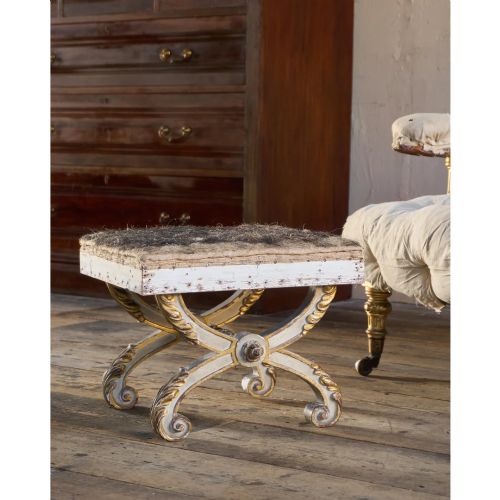
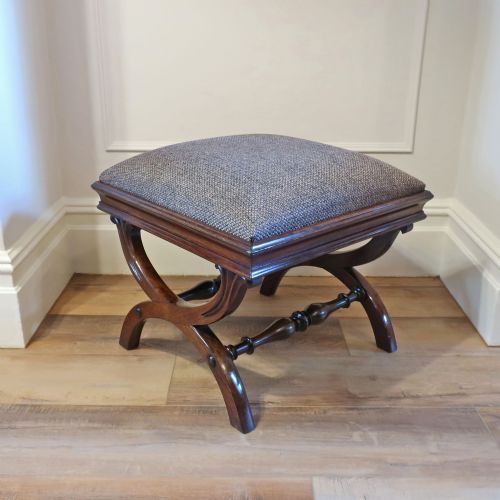


Grey Upholstered Ottoman
These grey upholstered ottoman pieces are practical seating and footrest forms, offering period charm through varied nineteenth and twentieth century designs.
Grey Upholstered Ottoman
When you search for grey upholstered ottoman, you look at seating and storage forms spanning the nineteenth and twentieth centuries. The selection ranges from Victorian stools and blanket boxes to French decorative benches.
You are most likely to meet nineteenth century walnut or mahogany pieces alongside French provincial and neoclassical styles. These items function as footstools, music stools, or low seats.
The evidence shows forms originating from British and French workshops, utilising traditional frames like the X-frame curule alongside simple pine boxes. Each piece offers a distinct period silhouette adapted for modern interiors.
How they were made
Makers utilised solid timbers such as mahogany, walnut, rosewood, and pine for the foundational frames. These woods were often hand-carved or painted to achieve distinct regional aesthetics.
Surface ornamentation included gilded finishes and carved decorative details on French and Regency examples. Textile coverings such as linen and check fabric were applied over traditional padding.
Grey Upholstered Ottoman Retail Price Guide 2026
Typical asking prices for grey upholstered ottoman among the pieces listed under this phrase on Sellingantiques today, from the lower quarter to the upper quarter. They describe what is for sale here now, not the wider market.
The listings feature pieces from the Regency, Victorian, and early twentieth-century periods, utilising mahogany, walnut, rosewood, and pine.
What varies in quality
The distinction between standard items and superior examples lies in the execution of the woodwork and carving. Hand-carved French stools and Regency pieces with specific details like lions paw feet show greater artisan investment than plain utility boxes.
Material selection also drives variation, as dense hardwoods like rosewood and walnut contrast with simpler pine construction. The sophistication of the frame design dictates the overall character of the piece.
Miles & Edwards
The Grey Upholstered Ottoman Glossary
- Ottoman
- A low upholstered seat or footstool without a back or arms, often incorporating storage space. These forms date across the nineteenth and twentieth centuries.
- Curule stool
- An ancient Roman magistrate chair design revived in nineteenth-century seating, featuring intersecting X-shaped legs. This form offers notable architectural presence.
- Gilt
- A thin layer of gold leaf applied to wood surfaces to create a decorative metallic finish. This technique appears on French decorative stools.
- Hessian
- A coarse woven fabric typically utilised as a foundational upholstery backing beneath top covers like linen. It provides structural support for padding.
Grey Upholstered Ottoman: Frequently Asked Questions
What periods do these ottomans and stools cover?
The listings span from the Regency era through the Victorian period and into the early twentieth century. You will encounter pieces dated across the nineteenth century alongside items from the 1920s and 1930s.
Each period brings distinct stylistic traits, moving from grand Regency forms to restrained Victorian items and decorative French designs.
How were these stools and ottomans originally used?
These pieces served multiple domestic functions, operating as footstools, music stools for piano players, and low seats in formal rooms. Some items, such as pine boxes, doubled as blanket storage.
Their compact size allowed them to be moved easily around the home to provide extra seating when required.
What materials are typical for the frames?
Frame construction relies heavily on hardwoods such as mahogany, walnut, and rosewood, alongside pine for utility pieces. Gilt and paint finishes frequently appear on French decorative items.
Upholstery materials recorded in the evidence include linen, Hessian, and various checked fabrics.
How can I identify French styles in the selection?
French pieces often display hand-carved decorative wooden frames, gilded surfaces, and neoclassical or provincial silhouettes. These items contrast with standard British Victorian forms through their ornate woodwork.
Labels in the evidence highlight French decorative, neoclassical, and provincial categories for easy recognition.