

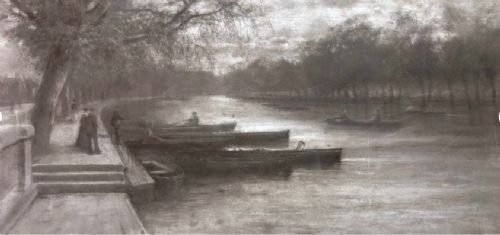
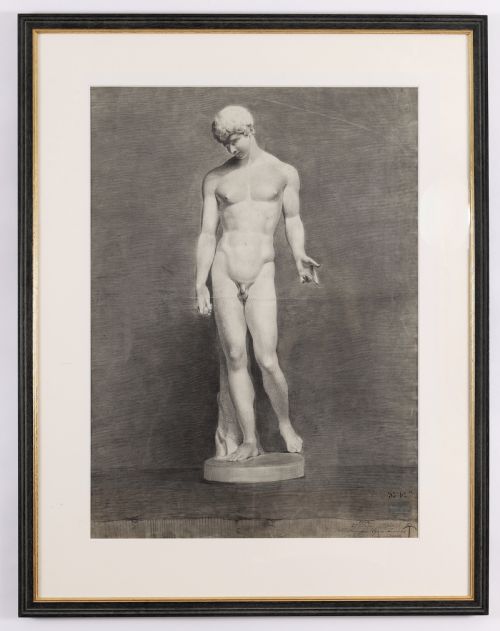


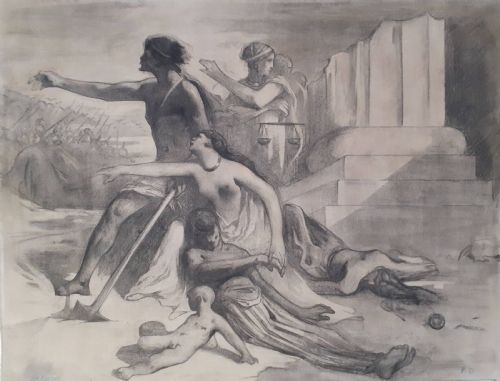
Grey Paper Charcoal Drawing
These grey paper charcoal drawing examples capture fleeting light and shadow with striking immediacy, offering collectors a tangible piece of European artistic history.
Grey Paper Charcoal Drawing
A grey paper charcoal drawing brings together tonal depth and delicate draftsmanship across various periods from the seventeenth century through to the mid twentieth century. Buyers seeking a grey paper charcoal drawing will encounter diverse subjects including landscapes, classical studies, and intimate portraits from British, French, Italian, and Dutch schools.
The selection ranges from early academic studies to impressionist and art deco works on toned paper. Portraiture and figurative compositions predominate, often framed as original artworks ready for display.
Pieces span multiple centuries, showing how artists utilised the coloured ground to build up highlights in chalk alongside deep charcoal shadows.
Materials and technique
Artists executed these works primarily with charcoal, chalk, and graphite upon paper, frequently employing toned or grey paper to act as a mid tone in the composition. This method allowed creators to apply dark charcoal for shadows and white chalk for highlights with rapid precision.
Supporting elements like wood and glass typically comprise the vintage frames housing these delicate works on paper. The interaction between the dry media and the tinted ground creates the characteristic atmospheric depth seen across the collection.
Grey Paper Charcoal Drawing Retail Price Guide 2026
Typical asking prices for grey paper charcoal drawing among the pieces listed under this phrase on Sellingantiques today, from the lower quarter to the upper quarter. They describe what is for sale here now, not the wider market.
Several ladies in these nineteenth century frames appear perpetually lost in thought, perhaps wondering if anyone will ever dust the mantelpiece.
Distinctions in quality
Quality rests upon the sureness of the hand and the sensitivity with which the artist exploited the tone of the paper itself. Strong academic grounding or clear stylistic influence distinguishes a master study from a routine exercise.
The preservation of the charcoal and chalk layer against the paper surface without excessive smudging determines the optical clarity of the finished piece. Superior works demonstrate deliberate control over negative space and tonal gradation.
John Macallan Swan·Frank Dobson·Francis Dodd·Cecil CP Lawson·George Richmond
The Grey Paper Charcoal Drawing Glossary
- Toned paper
- Paper manufactured or prepared with a neutral or coloured tint rather than stark white. This acts as an immediate mid tone in a drawing, saving the artist time and unifying the colour scheme.
- Academic realism
- A style of painting and drawing produced under the influence of European academies of art. It emphasises careful observation, anatomical accuracy, and adherence to classical traditions.
- Chalk
- A soft, dry drawing material made from earthy minerals, used here to apply opaque white highlights onto dark or grey grounds. It contrasts sharply with the velvety black of charcoal.
- Graphite
- A crystalline form of carbon used as a drawing medium for fine lines and subtle shading. It frequently appears alongside charcoal and chalk in nineteenth century portraiture.
Grey Paper Charcoal Drawing: Frequently Asked Questions
What is toned paper used for?
Toned paper provides a middle value background that allows artists to work in both directions towards dark and light. Instead of starting with a blank white sheet, the creator builds shadows with charcoal and lifts out highlights with chalk.
This technique speeds up the drawing process and creates atmospheric unity across the entire composition. It became especially popular in nineteenth century academic and impressionist sketching.
How do I date an antique drawing?
Dating relies upon stylistic markers, signatures, paper watermarks, and framing materials where original. Academic realism and tonalist influences often point towards nineteenth or early twentieth century execution.
Comparative study with documented works by known schools helps narrow down the period. Inscriptions on the reverse or contemporary framing methods also provide reliable chronological clues.
Can I hang drawings in bright rooms?
Works on paper are sensitive to ultraviolet light and excessive heat, which can fade charcoal and discolour the paper support. Position them away from direct sunlight and strong artificial spotlights.
UV filtering museum glass offers the best protection for valuable historical drawings. Maintaining stable humidity levels prevents the paper from warping or developing foxing.