
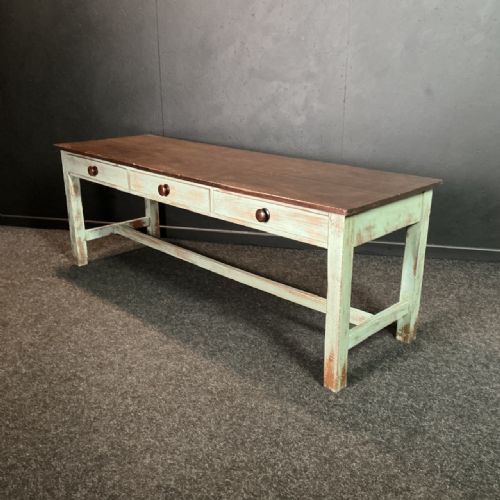
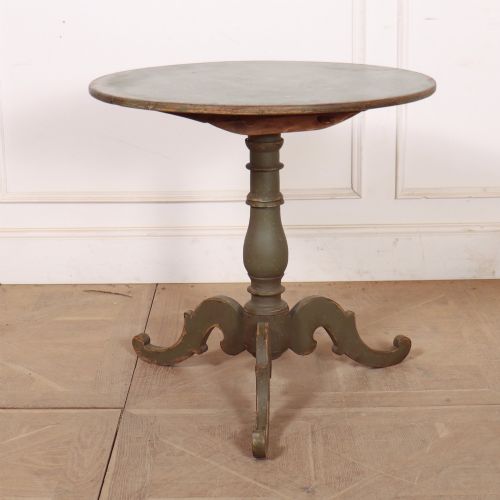
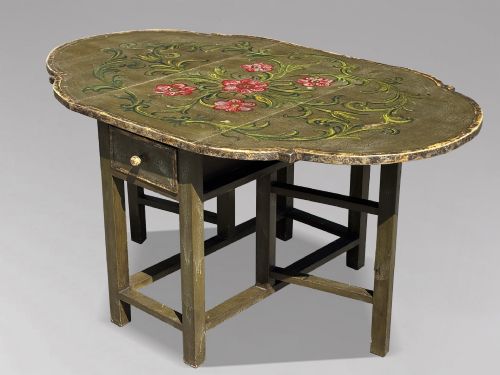


Green Wooden Side Table
A green wooden side table brings a practical surface and a painted pop of colour to a room.
Green Wooden Side Table
When you search for a green wooden side table, you find a selection of occasional surfaces spanning the eighteenth century to the twentieth century. These pieces appear in forms such as lamp tables, console tables, and drop-leaf tables, originating from English, French, Italian, Swedish, and Welsh workshops.
The aesthetic leans heavily towards country and provincial styles, including English Country, French Provincial, and Swedish Country, alongside more formal iterations in Neoclassical and Victorian designs. Most examples rely on painted finishes over timber carcasses, sometimes paired with marble, copper, or brass details.
How they were made
Makers constructed the structural frames primarily from pine, oak, and other hardwoods, assembling them with traditional joinery suited to tables and consoles. Surfaces received applications of paint, gesso, or giltwood, often built up over decades of regional use.
Selected examples incorporate inset tops of marble or verdigris copper, combining stone and metal with the painted wooden bases. Decorative flourishes range from hand-painted motifs to carved oak details and parcel-gilt accents.
The listings span from the 18th century through the 1930s, featuring pine, oak, paint, marble, and brass.
What varies in quality
Quality rests upon the harmony between the timber construction and the character of the painted surface, where authentic age shows in the softening of edges and layered pigments. Tables featuring integrated stone or marble tops demand precise masonry fit within the wooden frame.
Proportion and regional vernacular define the distinction between standard utility items and finer decorative pieces, such as Neoclassical consoles or Italian painted tables. Original surface patination elevates a piece far above later repainting efforts.
The Green Wooden Side Table Glossary
- Console table
- A table designed to stand against a wall, frequently supported by wall brackets or console legs. These pieces often feature decorative marble or painted wooden tops.
- Demi-lune
- A half-moon shape used for the tops and frames of certain console and side tables. This profile allows the piece to sit flush against a wall.
- Gesso
- A plaster-like material applied to wood as a base for painting or gilding. It provides a smooth surface for detailed decorative work.
- Drop-leaf table
- A table with hinged flaps on the sides that can be folded down or supported to increase the surface area. This mechanism offers flexibility in smaller spaces.
- Parcel-gilt
- Partially gilded with gold leaf or a gold-coloured finish to highlight specific carved details. This technique adds contrast against a painted wooden base.
Green Wooden Side Table: Frequently Asked Questions
Where should I place a green wooden side table?
These tables fit naturally beside seating in a living room, in a hallway as a console, or serving as a lamp table in a bedroom. Their compact footprints allow them to occupy tight corners without crowding the floor space.
The painted finish permits them to either complement existing colour schemes or act as a standalone accent piece against neutral walls.
How do I care for a painted wooden surface?
Dust the surface regularly with a soft, dry cloth to prevent dirt accumulation. Avoid harsh chemical cleaners that might strip or discolour the historic paint.
Protect the wood from direct sunlight and excessive moisture to maintain the integrity of the finish and prevent timber movement.
What is the difference between an 18th-century and a 20th-century table?
Earlier tables often display hand-mixed pigments, deeper patination from centuries of use, and vernacular construction methods specific to their region of origin. Twentieth-century pieces frequently exhibit cleaner lines or revival styles like Neoclassical or provincial copies.
Examining the underside, fixings, and wear patterns helps distinguish between eighteenth-century craftsmanship and later interpretations.
Can I use a marble-top table for everyday use?
Marble tops provide a durable, heat-resistant surface suitable for lamps, drinks, and decorative objects. Stone requires gentle cleaning with mild soap and water rather than acidic agents.
Care should be taken with heavy impacts that could chip the marble edge or strain the supporting wooden apron.