

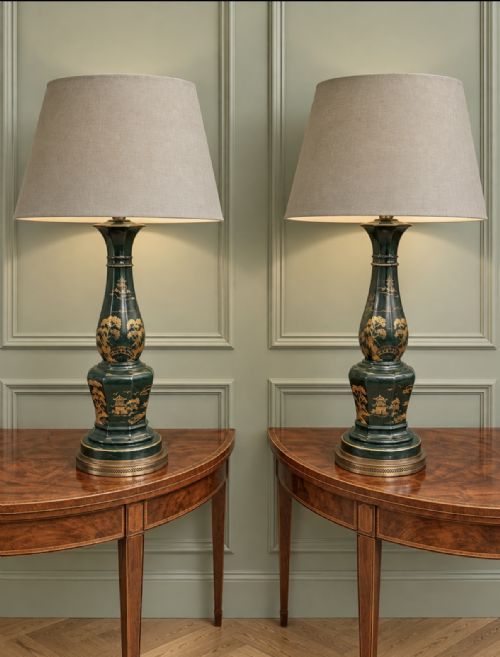
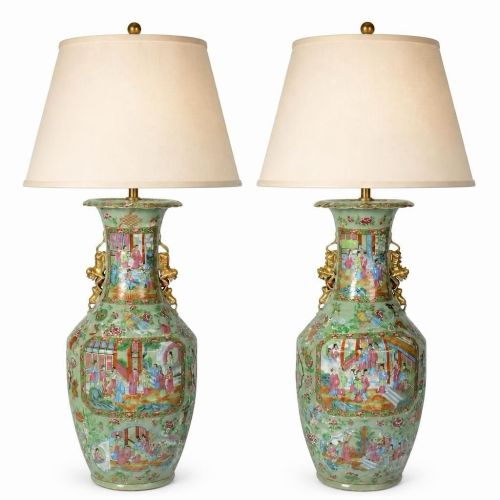
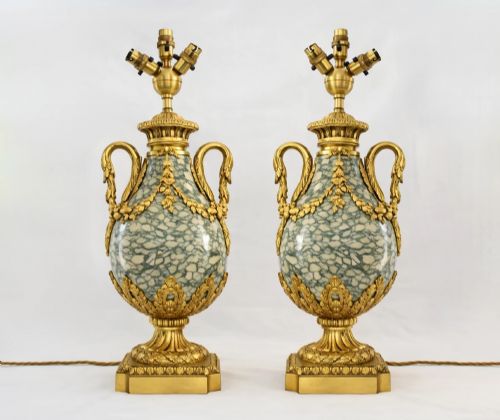


Green Vase Lamp Pair
These green vase lamp pairs bring symmetry and colour to a room, matching historic ceramics with wired lighting.
Green Vase Lamp Pair
A green vase lamp pair offers matching dual illumination using converted historic vessels mounted on stable bases. When you search for a green vase lamp pair, you encounter matched sets drawn from nineteenth-century Chinese export porcelain and French decorative arts.
The most common versions on this page are nineteenth-century Chinese ceramics, including Rose Medallion, Famille Verte, and Celadon pieces. These vessels are frequently paired with brass, ormolu, or gilt bronze mounts, alongside Victorian mantle lustres and marble cassolettes.
Origins span nineteenth-century workshops in China and France, reflecting Victorian and Louis XVI styles. Buyers find these balanced pairs utilised on side tables and mantles to introduce height and soft ambient lighting.
Materials and construction methods
Potters shaped ceramic and porcelain bodies, applying coloured glazes such as celadon or yellow and green grounds before firing. French and Chinese workshops then drilled these vessels to accommodate electrical wiring for modern use.
Metalworkers fitted the vases with brass, ormolu, and gilt bronze mounts, securing marble or ceramic bases beneath. Fabric elements complete the upper portions, while specialist techniques like pâte-sur-pâte add raised decorative relief to the porcelain surface.
Green Vase Lamp Pair Retail Price Guide 2026
Typical asking prices for green vase lamp pair among the pieces listed under this phrase on Sellingantiques today, from the lower quarter to the upper quarter. They describe what is for sale here now, not the wider market.
Listings feature nineteenth-century porcelain, brass, ormolu, and marble utilised across Chinoiserie and Louis XVI styles.
Distinguishing quality in matched pairs
Quality rests in the crispness of the hand-painted ceramic detail and the precision of the metal mounts. Finer pieces display finely chased ormolu and well-preserved enamel colours without blurring or fading.
Symmetry between the two vessels defines a superior pair, ensuring the dimensions, glaze saturation, and decorative motifs match closely. The integration of the electrical fittings into the historic body also determines the overall standard.
The Green Vase Lamp Pair Glossary
- Ormolu
- Gilt bronze mounted ornamentation popular in French decorative arts. It provides a bright metallic contrast to ceramic bodies.
- Celadon
- A pale green jade-like ceramic glaze developed in China. This glaze varies from sea-green to olive tones.
- Rose Medallion
- A distinct style of Cantonese porcelain decorated with panels of figures, birds, and flowers. Rose and green dominate the palette.
- Cassolette
- A decorative vase or urn designed with a reversible lid. These are frequently mounted in metal and converted into lamps.
- Famille Verte
- A porcelain palette featuring transparent green enamel alongside other colours. It originated in the Qing Dynasty.
- Pâte-sur-pâte
- A ceramic technique where wet porcelain slip is painted onto a body in layers. This builds up a low relief cameo effect.
Green Vase Lamp Pair: Frequently Asked Questions
How do I wire a ceramic lamp?
Wiring historic vases requires threading a cord through the drilled base and securing an approved lamp holder at the top. Professional electricians handle this task to protect the ceramic body from damage.
Collectors ensure the internal wiring meets current safety standards while preserving the external appearance of the antique mountings.
Are these lamps matched sets?
Most examples originate as balanced pairs created together in nineteenth-century workshops. Slight variations in hand-painted details often confirm their age and individual craftsmanship.
Buyers examine the height, glaze colour, and base dimensions to verify that both pieces form a cohesive pair for a mantle or table.
How do I clean antique porcelain lamps?
Dust the porcelain and metal mounts gently with a dry, soft cloth. Avoid harsh chemical cleaners that can damage historic glazes or gilt bronze surfaces.
Fabric shades require separate brushing or light vacuuming with a soft attachment to remove surface accumulation without disturbing the seams.
What is Chinese export porcelain?
Chinese export porcelain refers to ceramics manufactured in China specifically for Western markets. These pieces combine traditional Chinese shapes and glazes with decorative preferences popular in Europe.
Nineteenth-century examples frequently arrived in France and Britain, where local artisans added metal mounts and electrical fittings.