

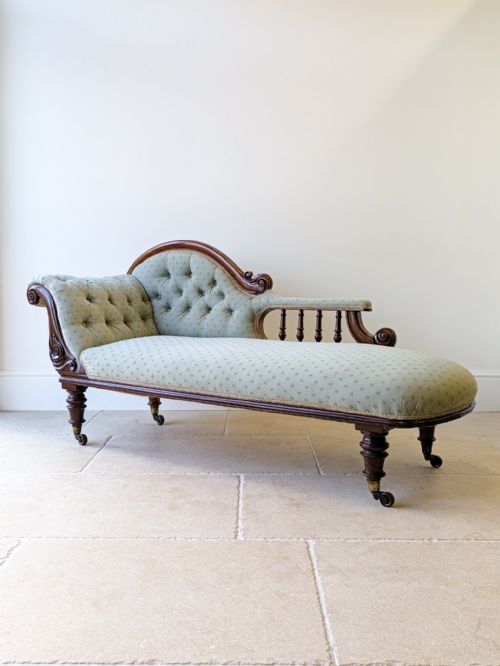
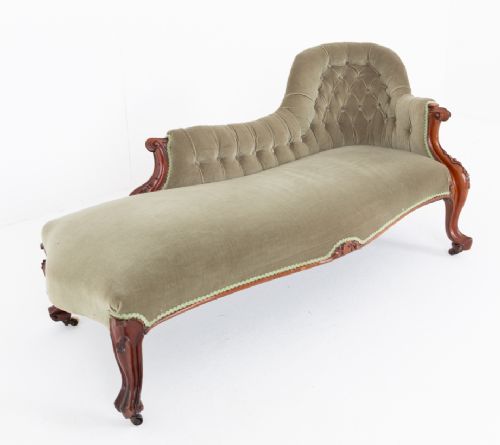


Green Upholstered Chaise
Green upholstered chaise pieces offer a reclining seat rooted in the nineteenth century, built for parlour comfort.
Green Upholstered Chaise
A green upholstered chaise is a reclining seat designed for the nineteenth-century interior, intended for resting in a semi-reclined posture. The examples found here span the Victorian era, the year eighteen sixty, and the nineteenth century at large.
Buyers encounter forms such as chaise longues, daybeds, conversation seats, and reception salon chaises. These pieces originate across Victorian, Victorian Rococo Revival, French Rococo, Arts and Crafts, and French Empire styles.
The most common version to meet on this page is the Victorian chaise longue or daybed, often framed in rosewood, mahogany, or walnut, and covered in velvet or fabric.
How they were made
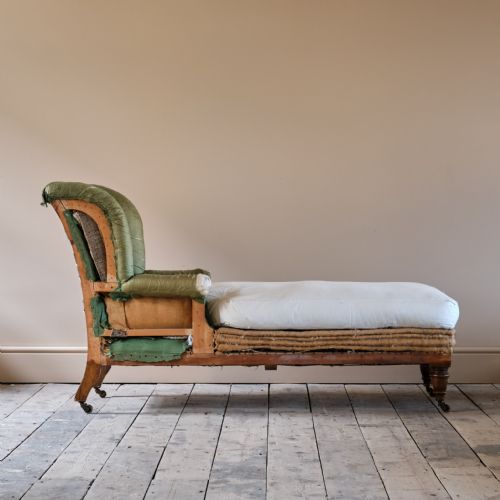
Makers constructed the frames of these reclining seats using solid hardwoods like mahogany, rosewood, walnut, and giltwood. Structural support relied on internal horsehair and hessian stuffing beneath the final textile covering.
Upholstery techniques involved rich velvet and fabric surfaces secured over traditional stuffing materials. Metal details such as brass components appear alongside carved wooden frames in styles from French Empire to Victorian Rococo Revival.
Green Upholstered Chaise Retail Price Guide 2026
Typical asking prices for green upholstered chaise among the pieces listed under this phrase on Sellingantiques today, from the lower quarter to the upper quarter. They describe what is for sale here now, not the wider market.
Current listings feature frames built from mahogany, rosewood, walnut, and giltwood, paired with velvet, fabric, horsehair, and hessian.
What varies in quality
Quality in a green upholstered chaise reveals itself in the depth of the wood carving and the refinement of the frame's silhouette. Pieces displaying intricate Victorian Rococo Revival or French Rococo detailing stand apart from simpler structural forms.
The choice of primary timber also dictates the tier of the piece, with richly grained rosewood and walnut carrying a different presence compared to standard mahogany or general hardwood frames.
William Birch
The Green Upholstered Chaise Glossary
- Chaise longue
- A long reclining chair designed for one person to stretch out their legs. It combines the seat of a chair with the length of a daybed.
- Daybed
- A couch that can be used for lounging, resting, or sleeping during the day. Nineteenth-century variants often feature a raised headrest.
- Duchesse brisée
- A French multi-piece lounge chair comprising a chair and one or two footstools that together form a continuous reclining surface. This style appears in giltwood execution.
- Horsehair
- A traditional stuffing material woven from tail or mane hair, utilised for its resilience and ability to hold shape within historical upholstery.
- Hessian
- A coarse woven fabric typically utilised as a foundational scrim beneath the outer textile and stuffing of nineteenth-century seating.
Green Upholstered Chaise: Frequently Asked Questions
What is a green upholstered chaise?
A green upholstered chaise is a nineteenth-century reclining seat designed for interior lounging, combining a chair back with an extended footrest. These pieces incorporate velvet and fabric coverings over traditional frames.
They appear in styles ranging from Victorian and French Rococo to Arts and Crafts, serving as both functional seating and prominent reception room furniture.
How were these daybeds used?
Historically, nineteenth-century daybeds and chaises provided a place for relaxation and reception in parlours and grand salons. Occupants reclined on them during the day without retiring to a bedroom.
They were placed in public rooms where guests were received, acting as statements of comfort and social standing within the home.
How do I live with a nineteenth-century chaise?
Living with a nineteenth-century chaise involves placing it where its long profile can be appreciated without blocking room traffic. It functions well as a reading seat or a distinctive anchor in a living space.
Care for the piece requires protecting the velvet or fabric upholstery from direct sunlight and maintaining the timber frame with appropriate wood care methods.
How do I tell Victorian styles apart?
Victorian styles are distinguished by their decorative carving, wood selection, and regional influences. Pieces span early Victorian mahogany up to later ornate Rococo Revival and Arts and Crafts designs.
Examining the woodwork reveals whether a maker followed French Empire symmetry or the more flowing, curved lines typical of Rococo revival work.