

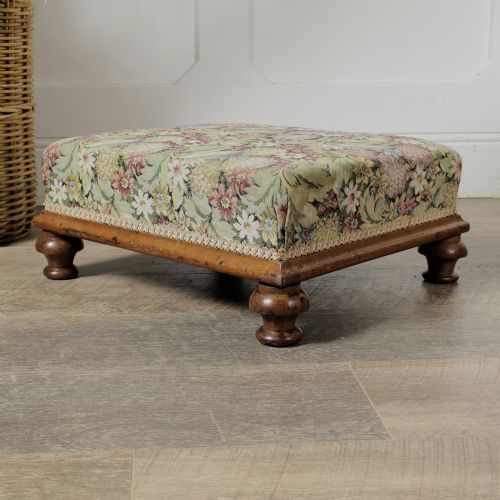


Green Tapestry Footstool
These green tapestry footstool examples bring period textiles and rich timber frames together for daily seating.
Green Tapestry Footstool
A green tapestry footstool is a low seat or rest upholstered in needlework, wool, or fabric, appearing in forms such as stools, ottomans, and window seats. Buyers searching for a green tapestry footstool encounter items spanning the Regency, Victorian, and 19th-century periods, alongside pieces from 1920.
How they were made
Frames are constructed from dense timbers including mahogany, walnut, and rosewood, often featuring carved wooden details. Joinery supports the weight of ottomans, centre stools, and long footstools.
Upholstery relies on tapestry, needlework, wool, and woven fabric stretched over padded foundations. Brass components occasionally provide structural or decorative support.
Green Tapestry Footstool Retail Price Guide 2026
Typical asking prices for green tapestry footstool among the pieces listed under this phrase on Sellingantiques today, from the lower quarter to the upper quarter. They describe what is for sale here now, not the wider market.
One Chinoiserie stool hides its pedigree within a twentieth-century Scottish design workshop.
What varies in quality
The refinement of the timber carving and the complexity of the frame dictate the standing of a piece. Elaborate forms like Regency waisted ottomans or carved rosewood frames sit above plain structural supports.
The execution of the needlepoint or tapestry upholstery alters the character of the object. Intricate wool needlework and original textiles command greater attention than standard fabric.
Whytock and Reid
The Green Tapestry Footstool Glossary
- Tapestry
- A thick fabric woven with decorative designs, frequently utilised for historical upholstery. It forms the primary surface texture on these stools.
- Ottoman
- A low, upholstered seat or bench without a back or arms, designed for resting feet or sitting. Examples range from Victorian mahogany pieces to Regency waisted variants.
- Needlework
- Hand-stitched thread patterns on canvas or fabric grounds, creating pictorial or geometric top surfaces. Original needlepoint survives on several nineteenth-century listings.
- Rosewood
- A heavy, dark timber valued for its rich grain and utilised in fine Regency and nineteenth-century frames. It takes a high polish.
- Centre stool
- A substantial seating form intended to stand away from walls in the middle of a room. Victorian examples often feature walnut construction.
Green Tapestry Footstool: Frequently Asked Questions
Where should I place a footstool?
These pieces sit comfortably in living spaces before armchairs or sofas, functioning as seats or rests.
Larger ottomans and centre stools also serve as standalone surfaces in hallways or bedrooms.
How do I identify a Victorian piece?
Victorian examples often employ walnut or mahogany with heavy carving influenced by Rococo Revival tastes.
Their upholstery frequently incorporates dense wool tapestry or needlework.
How do I care for the tapestry?
Keep wool and tapestry upholstery away from direct sunlight to prevent the green dyes and threads from fading.
Gentle surface cleaning preserves the historic fabric without disturbing the foundation.