
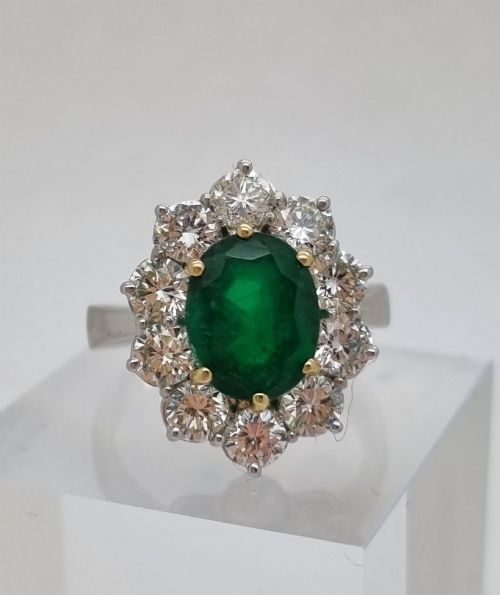
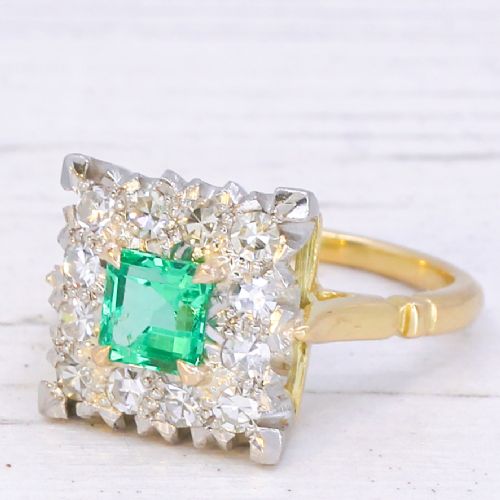


Green Stone Halo Ring
A green stone halo ring brings together a central coloured gem and a surrounding border of diamonds, offering timeless elegance on the hand.
Green Stone Halo Ring
A green stone halo ring centres on a vivid green gemstone such as an emerald, jadeite, or tourmaline, encircled by sparkling white diamonds. Buyers searching this phrase will find a variety of cluster and floral arrangements spanning several decades.
The most common iterations on this page feature an oval or marquis cut green stone framed closely by brilliant-cut diamonds. These pieces frequently date from the Edwardian era through to the mid-twentieth century and the 1960s.
Cluster and snowflake formations dominate the selection, bringing together distinct yellow gold, white gold, and platinum settings. Each piece showcases how jewellers arranged contrasting stones to maximise brilliance.
Materials and construction methods
Craftsmen built these rings using precious metals including 9ct gold, 18ct yellow and white gold, and platinum. Platinum settings frequently secure Edwardian and Art Deco diamond borders, while gold forms the warm shanks of mid-century pieces.
The central green stones, predominantly emeralds alongside tourmaline and jadeite, are held securely by claw or bezel settings. Surrounding diamonds are meticulously bead-set or prong-set to form the signature halo effect.
The available pieces span the Edwardian era, Art Deco period, 1950s, and 1960s.
Distinguishing quality in cluster rings
Quality rests primarily on the depth of colour and clarity of the central green stone, alongside the cut and match of the surrounding diamonds. Finer examples display vivid natural emeralds or jadeite paired with meticulously matched diamond borders.
The precision of the metalwork and the integrity of the setting determine longevity. Heavier gauge gold and robust platinum mountings indicate superior craftsmanship compared to lighter, more utilitarian settings.
The Green Stone Halo Ring Glossary
- Halo ring
- A ring featuring a central gemstone encircled by a concentric border of smaller pavé-set or claw-set diamonds. This design enhances the perceived size and brilliance of the middle stone.
- Cluster ring
- A jewellery arrangement where multiple smaller stones gather closely around a dominant centre gem. It often mimics floral patterns or geometric shapes.
- Marquis cut
- A boat-shaped gemstone cut featuring pointed ends and curved sides. This elongated form maximises carat weight visually on the finger.
- Platinum
- A dense, strong, and naturally white precious metal favoured in fine jewellery. It holds small claw settings securely without losing its structural integrity.
Green Stone Halo Ring: Frequently Asked Questions
How do I care for a green stone halo ring?
Clean your ring gently using warm soapy water and a soft brush, avoiding harsh ultrasonic cleaners that can damage natural emeralds or treated stones.
Store the piece separately in a fabric-lined box to prevent the diamonds from scratching the softer central green gemstone.
What periods do these rings come from?
The pieces span several distinct eras, including Edwardian designs from the 1910s, Art Deco creations from the 1920s, and later mid-century examples.
Each period brings its own characteristic metal choices and stone cuts, ranging from platinum geometric clusters to warmer gold floral arrangements.
Are the emeralds natural in these rings?
The selections encompass natural emeralds with verified origins, such as Colombian stones, alongside other green gems like tourmaline and jadeite.
Documentation or specific listing details often note the natural origin and any treatments associated with the central green stone.
Can these rings be resized easily?
Resizing depends on the metal type and the integrity of the shoulders, though most gold and platinum bands can be adjusted by a skilled jeweller.
Intricate cluster designs require careful handling to ensure the surrounding halo stones remain undisturbed during the process.