





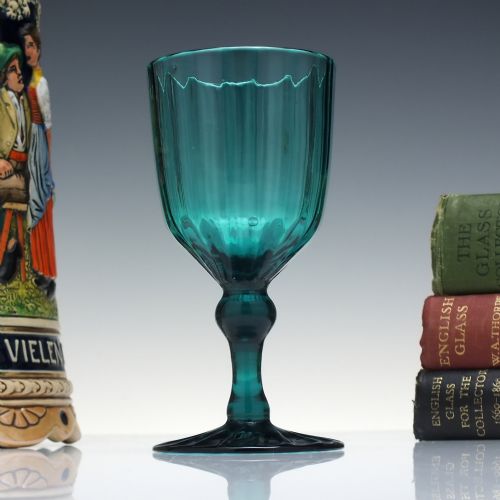


Green Stem Wine Glasses
Green stem wine glasses bring vibrant colour to the table, spanning Georgian roemers to Victorian and Edwardian services.
Green Stem Wine Glasses
Green stem wine glasses span several centuries of production, encompassing Georgian, Victorian, and Edwardian periods alongside continental European workshops. Collectors encounter various forms, from tall roemers with hollow stems to delicate dessert wine glasses and heavy cut crystal goblets.
The aesthetic ranges from deep Bristol green to pale green, emerald, aqua, and turquoise shades. Pieces frequently appear as pairs or larger sets of six or eight, designed for formal dining or dessert courses.
Materials and construction
These vessels utilise blown glass, lead glass, and crystal, often shaped through rib moulding or wheel cutting to achieve faceted surfaces. Glassmakers integrated coloured glass into the stems or bowls during the hot-working process.
Decoration often includes polychrome enamel and gold leaf applied to the exterior surfaces, particularly on Bohemian and German pieces from the turn of the twentieth century.
Green Stem Wine Glasses Retail Price Guide 2026
Typical asking prices for green stem wine glasses among the pieces listed under this phrase on Sellingantiques today, from the lower quarter to the upper quarter. They describe what is for sale here now, not the wider market.
Decoration methods recorded include polychrome enamel, gold leaf, and rib moulding.
Markers of quality
Quality rests in the crispness of the cutting, the weight and clarity of the metal, and the precision of the enamel work. Hand-painted floral motifs and gilding executed by skilled hands distinguish finer production from standard domestic glassware.
Proportion and balance also define superior examples, particularly in larger roemers where the hollow stem and wide foot require careful distribution of weight.
Theresienthal·Frits Hechert
The Green Stem Wine Glasses Glossary
- Roemer
- A traditional Germanic drinking vessel featuring a wide bowl sitting atop a cylindrical hollow stem studded with prunts. This form was widely produced in England and across Europe for white wine.
- Prunt
- A small applied blob of molten glass melted onto the stem to provide a secure grip. These decorative lumps are typical on roemers and older German glassware.
- Rib moulding
- A technique where molten glass is inflated inside a ribbed mould to create vertical ridges along the body or stem. This pattern provides additional refraction and texture.
- Enamel
- An opaque or translucent vitreous composition fused to the glass surface by firing. It allows for intricate floral and heraldic decoration in multiple colours.
Green Stem Wine Glasses: Frequently Asked Questions
What is a roemer glass?
A roemer is a traditional Germanic wine glass featuring a bulbous bowl and a distinctive hollow cylindrical stem.
These stems are usually adorned with applied glass prunts to ensure a firm grip during use.
How do I date green wine glasses?
Dating relies on stylistic markers, manufacturing techniques, and the depth of the glass colour. Georgian examples often show pontil marks and thicker metal, whilst Victorian and Edwardian pieces frequently feature brighter colours and finer mouldings.
Comparing the silhouette against known period forms helps narrow down the decade of production.
Are these glasses safe for daily use?
Many antique glasses remain structurally sound for occasional dining or celebratory toasts. Hand washing is essential to protect delicate enamel and gold leaf decorations.
Sudden thermal shock should be avoided to prevent cracking the older glass.
What causes the different shades of green?
Variations in colour arise from natural impurities in the sand and metal oxides used during the glass-making process. Bristol green and pale emerald tones reflect the specific recipes favoured by nineteenth-century glasshouses.
Turquoise and aqua shades often indicate later Victorian or Edwardian chemical formulations.