


Green Marble Top Pedestal
A green marble top pedestal brings striking mineral surface and architectural presence to a room, offering a functional surface rooted in nineteenth-century design.
Green Marble Top Pedestal
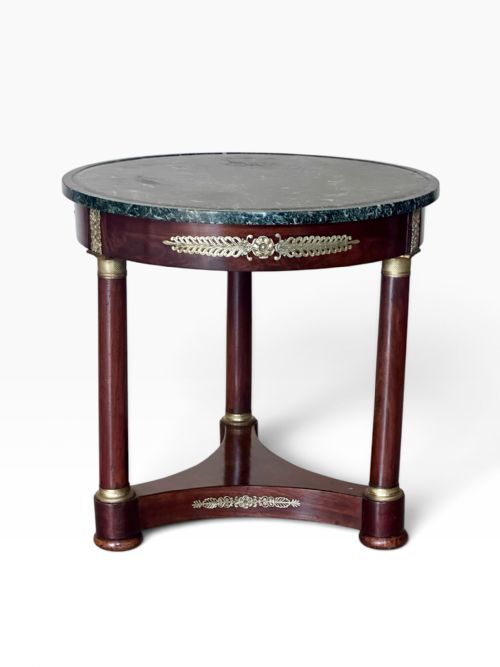
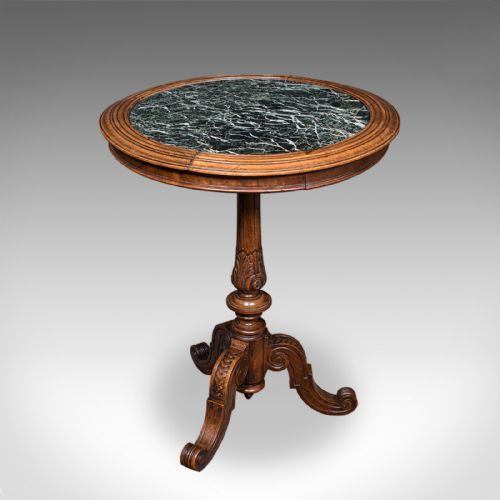
When you search for a green marble top pedestal, you encounter nineteenth-century decorative furnishings that span centre tables, lamp tables, bedside cabinets, and plant stands. The selection ranges from French Empire and Regency Gothic Revival designs to Italian giltwood and cafe tables, showing how diverse these stone-topped forms are.
The version you are most likely to meet on this page is a nineteenth-century French or Italian table featuring a polished green marble slab set upon timber, giltwood, or brass. These pieces cross various periods including the Victorian era and the early twentieth century, reflecting varied domestic and hospitality uses.
How they were made
Construction relies on combining solid timbers such as mahogany and walnut with carved or gilded elements like giltwood, brass, and ormolu. Artisans mounted heavy marble slabs securely onto these wooden and metallic frames, balancing the dense top stone with stable bases.
Surface decoration incorporates gold leaf and cast iron where appropriate, uniting classical French and Italian stylistic motifs with durable structural assembly.
Listings feature items spanning the nineteenth century, including Victorian, Regency, and French Empire periods, constructed from mahogany, walnut, giltwood, and marble.
What varies in quality
The distinction between ordinary and exceptional examples rests on the depth of hand-carving in the wooden or giltwood framework and the richness of the marble's natural veining. Finer pieces demonstrate precise joinery and sophisticated ornamentation, such as French Empire or Italian Rococo detailing.
Material selection dictates the upper tier, where genuine ormolu mounts, heavy cast brass, and substantial mahogany or walnut outperform simpler utility pieces like basic cafe or bistro tables.
The Green Marble Top Pedestal Glossary
- Giltwood
- Wood that has been treated with a thin layer of gold leaf or gold paint. This technique creates a luminous, reflective surface popular in classical European furniture.
- Ormolu
- Finely chased and gilt bronze used as a decorative mount on furniture. It provides metallic contrast against dark timbers and polished stone.
- Gueridon
- A small French table, often round, supported by one or more columns or figures. These pieces function as centre tables or display stands.
- Regency
- An English stylistic period spanning the early nineteenth century. Designs frequently draw upon Gothic Revival and classical motifs.
Green Marble Top Pedestal: Frequently Asked Questions
What rooms suit a green marble top pedestal?
These pieces fit comfortably in living rooms, hallways, and bedrooms as lamp tables, bedside cabinets, or plant stands. Their compact footprint allows them to occupy corners or central spaces effectively.
The contrasting green marble surface introduces colour and a solid platform for displaying objects, lamps, or bedside essentials without dominating the floor plan.
How do I identify French Empire style?
French Empire furniture displays classical proportions, restrained carving, and often incorporates ormolu mounts or giltwood details. The aesthetic reflects early nineteenth-century neoclassical ideals.
Pieces from this movement emphasise architectural dignity and symmetry, frequently pairing dark mahogany or walnut with polished stone tops.
Are these pedestals purely decorative?
While many serve as display surfaces for plants, lamps, or decorative objects, several variations include enclosed storage. Bedside cabinets and pedestal cupboards offer functional interior space.
This combination of a durable stone top and a cabinet base provides both a sturdy display area and practical concealment for household items.
How can I tell the period of a table?
Dating relies on observing stylistic markers such as Regency Gothic Revival tracery, Italian giltwood carving, or French Empire proportions. Material choices also provide clues to the era of manufacture.
Examining the underlying timber, assembly methods, and the specific cut of the green marble helps place the piece within the nineteenth or early twentieth century.