
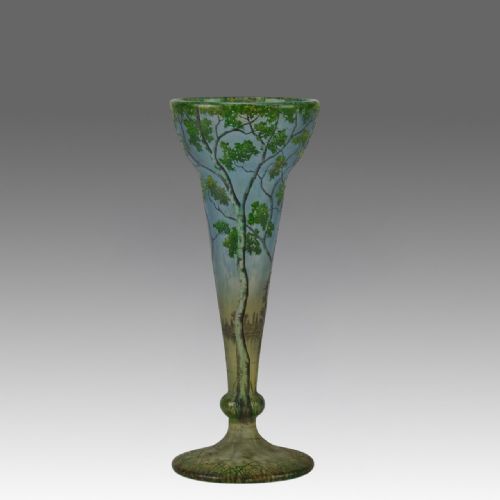


Green Enamelled Vessel
A green enamelled vessel brings vibrant colour and intricate metallic or painted surface detail to a room, spanning delicate glass and robust metalwork.
Green Enamelled Vessel
A green enamelled vessel encompasses a varied group of decorative objects, from nineteenth-century Japanese cloisonné bowls and temple water dispensers to European glass and porcelain vases. Buyers searching for a green enamelled vessel encounter pieces shaped across the nineteenth and early twentieth centuries, reflecting diverse global traditions including Qing Dynasty ceramics, Meiji period Japanese works, and Art Deco European glassware.
The most common forms on this page are bowls, lidded jars, and vases, produced in materials such as porcelain, cameo glass, and copper with champlevé or cloisonné enamel detailing. These items served ornamental and functional roles in period interiors, utilising styles from Art Nouveau and Arts and Crafts to Victorian and Bohemian designs.
How they were made
Maker techniques rely heavily on fusing vitreous enamel to metal bases like copper and brass, or applying hand-painted enamel decoration directly onto blown glass, earthenware, and porcelain. Cloisonné and champlevé methods involve soldering metal wires or carving cells to hold coloured enamel pastes before firing and polishing.
Glass vessels utilise blowing and cameo techniques, where layers of glass are etched or acid-carved to reveal contrasting background colours, whilst ceramics employ underglaze and overglaze enamels fixed through high-temperature kiln firings.
Materials span enamel, porcelain, brass, copper, cloisonne enamel, cameo glass, earthenware, and wood across periods from 1850 to 1930.
What varies in quality
Quality rests upon the precision of the enamel work, the clarity of the glass or porcelain body, and the crispness of the metallic detailing or wirework. Superior examples display flawless fusion without pitting or cracking in the vitreous layers, alongside finely balanced forms and sophisticated colour palettes.
The sophistication of the hand-painted or carved ornamentation distinguishes standard production pieces from masterworks, particularly in the fine detail of figurative or botanical motifs.
Daum Freres·Karl Palda·Royal Dux
The Green Enamelled Vessel Glossary
- Cloisonne enamel
- A metalwork technique where thin metal wires form raised barriers on the surface to create compartments filled with coloured enamel paste.
- Champleve enamel
- A method where troughs or cells are hollowed out of a metal surface and filled with enamel before firing.
- Cameo glass
- Glass formed with multiple coloured layers that are carved or etched away to produce a raised design in relief.
- Famille verte
- A Chinese porcelain palette dominated by green enamels, developing during the Qing Dynasty.
- Totai Shippo
- Japanese wire-free cloisonne, where enamel is applied directly to a carved or textured base such as tree bark.
Green Enamelled Vessel: Frequently Asked Questions
How do I clean a green enamelled vessel?
Dust gently with a soft, dry cloth to protect delicate enamel and metal surfaces. Avoid submerging antique pieces in water or using harsh chemical cleaners.
Moisture can seep into micro-cracks in old enamel or corrode exposed copper and brass bases over time.
What periods do these vessels come from?
The pieces span the nineteenth and early twentieth centuries, encompassing Victorian, Edo period, Meiji period, and Art Deco eras.
Stylistic markers help identify the specific decade, from nineteenth-century Chinese porcelain to 1930s European glass.
How were these vessels used originally?
Many served as decorative centrepieces, temple water dispensers, brush pots, or lidded jars for sugar and storage. Others were purely ornamental vases designed to showcase artistic glass-making and metalworking skills in formal reception rooms.
Their placement depended on the material, with delicate glass kept on mantels and robust bronze or cloisonne pieces displayed on tables.