
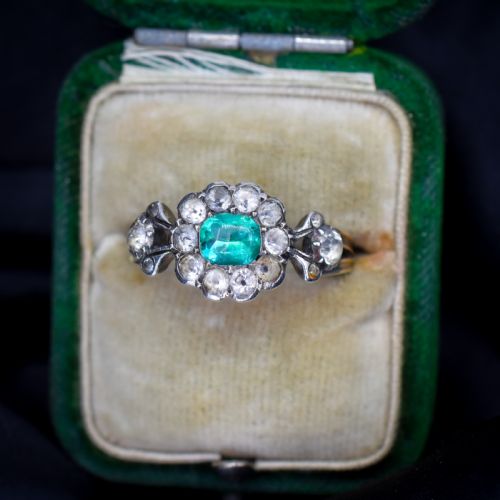
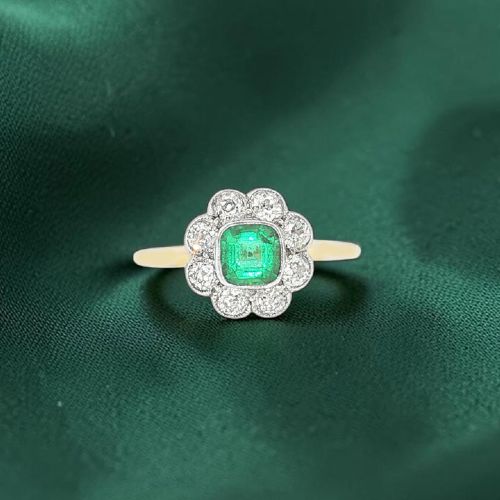


Green Emerald Target Ring
A green emerald target ring centres a vivid green gemstone within concentric tiers of sparkling diamonds, offering the geometric punch every collector desires.
Green Emerald Target Ring
A green emerald target ring presents a central emerald enclosed by a distinct outer border of diamonds, creating a focused concentric pattern that draws the eye directly to the core stone. These geometric layouts appear frequently in Art Deco and Edwardian designs, where symmetry and strong lines dominate.
The selections on this page span several eras, including the nineteenth century, the 1920s, the 1930s, and mid-century decades. Buyers encounter both circular target arrangements and rectangular cluster configurations that share the same concentrated visual impact.
Many examples utilise platinum settings to support fine diamonds, whilst others employ yellow gold, white gold, or silver-backed gold. The combination of vivid green emeralds and bright white diamonds defines the classic appearance of these rings.
Materials and construction
Jewellers constructed these rings using durable precious metals such as platinum and eighteen-carat white gold, which provided the necessary strength to hold intricate claw and bezel settings. Yellow gold and silver-backed gold appear in nineteenth-century and early twentieth-century pieces, reflecting the prevailing metallurgical practices of those periods.
Gemstone cutting varied from brilliant-cut and var-cut diamonds to baguette accents surrounding the central emerald. Master craftsmen balanced these stones carefully within tight geometric boundaries to achieve the precise target effect.
Some past owners hid paste gems in fine gold mounts to outwit eighteenth-century highwaymen.
Factors determining quality
The quality of a green emerald target ring rests upon the saturation and clarity of the central emerald, alongside the brilliance and match of the surrounding diamonds. Colombian and Zambian origins often distinguish higher-grade emeralds, whilst paste substitutes appear in alternative pieces.
Metalwork execution separates standard examples from exceptional items, particularly in the precision of the milgrain edges and the delicacy of the platinum wirework. Original period construction without later alterations commands greater attention from discerning collectors.
The Green Emerald Target Ring Glossary
- Target ring
- A ring featuring a central gemstone encircled by one or more concentric rings of contrasting stones. This layout creates a bullseye visual effect popular during the early twentieth century.
- Cluster ring
- A ring design where a central stone is surrounded by a group of smaller gems. This configuration maximises overall sparkle and presence on the finger.
- Milgrain
- A decorative technique involving tiny raised metal beads along the edges of a setting. It adds a refined texture typical of Edwardian and Art Deco jewellery.
- Paste
- Hand-cut lead glass used as a gemstone substitute in historic jewellery. Fine paste stones display notable brilliance and colour.
Green Emerald Target Ring: Frequently Asked Questions
How do I care for my ring?
Emeralds require gentle cleaning with warm soapy water and a soft brush, avoiding harsh ultrasonic cleaners that can damage the stone.
Store the ring separately in a fabric-lined box to prevent harder diamonds from scratching the softer emerald or the precious metal setting.
Are these rings suitable for daily wear?
Many buyers wear these antique rings daily, provided they remove them during heavy physical labour or gardening.
Platinum and high-carat gold settings offer good durability, but emeralds have natural inclusions that make them sensitive to sharp impacts.
How can I tell the period?
Period identification relies upon examining the metal alloys, stone cuts, and construction techniques visible beneath magnification.
Art Deco pieces often utilise platinum with geometric diamond arrangements, whilst nineteenth-century examples frequently show yellow gold and silver combinations.