






Grand Tour Side Table
These grand tour side table examples bring tactile Italian craftsmanship and mineral colour straight into a reception room.
Grand Tour Side Table
A grand tour side table draws on nineteenth-century travels through Italy, translating classical architecture and mineral specimens into domestic furniture. These pieces serve as centre tables, occasional tables, and low lamp tables within a home.
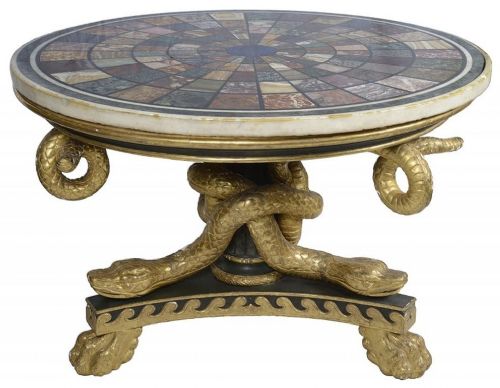
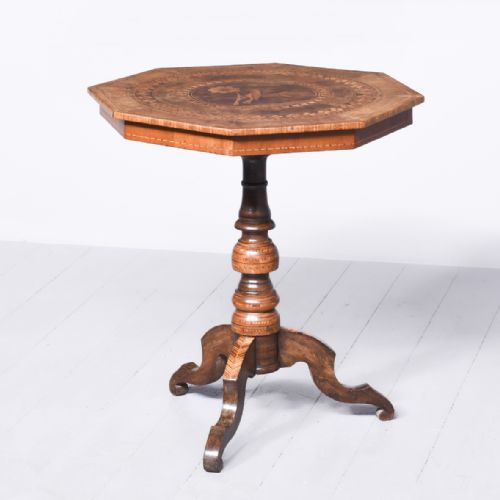
The material vocabulary relies heavily on specimen marble, scagliola, and intricate wood marquetry. Buyers frequently encounter Sorrento ware alongside heavy Italian walnut and ebonised frames.
Origins span the nineteenth century, including Victorian interpretations and Regency examples. Italian workshops dominate the output, particularly through inlaid floral and geometric table tops.
How they were made
Craftsmen shaped durable timbers such as walnut, mahogany, fruitwood, olivewood, and satin birch to form the structural bases and turned pedestals. Tops were frequently constructed from dense local stones or built up from fine timber veneers.
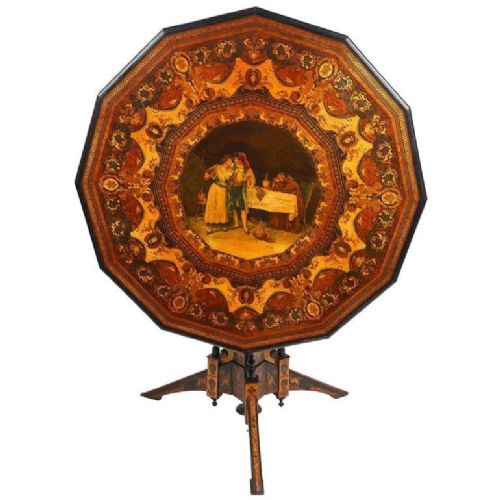
Surface decoration combined intricate marquetry and micro-mosaic techniques with pietra dura and scagliola inlays. Makers arranged coloured marble fragments meticulously to form geometric patterns or pictorial scenes.
Nineteenth-century artisans occasionally turned out tables bearing inlaid depictions of local feathered wildlife alongside geometric marble fields.
What varies in quality
Differentiation lies in the precision of the stone geometry and the complexity of the wood inlay. Tables featuring detailed pietra dura bird motifs or extensive specimen marble selections sit at the higher end of the scale.
Structural integrity of the base timbers and the crispness of the turned walnut columns dictate overall execution. Signed pieces and those retaining rich, varied tonal grains in the olivewood and walnut show superior workshop execution.
Almerico Gargiulo
The Grand Tour Side Table Glossary
- Specimen marble
- A table top composed of numerous small, geometric or triangular sections of different coloured marbles fitted together. This technique creates a varied, mosaic-like surface pattern.
- Sorrento ware
- Woodwork originating from the Italian town of Sorrento, characterised by intricate marquetry and micro-mosaic inlays. Artisans typically depicted local scenes, florals, or geometric designs onto walnut and olivewood.
- Pietra dura
- An artistic technique using cut and fitted polished coloured stones to create pictorial imagery. Masters used hardstones like jasper, chalcedony, and onyx to render birds or landscapes.
- Scagliola
- A composite material made from selenite, glue, and pigments, mimicking true marble. Craftsmen painted and polished this mixture to achieve realistic stone veining at a lower weight.
Grand Tour Side Table: Frequently Asked Questions
How are grand tour side tables structured?
These tables typically feature a solid timber base, often in walnut or ebonised wood, supporting a heavy stone or inlaid wooden top. Many examples utilise a central turned pedestal resting on tripartite or quadrupartite feet.
The tops are designed to showcase the decorative surface, whether through multicoloured stone specimens or precise wood veneers. Joinery prioritises stability to support the considerable weight of the marble tops.
Where should I place a specimen table?
These pieces function effectively as lamp tables, hall tables, or low centre tables in a principal reception room. Their decorative surfaces benefit from placement near natural light sources to reveal the varied grain of the stones and wood.
Ensure the floor surface is level and capable of supporting denser marble or scagliola constructions. Avoid positioning them in direct sunlight to protect sensitive wood veneers and polished finishes.
What defines Sorrento ware furniture?
Sorrento ware refers to wooden items decorated with fine marquetry and pictorial inlay originating from southern Italy. Makers utilised local timbers like walnut, olivewood, and satin birch to create contrasting geometric and floral designs.
These surfaces often display remarkable depth through the natural colour variations of the woods used. Such tables were frequently purchased by nineteenth-century travellers as portable souvenirs of their journey.
How do I distinguish scagliola from marble?
Scagliola feels slightly warmer to the touch than natural stone because it is a plaster-based composite material. Closer inspection under magnification may reveal tiny binder matrices rather than crystalline mineral structures.
Makers employed scagliola to replicate expensive marbles while reducing the overall weight of large centre tables. Both materials received high-gloss polishes to achieve a reflective, luxurious finish.