



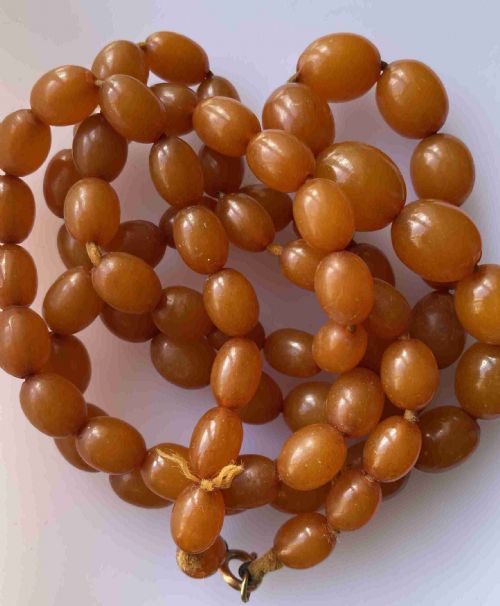


Graduated Bead Strand
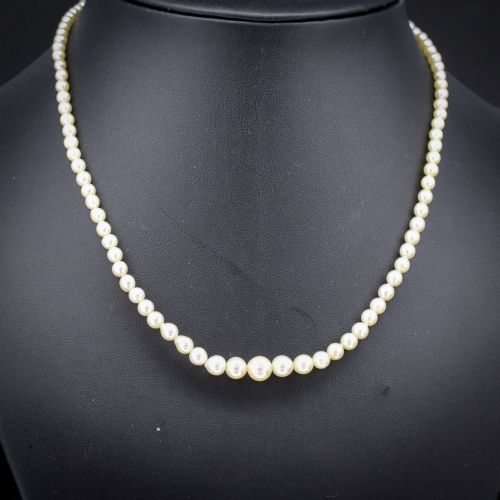
A graduated bead strand carries size variation down the neck, bringing proportion and rhythm to antique amber, coral, and pearl necklaces.
Graduated Bead Strand
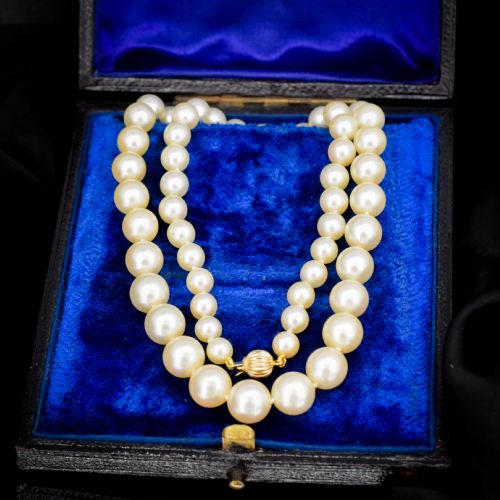
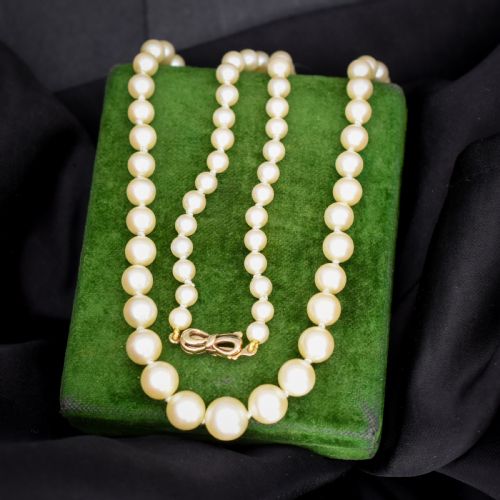
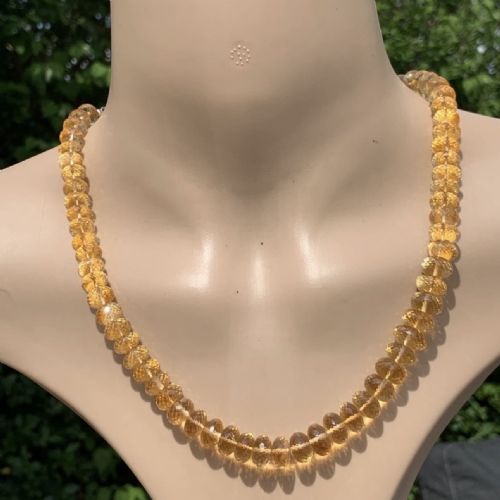
A graduated bead strand arranges individual ornaments from small to large towards the centre, creating a balanced silhouette along the collarbone. These pieces span from Victorian coral and Whitby jet through Edwardian amber to Art Deco pearls and mid-century synthetic resins.
Necklaces dominate the selection, appearing with clasps in 9ct gold, 18ct white gold, and silver, alongside strung lengths secured on silk thread or cord. The proportions shift from shorter sixteen-inch collars to longer twenty-nine-inch strands, accommodating different periods of dress.
Victorian and Edwardian examples lean towards organic materials like natural pink coral, un-dyed red coral, and hand-carved Whitby jet. Later twentieth-century variations introduce Bakelite, phenolic resin, and cultured pearls alongside traditional gold barrels.
How they were made
Materials dictate the construction, utilising natural substances such as pearl, amber, coral, and Whitby jet alongside early plastics like Bakelite and phenolic resin. Metal components employ 9ct and 18ct gold or silver for clasps and barrels.
Stringing relies on silk thread or cord to link the elements, allowing the strand to drape naturally around the neck. Beads are individually shaped, carved, or faceted before being graded by size and arranged sequentially.
Graduated Bead Strand Retail Price Guide 2026
Typical asking prices for graduated bead strand among the pieces listed under this phrase on Sellingantiques today, from the lower quarter to the upper quarter. They describe what is for sale here now, not the wider market.
Some twenty-eight-inch amber strands tip the scales at a hefty eighty grams, demanding a sturdy collarbone.
What varies in quality
The precision of the grading determines the visual harmony of the strand, where a smooth transition from the smallest terminal beads to the largest central ornament separates finer work from random assembly. Uniformity in the material, whether matching the rich tones of Baltic amber or the lustre of pearls, defines the upper tier.
The choice of securing mechanism influences overall integrity, with solid gold or silver clasps and secure silk threading marking higher-grade construction compared to basic cord. Carving depth and surface finish on materials like Whitby jet or natural coral further distinguish superior examples.
The Graduated Bead Strand Glossary
- Graduation
- The deliberate scaling of bead dimensions from small to large towards the centre of a necklace. This creates a balanced visual weight and sits comfortably against the collarbone.
- Bakelite
- An early phenolic resin used for moulded beads in the twentieth century. It offers distinct tactile warmth and dense coloration.
- Cultured pearl
- An oyster-produced pearl grown with human intervention rather than entirely by chance. These form the lustrous centrepieces of many twentieth-century strands.
- Whitby jet
- A hard, fossilised wood found in Yorkshire and carved into dark mourning jewellery. It takes a high, deep polish.
Graduated Bead Strand: Frequently Asked Questions
How do I wear a long bead strand?
Longer strands, such as twenty-nine-inch amber or coral pieces, can be worn as a single sweeping length or doubled over the collar. The graduated scaling remains visible regardless of how the necklace is draped.
Pairing these with simpler necklines allows the natural variation in bead size and material tone to take focus without visual clutter.
What materials are common in these necklaces?
The selection encompasses organic substances like coral, amber, Whitby jet, and pearls, alongside early plastics such as Bakelite. Metal elements appear primarily in gold and silver clasps.
Each material brings a distinct weight and surface texture, from the deep polish of jet to the warm touch of amber.
How can I tell Victorian pieces apart?
Victorian examples frequently utilise materials associated with mourning or natural specimens, such as hand-carved Whitby jet and un-dyed red coral. These often feature simple cord or early metal findings.
Later Edwardian and Art Deco pieces shift towards symmetrical cultured pearls and precision-graded amber or phenolic resin.
Are these necklaces re-strung?
Many older pieces utilise silk thread or cord that benefits from periodic maintenance to ensure the stringing remains secure. Checking the flexibility between beads indicates whether the internal thread is holding firm.
Original silk adds historic context, but stable modern cord protects heavier amber and coral beads from loss.