


Gothic Trestle Dining Table
A gothic trestle dining table brings severe ecclesiastical lines and sturdy timber into a modern interior.
Gothic Trestle Dining Table
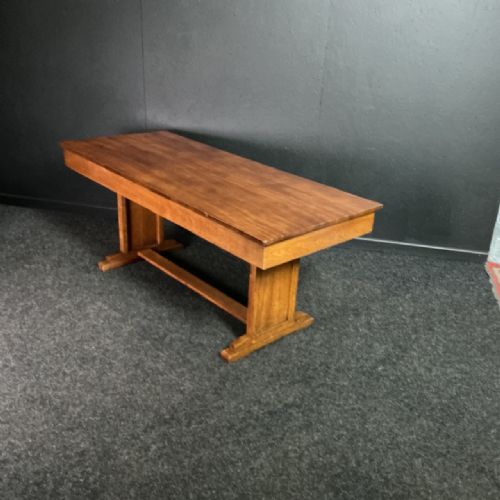
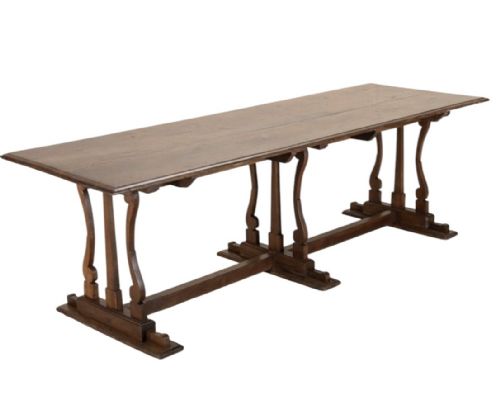
A gothic trestle dining table is a substantial wooden board supported by heavy upright ends or trestles, built to seat large numbers for communal meals. When you search for a gothic trestle dining table, you find pieces rooted in medieval refectory forms adapted during the nineteenth and early twentieth centuries.
The examples on this page span the Victorian era, the Arts and Crafts movement, and the early twentieth century, reflecting revivals of Gothic, Jacobean, and Flemish Renaissance styles. You meet oak most often, alongside walnut, mahogany, and pitch pine, shaped into library tables, refectory tables, and abbey tables.
Makers drew on historic monastery and public school furniture to create monumental dining tables. These forms bridge kitchen utility and formal reception spaces, carrying deep overhangs and architectural undercarriages.
Assessing Quality and Execution
Quality rests in the selection of timber and the integrity of the joinery rather than surface ornamentation alone. Superior pieces utilise thick, single-board top planks and heavy, stable trestle bases that resist warping over time.
Carving depth and sharpness separate standard production from exceptional examples, with master craftsmen delivering crisply undercut tracery and balanced proportions. The handling of edge profiles and the fit of pegged joints reveal the underlying skill of the workshop.
Listings feature oak predominantly, supported by walnut, pitch pine, and mahogany across nineteenth and early twentieth-century periods.
Sir Robert Lorimer·Pugin
The Gothic Trestle Dining Table Glossary
- Refectory table
- A long, narrow dining table originally used in monastic dining halls. These pieces evolved into domestic centrepieces during various architectural revivals.
- Trestle
- A structural support consisting of a horizontal beam fixed to two splayed legs. This arrangement maximises legroom along the length of the table.
- Gothic Revival
- An architectural and decorative style that draws inspiration from medieval design. It employs pointed arches, heavy mouldings, and ecclesiastical motifs.
- Mortise and tenon
- A primary joint where a projecting tongue fits snugly into a matching cavity. Pegs are often driven through the joint to lock the timbers firmly together.
- Green Man
- A sculptural motif depicting a human face emerging from or entwined with foliage. It symbolises rebirth and appears frequently in carved architectural woodwork.
Gothic Trestle Dining Table: Frequently Asked Questions
How do I seat people around trestle legs?
Trestle supports sit inward from the ends of the top board, which naturally creates unobstructed legroom along the entire length of the table. Benches or long forms fit easily beneath the overhang.
Dinners run smoothly because diners can slide along benches without navigating corner table legs.
Are these tables suitable for everyday family dining?
Solid oak and walnut construction handles daily use and heavy weights without difficulty. The dense hardwoods shrug off normal knocks from plates and cutlery.
A simple wax finish protects the timber while allowing easy cleaning after meals.
How do I tell a Victorian gothic table from an older one?
Nineteenth-century revival pieces often display machine-sawn timber marks on hidden undersides alongside traditional hand-carved surfaces. The proportions tend to match nineteenth-century room scales rather than medieval dimensions.
Examining the underside and joint pegging reveals the technological footprint of the Victorian workshop.
What is the difference between a refectory and a trestle table?
A refectory table generally uses four or six upright legs connected by low stretchers, while a trestle table relies on two end supports connected by a central beam. Both forms served similar communal dining functions in historic settings.
Makers frequently combined the terms in nineteenth-century listings to describe long, narrow dining formats.