


Gothic Revival Trestle Desk
These gothic revival trestle desk pieces combine sturdy architectural forms with practical writing surfaces, offering solid historic character for any study or library.

Gothic Revival Trestle Desk
A gothic revival trestle desk is a functional writing surface shaped by medieval architectural forms, frequently taking the form of library tables, writing tables, and writing desks from the nineteenth century. These items emerge from periods including the Victorian era, alongside later examples stretching into the early twentieth century.
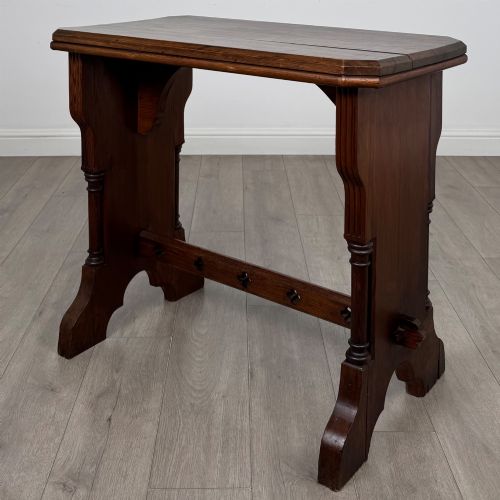
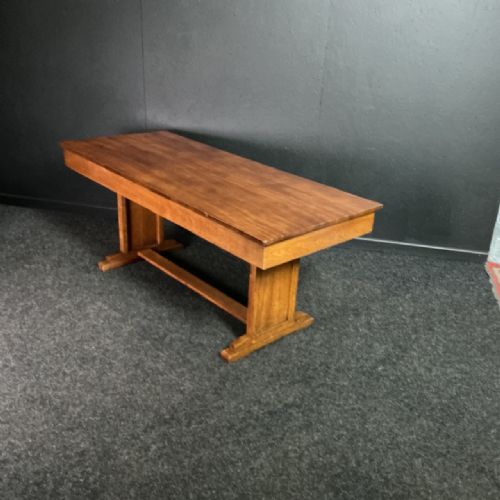
The versions most commonly met on this page are constructed in pitch pine or oak, often following ecclesiastical or institutional designs. You will encounter pieces ranging from narrow freestanding tables to substantial writing desks bearing distinct X frame or trestle supports.
How they were made
Carpenters relied on robust timbers such as pitch pine, oak, and walnut, often pairing heavy wooden frames with inset leather writing surfaces. Construction methods prioritized stability and durability, utilising sturdy trestle bases and X frame supports suited for heavy institutional or public school use.
Surface treatments included ebonised wood finishes and natural timber grains that highlighted the structural honesty favoured by Victorian Gothic and Arts and Crafts makers. Joinery was built to last, anchoring substantial tops to heavy panelled or framed legs.
Styles include Victorian Gothic, Arts and Crafts, and standard Victorian designs applied to functional writing and hall tables.
What varies in quality
Quality rests in the architectural ambition of the timber framing and the integrity of the original materials, distinguishing straightforward utilitarian benches from distinguished designer commissions. Finer items display thoughtful proportion in their trestle supports and sophisticated application of Gothic ornament.
The choice of primary timber shifts the character of the piece, with dense oak and figured walnut holding a different presence compared to simpler pitch pine. Intact leather inserts and well-preserved original surfaces elevate an example above heavily altered or stripped pieces.
Charles Bevan·Gillows·Pugin
The Gothic Revival Trestle Desk Glossary
- Trestle
- A structural support consisting of a horizontal beam fixed to two splayed legs, providing sturdy stability for heavy writing tables. This form underpins many medieval and Gothic revival designs.
- Pitch Pine
- A durable resinous softwood widely utilised in Victorian and ecclesiastical furniture making for its strength and distinct grain pattern. It forms the basis of numerous side and writing tables on this page.
- Ebonised Wood
- Timber treated with a chemical stain or finish to simulate expensive ebony, popular for dramatic contrast in nineteenth-century decorative schemes. It lends a sharp, dark edge to Gothic detailing.
- X Frame
- A stretcher or leg configuration forming an intersecting cross shape beneath the table top, enhancing lateral rigidity. This configuration defines several of the historical trestle tables listed here.
- Ecclesiastical
- A style drawing directly from church architecture and furnishings, featuring pointed arches and heavy framing. Many school library and writing tables adopt these solemn architectural motifs.
Gothic Revival Trestle Desk: Frequently Asked Questions
Where were these desks originally used?
These pieces served primarily in institutional settings such as public school libraries, ecclesiastical offices, and substantial Victorian residences. Their robust construction was designed to withstand heavy daily use.
Over time, many of these sturdy surfaces transitioned into private studies and domestic libraries, where their architectural presence added character to the room.
How do I care for the leather top?
Leather writing surfaces benefit from gentle cleaning with a slightly damp cloth followed by a neutral leather cream to keep the material supple. Avoid harsh chemical cleaners that can strip the historic dye.
Keeping the desk away from direct sunlight and extreme radiator heat prevents the leather from drying out and cracking across the writing area.
Are these tables suitable for daily computer work?
The generous proportions of many library and writing tables provide ample room for modern monitors and keyboards while maintaining historic charm. Their solid timber construction easily supports office equipment.
Checking the knee clearance beneath the trestle frame ensures your seating arrangement fits comfortably with the specific crossbeams of the chosen desk.
How do I distinguish Victorian Gothic from Arts and Crafts?
Victorian Gothic examples tend to lean heavily into formal medieval ecclesiastical motifs, pointed arches, and sharp geometric carvings. They often employ heavier mouldings and dark ebonised accents.
Arts and Crafts pieces emphasise visible construction methods and simpler, honest joinery with less applied ornament, reflecting a shift towards straightforward utility in later decades.