


Gothic Revival Refectory Table
These heavy timber tables bring unmistakable medieval character to a modern room.
Gothic Revival Refectory Table
A gothic revival refectory table combines the long, narrow proportions of traditional monastic dining furniture with architectural details borrowed from medieval stone buildings. These pieces appear in forms ranging from substantial eighteen-foot dining boards to compact library tables, country kitchen tables, and serving consoles.
The material record for a gothic revival refectory table heavily favours solid oak, though examples also surface in mahogany, sometimes accompanied by brass hardware or matching benches. Dating spans the nineteenth century through the early twentieth century, taking in Victorian, Arts and Crafts, and Flemish Renaissance revival movements.
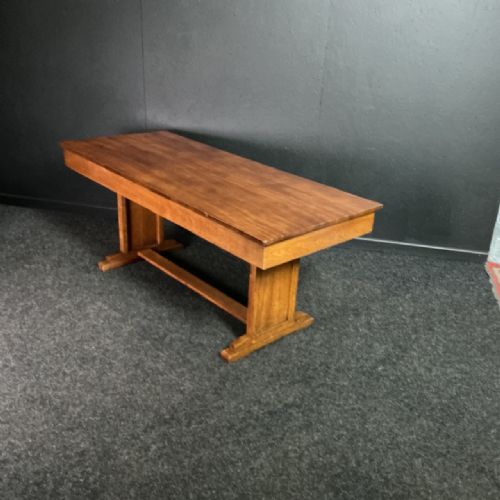
Buyers encounter heavy trestle tables, pieces with drawers, and specialised forms such as ships gallery tables or public school library tables. The overarching aesthetic draws directly upon the architectural vocabulary popularized by designers like Pugin and Lorimer.
How they were made
Makers constructed a gothic revival refectory table primarily from solid oak, utilising thick plank tops secured to sturdy underframes and trestle supports. Mahogany also appears among the available timber choices for these long dining surfaces.
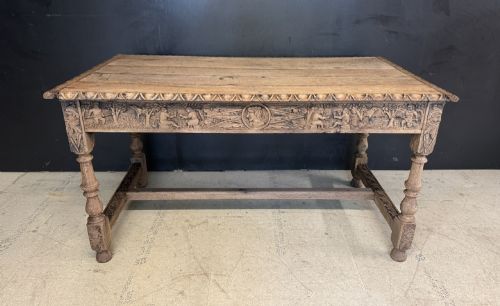
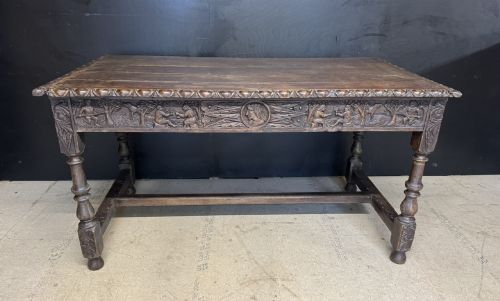
Carpenters applied deep hand carving to decorate the friezes, legs, and aprons with motifs such as the Green Man and Gothic tracery. Drawer construction and heavy jointing ensured the tables could withstand the daily demands of public school, monastery, and country house dining.
Keep an eye out for the leafy grin of the Green Man hiding amongst the carved oak tracery.
What varies in quality
The distinction between ordinary and exceptional pieces lies in the depth and crispness of the timber carving, particularly on the friezes and underframes. Tables featuring architectural details executed with sharp, confident chisel work command greater appreciation than those with shallow or mechanical decoration.
Timber selection and structural proportion dictate the presence of the piece in a room, with dense, figured oak and well-balanced plank tops representing the upper tier of the range. Proportion and the integrity of the original underframe separate utilitarian workshop output from master-designed commissions.
Sir Robert Lorimer
The Gothic Revival Refectory Table Glossary
- Refectory table
- A long, narrow dining table originally designed for monastic dining halls. These pieces provide generous surface area while maintaining a narrow profile suitable for domestic dining rooms.
- Green Man
- A sculptural motif depicting a human face disgorged from foliage or surrounded by leaves. This ancient symbol frequently decorates the carved wooden panels and friezes of nineteenth-century revival furniture.
- Trestle table
- A table supported by two or more vertical frames connected by a horizontal beam or stretcher. This structural arrangement offers stability and maximises legroom along the length of the board.
- Plank top
- A table surface constructed from wide boards running the full length of the piece. Traditional examples showcase the natural grain and growth rings of solid timber.
- Arts and Crafts
- A design movement valuing handcraftsmanship, traditional materials, and simple utility over mass production. Furniture from this tradition emphasises honest construction and visible joinery.
Gothic Revival Refectory Table: Frequently Asked Questions
How do I seat people comfortably around a refectory table?
The narrow proportions of these long boards allow diners to sit close together along both sides without excessive reaching across the centre. Trestle bases and recessed underframes help maximise legroom.
Benches often accompany these tables, reflecting historical dining arrangements and allowing flexible seating capacity for larger gatherings.
What is the difference between a refectory table and a standard dining table?
Refectory tables are traditionally much longer and narrower than standard dining tables, originating from communal eating halls where space efficiency and shared seating were paramount. Their substantial underframes and trestle supports distinguish them from four-legged domestic tables.
Heavy timber construction and architectural detailing further separate these pieces from ordinary dining furniture.
How do I care for an antique oak table top?
Solid oak surfaces respond best to regular dusting with a dry cloth and occasional treatment with quality bees-wax to nourish the timber. Avoid placing hot dishes or liquids directly onto the wood to protect the historic finish.
Keeping the table away from direct heat sources prevents the timber planks from drying out and splitting over time.
How do I distinguish nineteenth-century revival from earlier oak tables?
Nineteenth-century gothic revival pieces often display machine-assisted saw marks alongside hand carving, combined with standardised fixings and distinctive revival hardware. Stylistic details frequently mix Gothic, Renaissance, and Arts and Crafts motifs in a single piece.
Examining the underside, drawer linings, and joint construction reveals the manufacturing methods characteristic of the Victorian era.