



Gothic Brass Lighting Pair
A gothic brass lighting pair brings medieval architectural weight and ecclesiastical solemnity directly into a room through rich metalwork.
Gothic Brass Lighting Pair
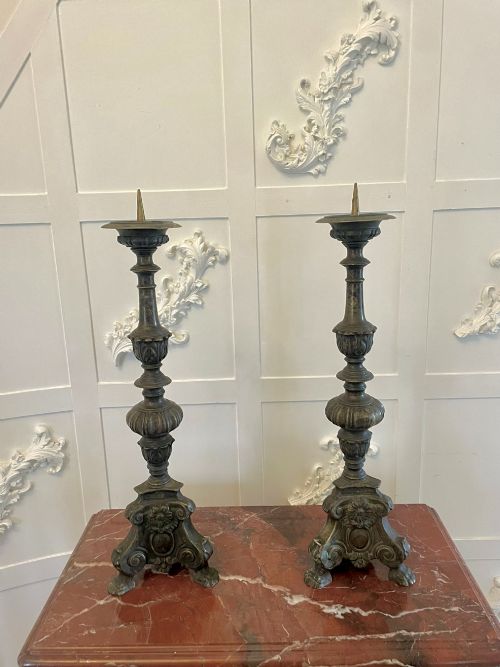
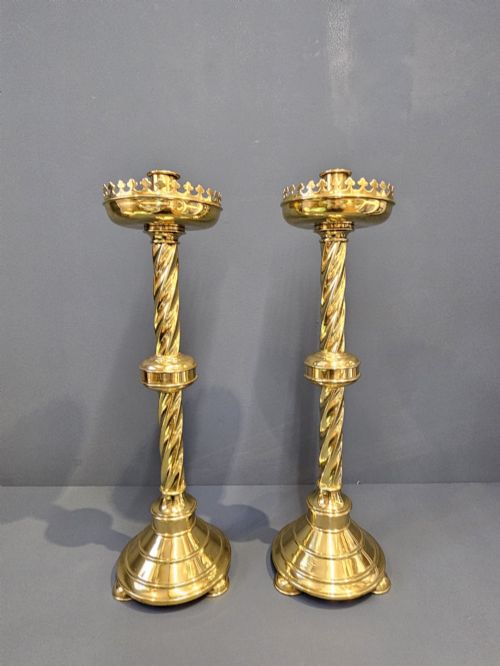
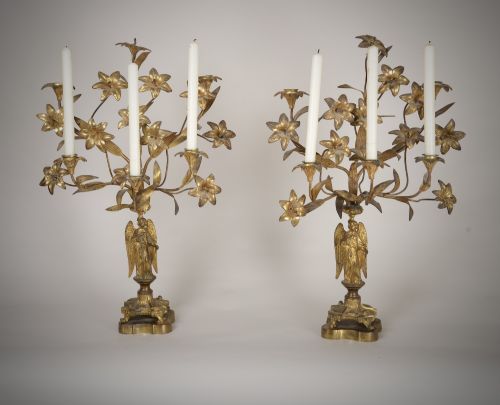
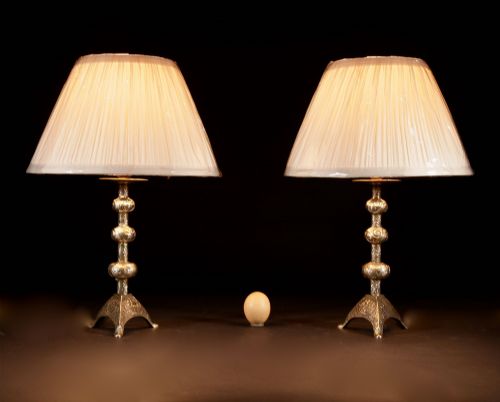
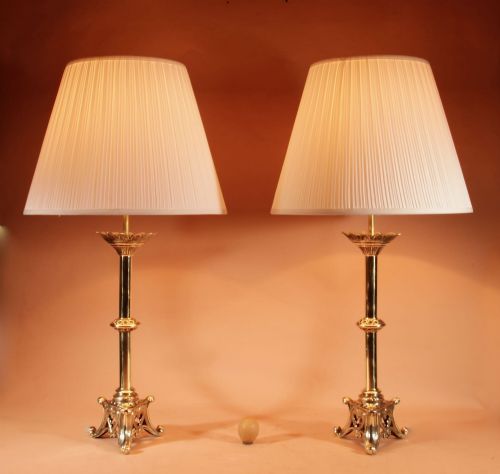
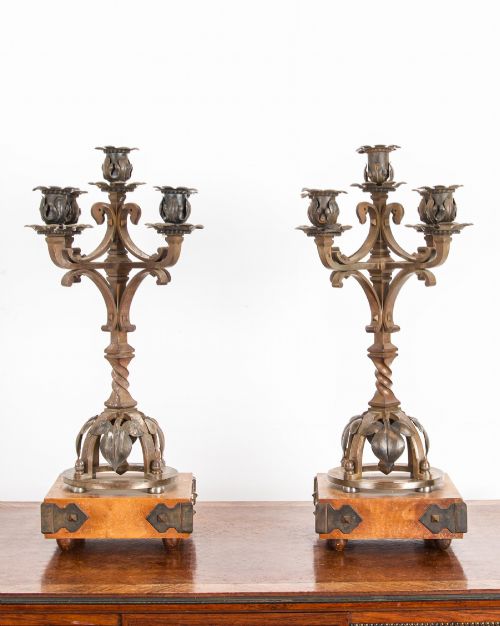
A gothic brass lighting pair consists of dual matching metal fixtures designed for candles or wired for electricity, drawing heavily on medieval church architecture and ornamentation. These pieces range from tall altar sticks and pricket forms to multi-branch candelabra, wall sconces, and table lamps.
The version most commonly encountered on this page is the Victorian church or altar candlestick, often produced in heavy cast brass during the nineteenth century. Alongside these ecclesiastical survivals, collectors find domestic variants crossing into Arts and Crafts, Romanesque Revival, and Amsterdam School aesthetics.
Origins span British workshops of the Victorian era through to early twentieth-century continental production, maintaining a steadfast devotion to pointed arches, quatrefoils, and heraldic motifs. Whether adapted into lamps or retaining their original pricket spikes, these pairs serve as sculptural focal points rooted in revivalist historicism.
How they were made
Makers relied primarily on brass, cast brass, and bronze, utilising sand-casting techniques to achieve the substantial weight and intricate relief work characteristic of the style. Molten metal poured into detailed moulds created the heavy bases, knopped stems, and drip pans, which workers then finished by hand with chisels and files.
Secondary materials such as wrought iron, copper, fabric, and occasional ormolu or gilt finishes appear to accent specific components like pricket spikes or bobeches. Structural joins were typically threaded, bolted, or pegged together mechanically rather than welded, allowing complex multi-tier candelabra to be assembled from distinct cast segments.
Listings feature periods spanning the Victorian era, the nineteenth century, and the early twentieth century up to the 1930s.
What varies in quality
Quality rests significantly on the crispness of the casting and the depth of the chased detailing on stems and bases. Superior examples exhibit sharply defined architectural tracery and clean relief work, whereas lesser pieces show softened edges where worn moulds have dulled the ornamentation.
The choice of materials and metal gauge also dictates the standing of a piece, with heavy gauge solid brass and bronze commanding greater presence than thinner pressed components. Furthermore, the integrity of the original construction - such as stable multi-tiered assemblies and well-balanced proportions - separates mass-produced commercial foundry work from finer ecclesiastical commissions.
Wm. Tonks & Sons·Dr Christopher Dresser·T Thomason & Co
The Gothic Brass Lighting Pair Glossary
- Pricket
- A sharp metal spike on a candlestick designed to pierce the base of a candle and hold it upright. This form predominates in church and altar lighting.
- Candelabra
- A branched lighting fixture holding multiple candles or lamp fittings on separate arms. These pieces often feature central shafts flanked by symmetrical scrolls.
- Ecclesiastical
- Pertaining to the Christian church and its clergy, describing items originally commissioned for liturgical use in chapels and cathedrals. Such objects generally display heavier construction and overtly religious motifs.
- Bobeche
- A small collar or disc fitted below the candle nozzle to catch dripping wax. In antique pieces, this component is frequently cast as an integral part of the drip pan.
- Knoop
- A decorative swelling or knob on the stem of a candlestick, providing both visual punctuation and a secure grip. These nodes often take bulbous, faceted, or compressed spherical forms.
Gothic Brass Lighting Pair: Frequently Asked Questions
What is a gothic brass lighting pair?
A gothic brass lighting pair comprises two matched metal fixtures inspired by medieval architecture, featuring elements like pointed arches, quatrefoils, and heavy turned stems. These objects were predominantly created as church altar pieces or domestic revival items during the nineteenth and early twentieth centuries.
Today, collectors encounter them in various formats including pricket sticks, branched candelabra, and table lamps. Their robust construction and dark patinated metal surfaces lend an architectural gravity to interiors.
Were these originally for candles or electricity?
The vast majority of these pieces were manufactured strictly for wax candles, often utilising sharp prickets or sockets to secure the tapers during services or evening gatherings. Many surviving pairs have since been professionally adapted into table lamps or wall lights with internal wiring.
When evaluating a pair, check whether the original candle cups and prickets remain intact or if modifications were made later. Unconverted pieces retain their authentic liturgical or domestic function, while wired examples offer practical illumination.
How do I date a gothic brass lighting pair?
Dating relies heavily on stylistic markers, construction methods, and the specific revival movement indicated by the design. Pieces marked as Victorian or associated with the Arts and Crafts movement generally date from the mid-nineteenth to the early twentieth century.
Examining the casting seams, fastener types, and surface patination helps narrow the decade of production. Documentation or stamped foundry marks, when present, provide the most direct confirmation of age.
How do I clean antique brass?
Antique brass is best maintained with minimal intervention, preserving the dark patination and age-acquired surfaces that collectors value. Avoid harsh chemical polishes that strip away historical depth and leave an overly bright, unnatural finish.
Gentle dusting with a soft, dry cloth is usually sufficient for routine care. If cleaning is necessary, consult a specialist to ensure the historic metalwork is not compromised.
How do I style these in a modern home?
These pieces work effectively as symmetrical focal points on mantelpieces, sideboards, or large dining tables. Their dark metallic tones and vertical lines complement natural wood, stone, and rich textiles.
Whether left as sculptural candlesticks or wired for ambient lighting, they introduce historical character and architectural structure to contemporary or traditional spaces alike.