
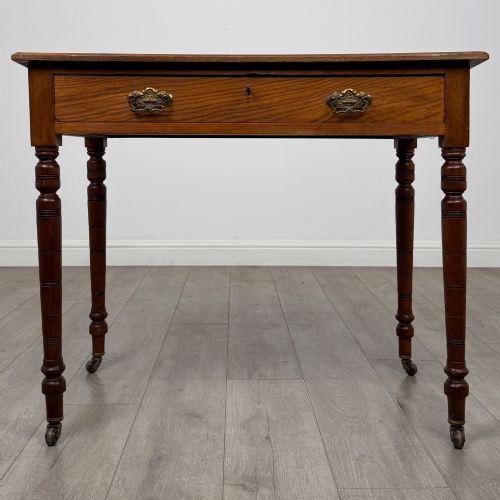
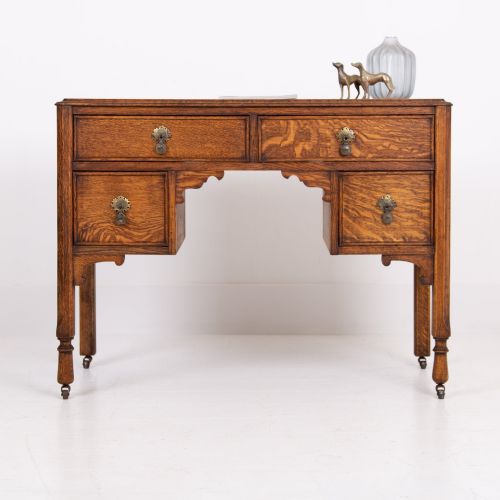
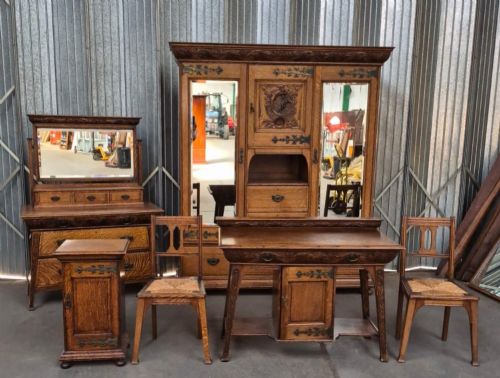
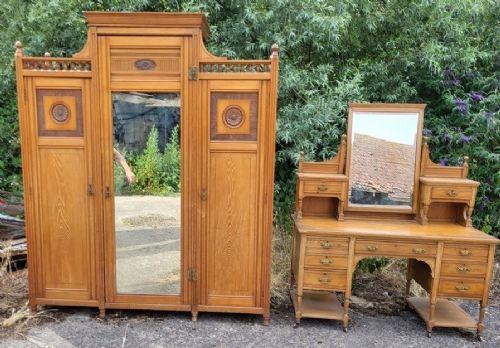
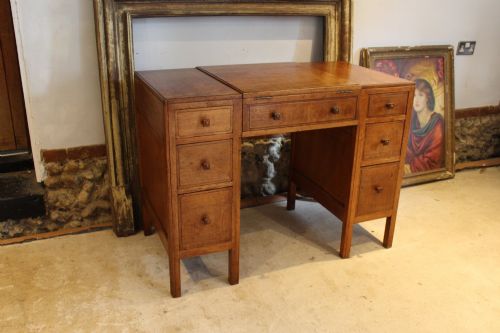
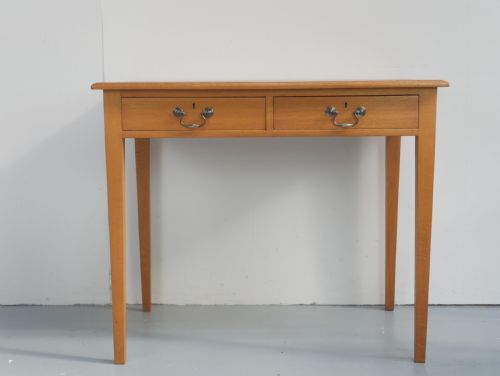


Golden Oak Dressing Table
A golden oak dressing table brings warm timber tones and period craftsmanship directly into the bedroom.
Golden Oak Dressing Table
The objects listed on this page span several decades, featuring Arts and Crafts movement designs alongside streamlined Art Deco pieces. Makers utilise light honeyed oak tones, burr oak panels, and contrasting wood inlay to create functional bedroom centrepieces.
Many variations exist within the selection, from standard pedestal dressing tables to dressing chests of drawers fitted with glass mirrors. These pieces often form part of larger bedroom suites that include wardrobes and writing tables.
Materials and construction techniques
Makers construct these items primarily from solid oak and burr oak, occasionally incorporating ash for internal framing or secondary elements. Brass and iron hardware provides structural support and handles, while rush seating and glass components appear on related suite items.
Craftsmen apply traditional joinery methods alongside decorative wood inlay and marquetry techniques, particularly on Arts and Crafts and Art Deco pieces. The natural grain of the timber receives careful finishing to highlight the warm golden hue characteristic of the period.
Several pieces arrive paired with matching rush-seated chairs, proving that eighteenth-century comfort priorities occasionally involved woven wetland grasses.
Judging the quality of period pieces
Quality rests on the integrity of the timber selection, such as the use of figured burr oak, and the precision of decorative wood inlay. Finer examples display thoughtful proportions and considered integration of brass or iron fixtures.
Attribution to known workshops or retail houses elevates the standing of a dressing table. Pieces demonstrating distinctive Arts and Crafts or Art Deco styling show superior design ambition compared to standard utilitarian production.
Shapland & Petter·Heal & Sons·George Walton·B Cohen & Sons·Arnott & Co
The Golden Oak Dressing Table Glossary
- Burr oak
- A timber growth that produces highly figured, swirling patterns in the wood grain. Furniture makers select these panels for decorative impact on drawer fronts and cabinet doors.
- Arts and Crafts
- A design movement prioritising handcraftsmanship and simple forms over mass production. Pieces from this style often feature exposed joinery and subtle artistic details.
- Marquetry
- The art of applying pieces of veneer to a structure to form decorative patterns. Craftsmen utilise different wood species to create geometric or pictorial designs.
- Dressing chest
- A lower form of furniture combining drawers with a fixed or pivoting mirror. This term frequently appears interchangeably with dressing table in period listings.
Golden Oak Dressing Table: Frequently Asked Questions
What periods do these dressing tables come from?
The available selection spans the late nineteenth century through the Victorian era into the Edwardian period, with later examples extending into the nineteen-twenties and nineteen-thirties. Arts and Crafts and Art Deco stylistic influences appear prominently across these decades.
Buyers encounter both standalone tables and pieces that originally formed part of larger multi-item bedroom suites. Each era brings distinct hardware choices and decorative treatments to the oak timber.
How do I incorporate a golden oak dressing table at home?
These pieces serve well as functional bedroom furnishings or as statement writing tables and console desks in other living spaces. The warm golden tones of the timber complement both traditional interiors and modern minimalist settings.
Pairing the dressing table with period seating or placing it alongside complementary oak furniture unifies the room design. The built-in mirrors and storage drawers provide practical everyday utility.
Are these dressing tables part of larger bedroom suites?
Several pieces originate from multi-piece bedroom suites that include matching wardrobes, washstands, and pedestals. These comprehensive suites reflect coordinated interior furnishing choices from the late Victorian and Edwardian periods.
Individual dressing tables also appear independently from makers who retailed furniture directly to households. Both standalone items and suite components share the same foundational oak construction.
How do I distinguish between Arts and Crafts and Art Deco styles?
Arts and Crafts pieces emphasise honest construction, visible joinery, and natural materials with simple, sturdy lines. They often date from the late nineteenth or early twentieth century.
Art Deco items introduce geometric patterns, stylised marquetry inlay, and streamlined silhouettes typical of the nineteen-thirties. The hardware and overall proportions reflect the modernising design ethos of the interwar period.