
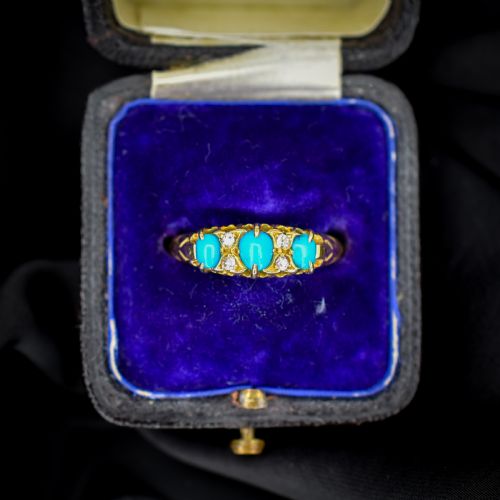
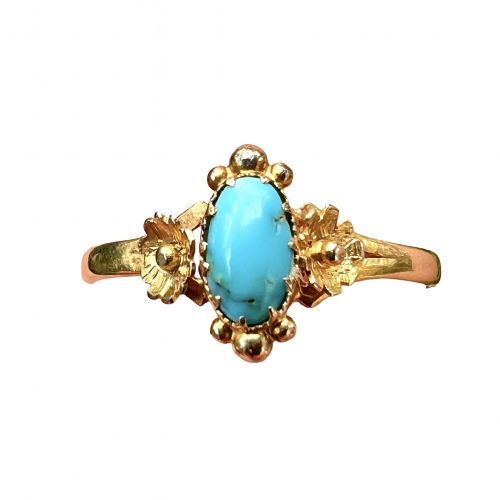


Gold Turquoise Cluster Ring
A gold turquoise cluster ring brings together vivid blue stones and warm yellow or rose gold in a compact, eye-catching design.
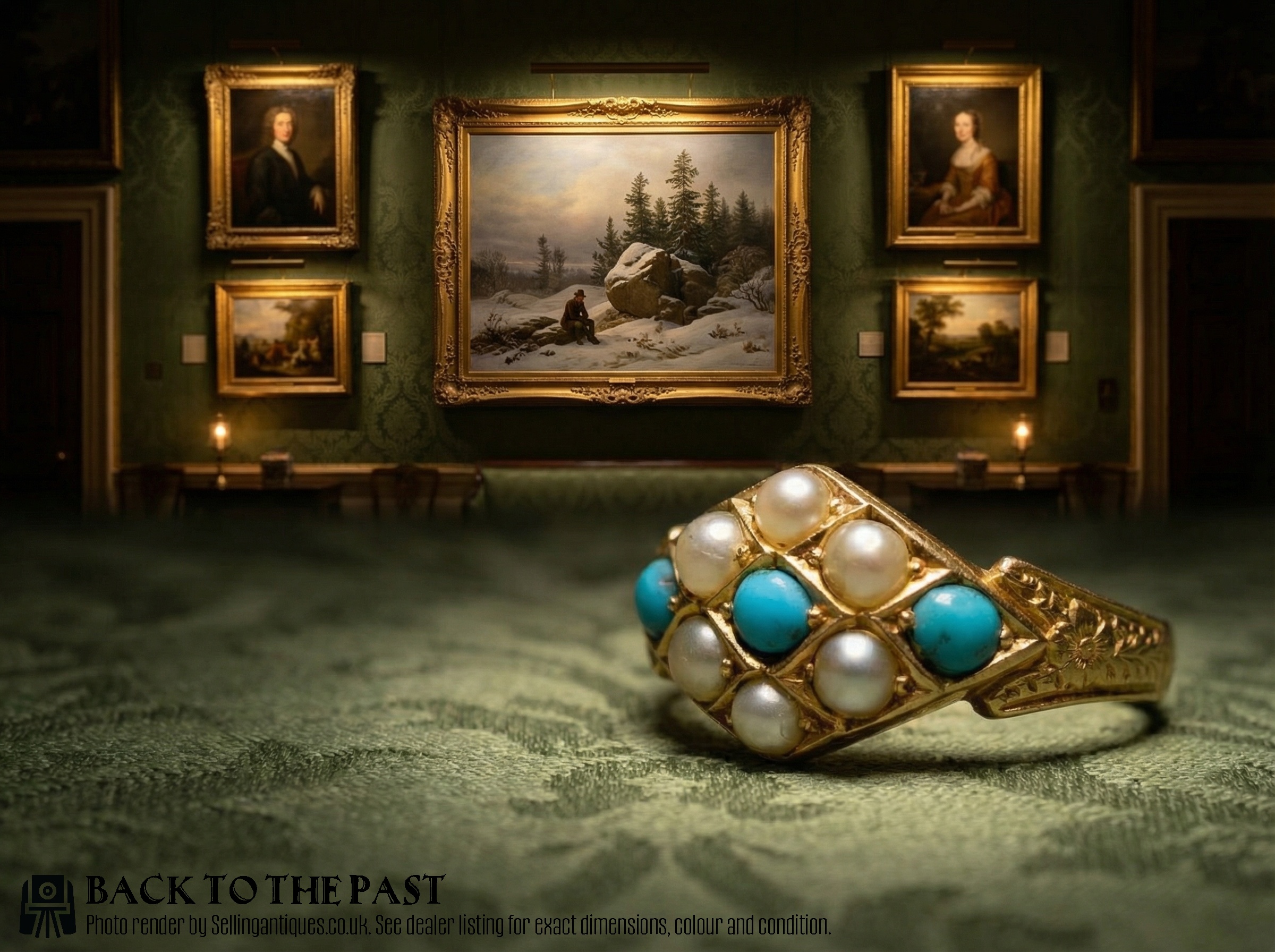
Gold Turquoise Cluster Ring
The most common version met on this page is the Victorian ring, often formed as a flower, star or navette cluster. Alongside individual rings, the selection occasionally encompasses broader groupings or related forms like earrings.
Makers and jewellers from the past utilised various carats of gold, pairing the distinctive robin-egg blue of turquoise with seed pearls or rose-cut diamonds. Buyers searching for a gold turquoise cluster ring encounter both ornate scrollwork designs and simpler, geometric cluster settings.
How they were made
Goldsmiths constructed these rings using differing purities of gold, notably 9ct, 14ct, 15ct and 18ct yellow and rose gold. Metalwork techniques involved casting, hand-forming scroll boat mounts, and fabricating intricate navette or flower clusters to hold the stones securely.
Turquoise cabochons were meticulously set alongside seed pearls or old rose-cut diamonds, often utilising collet or bezel settings. Jewellers balanced the softer turquoise material with sturdier gold frames, sometimes incorporating silver backings in earlier Georgian and Victorian workshops.
Common motifs include floral clusters, starbursts, scroll boats and evil eye designs incorporating pearls and diamonds.
What varies in quality
The overall standard rests heavily on the natural colour uniformity and matrix of the turquoise stones, where an even, unblemished robin-egg blue commands greater appreciation. The grade of the surrounding gold work, from delicate openwork wire to substantial cast shanks, also defines the higher end of the range.
Superior execution shows in the precision of the cluster arrangement and the quality of any accompanying rose-cut diamonds or matched seed pearls. Craftsmanship that preserves the integrity of delicate motifs like flower petals or scroll boat shoulders separates finer examples from standard production.
Julius Cohen
The Gold Turquoise Cluster Ring Glossary
- Cluster ring
- A ring featuring a central stone or group of stones surrounded by a border of smaller gems. This layout maximises visual impact and light reflection.
- Navette
- A boat-shaped or marquise gemstone setting that tapers to points at both ends. It creates an elongated silhouette on the finger.
- Seed pearl
- A very small, natural or cultured pearl used widely in historic cluster designs. These tiny pearls add a soft, luminous border to coloured stones.
- Rose-cut diamond
- An antique diamond cut featuring a flat base and a domed crown with triangular facets. This style produces a gentle, subtle shimmer rather than modern brilliance.
- Cabochon
- A gemstone shaped and polished with a smooth, convex top rather than faceted edges. Turquoise is almost universally cut this way to display its colour.
Gold Turquoise Cluster Ring: Frequently Asked Questions
How do I clean a turquoise ring?
Turquoise is a relatively soft and porous gemstone that absorbs moisture, oils and chemicals easily. Avoid liquid jewellery dips, ultrasonic cleaners and harsh scrubbing.
Instead, wipe the stone gently with a soft, damp cloth after wearing and store the ring away from direct sunlight and cosmetics.
Can I wear my cluster ring daily?
While gold provides a durable band, historic turquoise stones require careful handling due to their lower hardness on the Mohs scale. Daily wear is possible with mindful habits.
Remove the ring before gardening, exercising, swimming or applying hand lotion to protect both the turquoise and any delicate seed pearls.
How do I tell Victorian from Edwardian?
Victorian rings, dating from the nineteenth century, frequently utilise heavier 15ct or 18ct yellow gold and often feature romantic motifs like flowers, hearts and rich scrollwork.
Edwardian pieces from the early twentieth century lean towards lighter 9ct gold, white gold or platinum accents, favouring lacy openwork and brighter diamond pairings.
What does a boat shape mean?
A boat shape, or navette design, refers to an elongated mounting that curves gently across the finger like a hull. This silhouette was popular in the late Victorian era.
It allows a cluster to display multiple rows of turquoise and diamonds without sitting overly high above the band.