
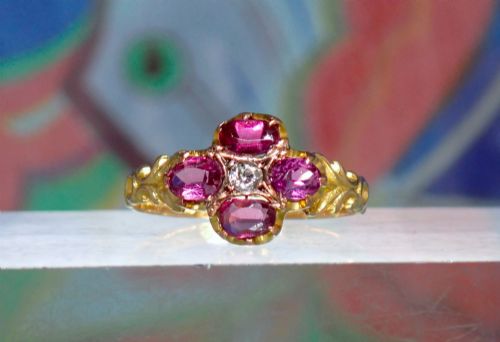


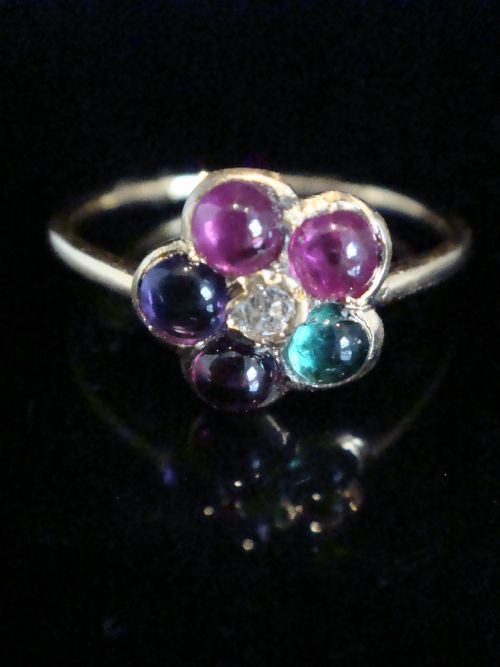
15ct Gold Cluster Ring
A 15ct gold cluster ring gathers gemstones around a central focus, offering distinct historical character and rich colour.
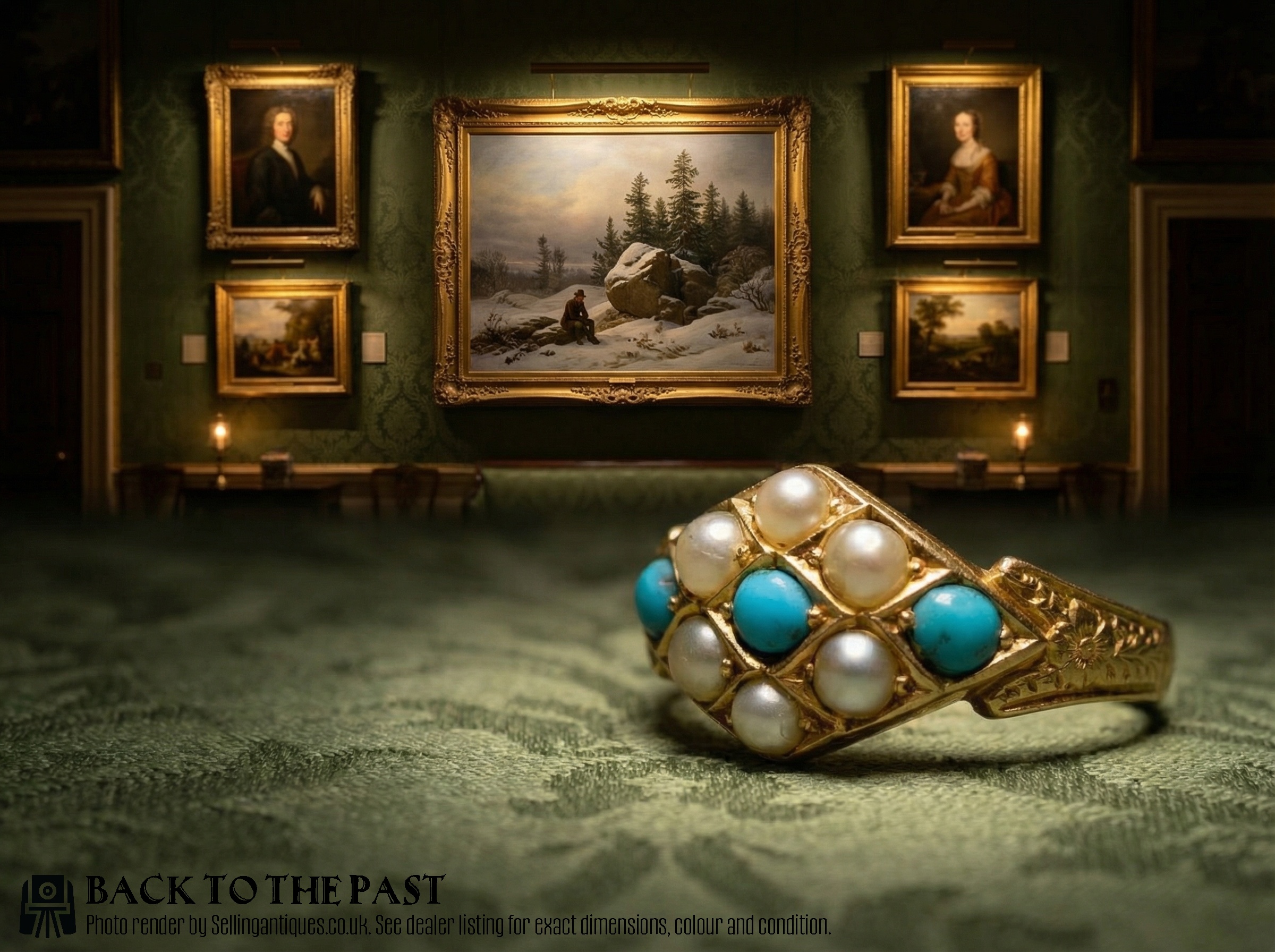
15ct Gold Cluster Ring
A 15ct gold cluster ring brings together central stones framed by smaller gems, defining the look of antique cluster jewellery. The pieces seen here span Georgian, Victorian, Edwardian, and Art Deco periods, capturing shifts in design from delicate floral motifs to geometric arrangements.
Victorian examples dominate the selection, frequently pairing turquoise, pearl, garnet, ruby, or emerald with yellow gold bands. Georgian pieces provide earlier stylistic markers like heart and bow configurations, while Art Deco pieces introduce platinum settings alongside diamonds.
How they were made
Goldsmiths worked with 15ct yellow gold to construct settings that secured varied combinations of almandine garnet, turquoise, split pearl, diamond, ruby, and emerald. Stones were shaped with rose cut or old cut facets, reflecting the hand-working techniques of nineteenth and early twentieth century workshops.
Platinum appears alongside gold in later twentieth century designs to mount diamonds securely. Gemstones are arranged in tight daisy or cluster configurations, demonstrating precise metalwork that maximises visual impact.
Available pieces span Georgian, Victorian, Edwardian, Art Deco, and mid-century eras, reflecting changing decorative tastes.
What varies in quality
The standard of a 15ct gold cluster ring depends on the matching and selection of its gemstones, such as natural pearls, Burmese sapphires, or clean rubies and emeralds. Finer examples display harmonious colour saturation and well-matched stone sizes within the cluster arrangement.
The complexity of the metalwork also differentiates pieces, distinguishing simple bezel settings from intricate floral or heart and bow designs that require advanced hand-crafting skills.
The 15ct Gold Cluster Ring Glossary
- 15ct Gold
- An alloy containing 62.5 percent pure gold, historically characteristic of British jewellery before the standard shifted to 9ct and 18ct.
- Rose Cut
- A historic gemstone cutting style featuring a domed top covered in triangular facets and a flat base.
- Old Cut
- An early precursor to the modern brilliant cut diamond, characterised by a smaller table, higher crown, and hand-shaped facets.
- Split Pearl
- A small natural pearl sliced in half for mounting flush against a gold backing in cluster and floral designs.
- Almandine Garnet
- A deep red variety of garnet frequently utilised in Victorian and Georgian cluster jewellery.
15ct Gold Cluster Ring: Frequently Asked Questions
How do I care for a 15ct gold cluster ring?
Clean these pieces gently with a soft cloth, avoiding harsh chemical dips that can damage softer gems like pearls or turquoise.
Store them separately in a lined box to prevent scratching between the central stones and the surrounding gold or platinum settings.
Are these rings suitable for daily wear?
Victorian and Georgian cluster rings often feature delicate stones such as pearls, turquoise, or opals that require mindful wear to preserve their condition.
Removing the ring during heavy physical tasks protects the antique settings and softer gems from accidental impact.
How can I tell a Victorian cluster ring from a Georgian one?
Georgian pieces often utilise closed-back settings that trap foil behind gemstones to enhance their colour and brilliance under candlelight.
Victorian examples typically employ open-back settings and frequently incorporate floral or daisy motifs alongside bright yellow gold bands.
What does a REGARD cluster ring mean?
A REGARD ring spells out a sentimental acrostic using the first letter of each gemstone: Ruby, Emerald, Garnet, Amethyst, Ruby, and Diamond.
These nineteenth century tokens conveyed affectionate messages through the deliberate selection of coloured stones.