



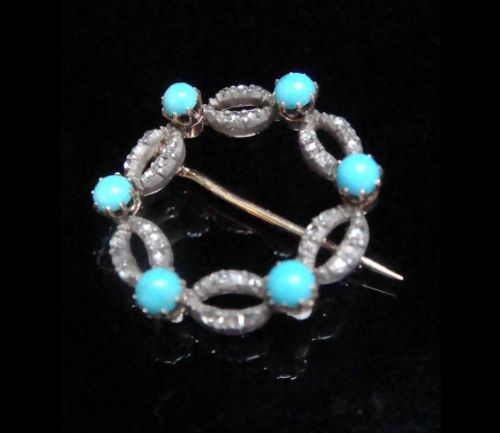


Silver Turquoise Jewellery
Silver turquoise jewellery brings together bright robin-egg blue stones and polished metal across brooches, pendants and earrings from the Victorian and Edwardian eras.
Silver Turquoise Jewellery
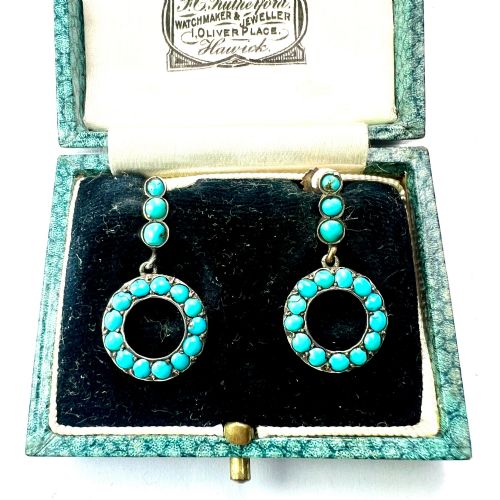
Silver turquoise jewellery encompasses a varied selection of ornamental pieces designed to be worn on the person, featuring the distinctive blue-green stone set within metal frameworks. When exploring silver turquoise jewellery on this page, buyers encounter forms ranging from delicate drop earrings and horseshoe brooches to elaborate pendants and belt buckles.
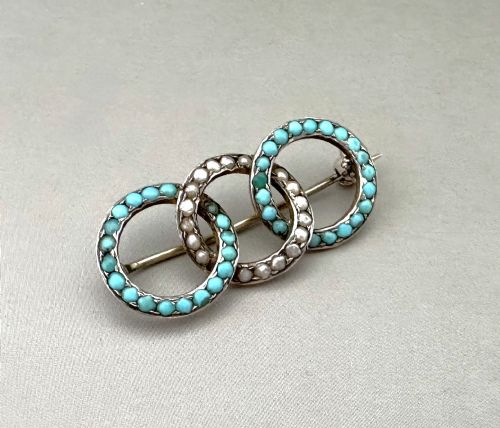
The objects span multiple decades of production, drawing heavily on Victorian sentimentality, Edwardian refinement and the handcrafted ethos of the Arts and Crafts movement. Surviving examples often incorporate subsidiary elements such as pearls, enamel work, diamonds or gold accents to enhance the visual impact of the central turquoise stones.
How they were made
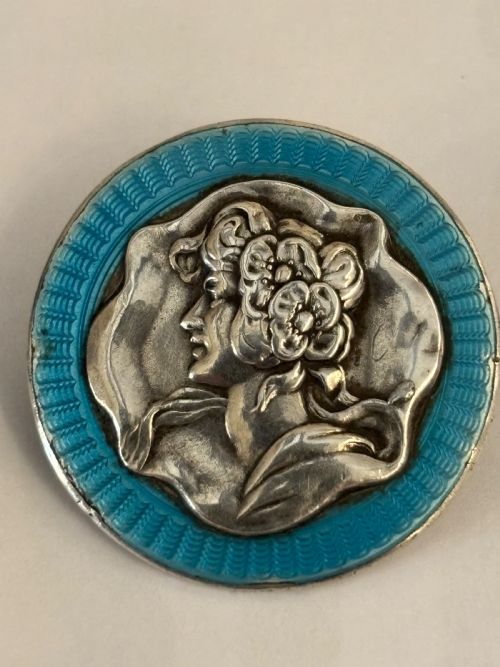
Makers utilised sterling silver and silver gilt as the primary structural metals, frequently employing filigree techniques and hand-beating methods to shape delicate wirework and settings. Stones were integrated alongside vitreous enamel and guilloche work, bonding coloured glass pastes or opaque minerals to the metallic bases through high-temperature firing.
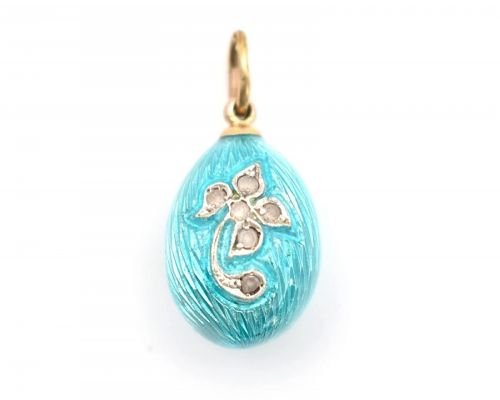
Combinations of gold and silver appeared in composite mountings, particularly where older stones required secure claw or bezel settings alongside pavé-set diamonds or seed pearls. Metal components were cast, hand-pierced or assembled by jobbing jewellers and regional workshops before receiving final polishing or gilding.
What varies in quality
The condition and matrix of the turquoise itself influence the character of each piece, alongside the preservation of supplementary enamel or delicate pearl drops. Intact surface polish on both metal and stone indicates careful handling through successive generations.
The Gaskins·Murrle Bennett·Henry Matthews·Dorrie Nossiter·Liberty and Co
The Silver Turquoise Jewellery Glossary
- Turquoise
- A hydrous phosphate of copper and aluminium valued for its robin-egg blue or greenish-blue coloration. It appears frequently in nineteenth and early twentieth-century settings.
- Guilloche
- A decorative engraving technique producing precise, intricate repetitive patterns beneath translucent enamel. It provides a shimmering backdrop to mounted stones.
- Parure
- A matching set of jewellery designed to be worn together, typically comprising earrings, a necklace and a brooch or ring. Such matched suites remain scarce.
Silver Turquoise Jewellery: Frequently Asked Questions
How do I clean silver turquoise jewellery?
Clean these items with a dry or very slightly damp soft cloth, avoiding chemical dips that can damage porous turquoise stones and fragile enamel.
Keep moisture away from the settings to prevent deterioration of historic adhesives and backing foils used in older mounts.
Can I wear these pieces every day?
Wear them with care, as Victorian and Edwardian settings often feature delicate claws and soft turquoise stones that are susceptible to knocks.
Remove items before swimming, gardening or heavy physical tasks to protect the silverwork and stones from undue stress.
How do I identify Arts and Crafts pieces?
Look for hand-hammered silver surfaces, prominent bezels holding irregular turquoise matrix stones and motifs inspired by nature.
Many pieces from this movement showcase visible tool marks and rejection of factory uniformity in favour of individual artistic expression.
What is silver gilt?
Silver gilt, also known as vermeil, is sterling silver that has been coated with a thin layer of gold.
This technique provided the rich warmth of a gold object while utilising a silver base for structural elements.