
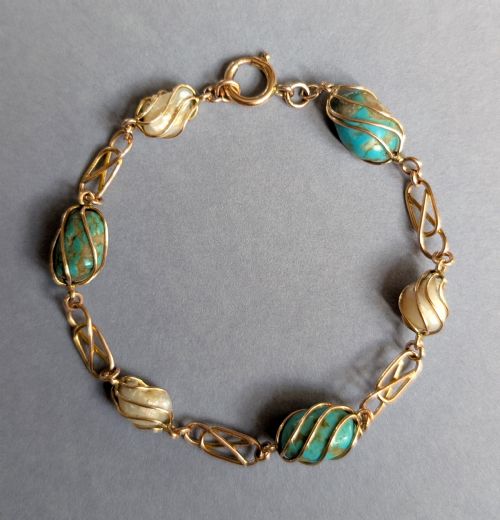


Gold Turquoise Bracelet
A gold turquoise bracelet brings together rich gold links and vibrant blue stones, offering a timeless piece of historical jewellery to wear daily.
Gold Turquoise Bracelet
A gold turquoise bracelet is a wrist ornament fashioned from yellow or rose gold and set with turquoise stones, often accompanied by pearls. The examples found here span the Victorian and Edwardian eras, stretching from roughly eighteen-eighty through to nineteen-hundred, alongside occasional later pieces.
You are most likely to meet curb link and gate link designs on this page, frequently fitted with heart padlocks or cluster clasps. These forms reflect the prevailing styles of late nineteenth-century jewellery production in Britain.
Makers utilised various link configurations, including expandable stretches and multi-strand chains, to suit different tastes of the period. The integration of seed pearls alongside turquoise stones remains a recurring decorative feature across the selection.
How they were made
Goldsmiths worked primarily in nine-carat and fifteen-carat gold, shaping the metal into solid curb links, hollow gate sections, and fine wirework chains. Stones were then set by hand into bespoke bezels or mounted alongside delicate seed pearls.
Structural elements such as safety chains, expandable springs, and clasp mechanisms required precise mechanical skill to ensure durability. Many pieces combined casting with hand-finishing techniques to achieve secure stone settings and smooth articulated joints.
What varies in quality
The distinction between standard examples and the finest pieces lies in the weight of the gold and the uniformity of the turquoise stones. Heavier gauges of gold and matched sets of vibrant blue stones elevate the overall standard.
Attention to detail in the clasp mechanism, such as engraved heart padlocks or fully integrated safety chains, demonstrates superior craftsmanship. Pieces retaining their original fitted boxes also command greater interest from collectors.
Liberty and Co
The Gold Turquoise Bracelet Glossary
- Curb link
- A type of jewellery chain formed of interlocking, slightly flattened links that lie uniform against the wrist.
- Gate link
- A structural bracelet design composed of parallel metal bars connected by vertical links, reminiscent of a garden gate.
- Padlock clasp
- A small lock-shaped fastening device, frequently used as a decorative centrepiece on Victorian charm and curb link bracelets.
- Seed pearl
- A very small, naturally formed pearl, often drilled and threaded to accent turquoise clusters in nineteenth-century jewellery.
- Bezel setting
- A method of securing a gemstone by surrounding it with a thin collar of metal pushed over the stone edge.
Gold Turquoise Bracelet: Frequently Asked Questions
How do I care for a vintage gold turquoise bracelet?
Turquoise is a relatively soft and porous stone that absorbs oils and moisture easily. Avoid immersing the bracelet in water or ultrasonic cleaners, and wipe it gently with a soft dry cloth after wearing.
Store the piece flat in a lined box away from direct sunlight and other jewellery that might scratch the gold links or stones.
Are these bracelets suitable for everyday wear?
Many of these pieces were constructed with daily wear in mind, featuring robust curb or gate links. However, the presence of seed pearls and antique clasps means gentle treatment preserves their longevity.
Checking that safety chains are fastened securely helps prevent accidental loss when wearing the bracelet out.
How can I tell a Victorian bracelet from an Edwardian one?
Victorian pieces often feature heavier fifteen-carat gold, robust curb links, and sentimental motifs like heart padlocks. They frequently date from the late nineteenth century around eighteen-eighty.
Edwardian designs tend towards lighter nine-carat rose gold, delicate gate links, and expandable stretch mechanisms popular in the early nineteen-hundreds.
What does an expandable bracelet mean?
An expandable or stretch bracelet uses internal spring mechanisms hidden within the links to allow the band to expand over the hand. This design fitted comfortably without requiring a traditional clasp.
Makers frequently applied this technique to rose gold gate link configurations during the Edwardian period.