
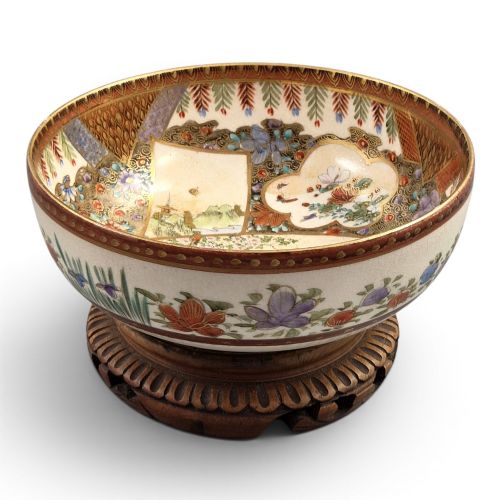
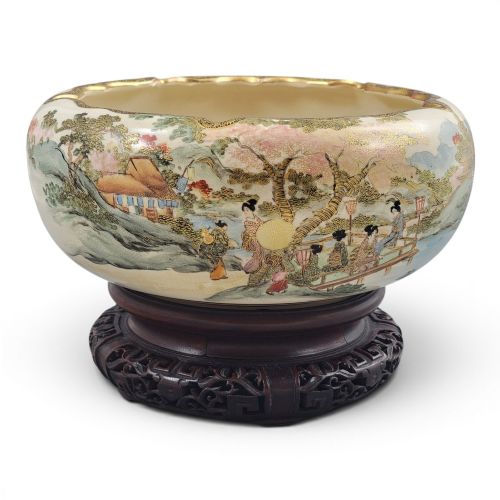


Gold Satsuma Bowl
A gold satsuma bowl brings intricate Meiji period earthenware and heavy gilding into a room.
Gold Satsuma Bowl
A gold satsuma bowl is a piece of Japanese decorative ceramics originating primarily in the Meiji period, alongside Victorian, Edwardian, and later Taisho examples. These vessels range from decorative bowls and sugar bowls to bowls and saucers and incense burners.
Most pieces seen here belong to the Meiji period, featuring elaborate hand-painted scenes and rich gold leaf or gilt highlights. Collectors encounter forms varying from standard footed bowls to monumental presentation pieces.
Kyoto studios and renowned makers produced much of this work, often incorporating the Shimazu crest alongside figurative or floral motifs. The palette typically combines cobalt blue, enamel, and extensive gilding upon a crackle-glazed earthenware body.
How they were made
Potters shaped these vessels from earthenware, applying a characteristic crackle glaze that formed the base for subsequent decoration. Artisans then hand-painted detailed scenes using mineral enamels before adding gold leaf and gilt accents.
Firing techniques allowed workshops in Kyoto and Yokohama to achieve the dense, layered compositions seen on signed pieces by masters like Kinkozan, Kozan, and Shizan.
The listings on this page span the 19th century, Edwardian, Victorian, and Taisho periods, utilising earthenware, enamel, gold leaf, wood, and gilt.
What varies in quality
Quality rests in the precision of the brushwork and the density of the gilding, distinguishing workshop production from standard output. The fineness of the crackle glaze and the clarity of signatures or the Shimazu mon also mark the superior tier.
Compositional ambition separates simple floral pieces from monumental bowls depicting complex figural narratives such as samurai battles or domestic scenes.
Kozan·Shizan·Kinkozan·Nikko·Hododa·Shozan
The Gold Satsuma Bowl Glossary
- Satsuma
- Earthenware originating from Satsuma province in Japan, known for its pale crackle glaze and intricate enamel decoration. It became widely exported during the Meiji period.
- Meiji Period
- The era of Japanese history lasting from 1868 to 1912, characterised by extensive international trade and highly detailed decorative arts. Much of the exported pottery dates from this timeframe.
- Gilt
- A thin layer of gold applied to the surface of the ceramic to highlight borders, motifs, and figural scenes. It provides the characteristic metallic sheen on these bowls.
- Shimazu Crest
- The heraldic badge or mon of the Shimazu clan, frequently found on Satsuma wares produced in workshops associated with the domain. It typically depicts a circle enclosing a cross.
- Millefleur
- A decorative pattern translating to thousand flowers, covering the entire surface of the ceramic in dense floral arrangements. This style appears on specialised bowls and saucers.
Gold Satsuma Bowl: Frequently Asked Questions
What is a gold satsuma bowl?
A gold satsuma bowl is an earthenware vessel from Japan, decorated with enamels and extensive gilding. These pieces mostly date from the Meiji period and feature hand-painted scenes.
Makers often signed their work or included clan crests. The body typically displays a fine crackle glaze beneath the painted decoration.
How do I identify a Meiji period bowl?
Meiji period bowls show detailed craftsmanship, often combining cobalt blue and gold leaf. Signatures from studios in Kyoto or Yokohama frequently appear on the base.
The historical context of the late nineteenth century drove export production, leading to diverse motifs from floral arrangements to samurai battles.
How were these bowls used originally?
These pieces served primarily as decorative objects for display in domestic interiors. Some specialised forms functioned as sugar bowls or incense burners.
Export markets in the West prized them as examples of Japanese craftsmanship. They occupied prominent places in Victorian and Edwardian reception rooms.
How do I care for a gilt ceramic?
Clean these bowls gently with a dry or very soft cloth to protect the fragile enamel and gold leaf. Avoid moisture and harsh cleaning agents that might damage the crackle glaze.
Display the pieces away from direct sunlight to preserve the colours. Handle them carefully by the base rather than the rim.