
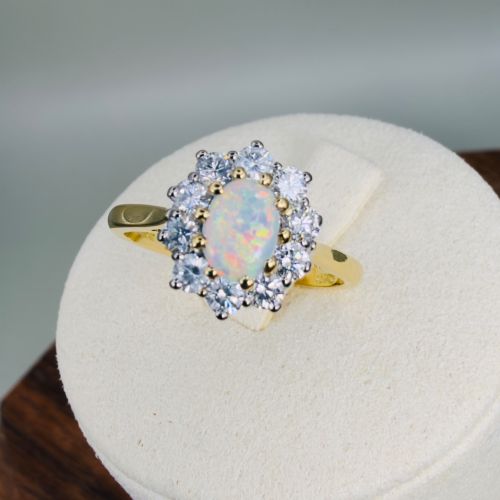
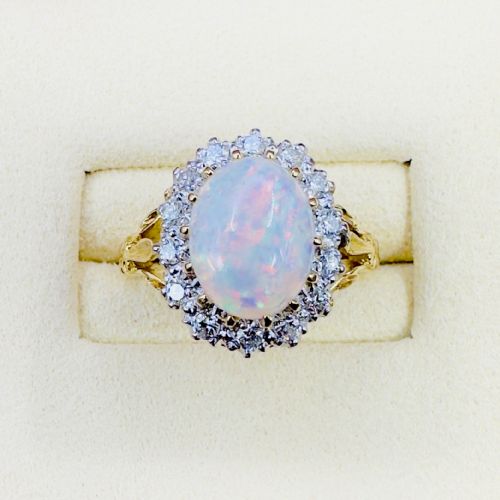


Gold Opal Halo Ring
A gold opal halo ring sits at the centre of the finger with a central stone encircled by smaller gems.
Gold Opal Halo Ring
A gold opal halo ring centres on an opal cabochon or oval cut stone, framed by a border of diamonds, sapphires, rubies, or emeralds. These pieces span periods from the sixteenth century through Victorian and Edwardian eras, up to the mid twentieth century.
Buyers meet vintage and traditional classic styles alongside cocktail rings. The construction typically places the opal as the focal point, surrounded by smaller gemstones that define the halo format.
Origins range across antique workshops and mid century production, with rings and occasional earrings appearing in the record. The core design remains consistent in its circular or oval surround of the central opal.
How they were made
Metals span nine carat and eighteen carat gold, alongside eighteen carat white gold and standard gold alloys. Goldsmiths set cabochon opals and rose cut diamonds into these metal mounts using traditional claw or bezel settings.
Cluster and halo formations rely on precise stone placement where smaller diamonds or coloured gems encircle the main opal. Jewellers balance the soft nature of opals with harder framing stones like diamonds and sapphires to protect the central gem.
Central opals are paired with diamonds, sapphires, rubies, emeralds, and water opals across different cluster configurations.
What varies in quality
The play of colour within the opal dictates much of the visual weight, alongside the clarity and cut of the surrounding diamonds. Higher grade pieces display vibrant spectral flashes across the stone surface rather than a flat milky appearance.
Metal work execution distinguishes finer examples, visible in the neatness of the claw settings and the symmetry of the halo surround. The integration of supporting gemstones like rubies, emeralds, or sapphires adds complexity to the design execution.
The Gold Opal Halo Ring Glossary
- Cabochon
- A gemstone shaped and polished with a smooth convex surface rather than faceted. This cut suits opals by highlighting their internal play of colour.
- Halo
- A ring of smaller gemstones, typically diamonds, encircling a larger central stone. This arrangement maximises the visual impact of the primary gem.
- Cluster ring
- A piece featuring a central stone grouped with multiple surrounding stones. It forms the structural basis for most halo designs.
- Rose cut
- A diamond cut with a flat base and a domed crown consisting of triangular facets. Antique pieces frequently employ this method for accent stones.
- Water opal
- A transparent or translucent variety of opal exhibiting a watery body colour. These stones display subtle play of colour within a clear matrix.
Gold Opal Halo Ring: Frequently Asked Questions
How do I care for my ring?
Opals contain water and require gentle cleaning with a soft cloth and warm water. Avoid harsh chemicals, ultrasonic cleaners, and sudden temperature changes.
Store the piece separately from harder jewellery to prevent scratching the softer central stone.
Can I wear this every day?
Daily wear is possible with careful habits, though opals rate softer on the hardness scale than diamonds. Removing the piece during manual work protects the setting and stones.
Vintage and antique examples benefit from occasional checks by a jeweller to ensure the settings remain secure.
How do I identify the period?
Victorian and Edwardian examples often feature hand chased band details and rose cut diamonds. Mid century pieces tend to use standard brilliant cuts and different gold purities.
Hallmarks and regional assay marks stamped inside the band provide direct evidence of the manufacturing date and origin.
What is a halo setting?
The halo setting places a ring of smaller accent stones around the central opal. This design originated to enhance the perceived size and brilliance of the main gem.
Diamond surrounds are most common, though sapphire, ruby, and emerald borders appear in period pieces.