




Gold Madonna Child Pendant
A gold madonna child pendant is a wearable piece of devotion, carrying centuries of French religious artistry in precious metal.
Gold Madonna Child Pendant
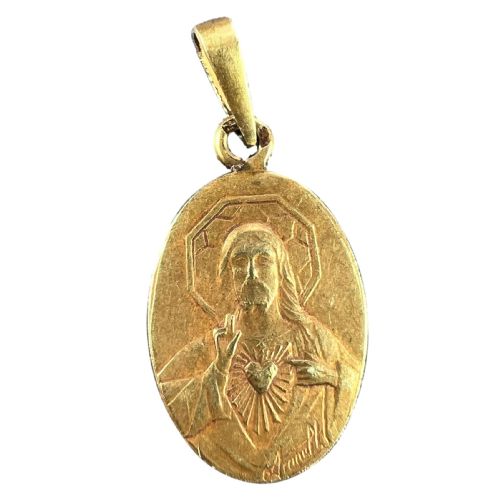
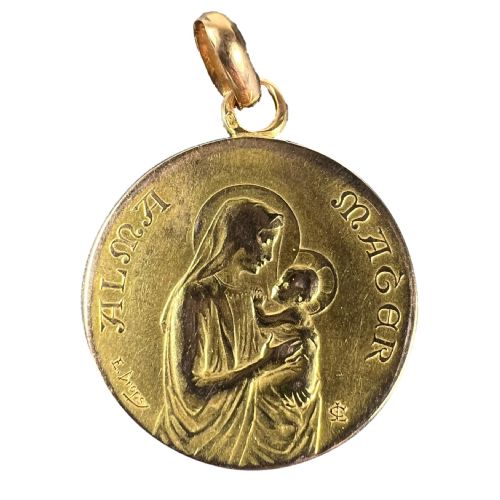
A gold madonna child pendant is a devotional jewel capturing the maternal figure of the Virgin Mary and the infant Jesus. When searching this phrase, buyers encounter French medals and charms originating from the early twentieth century, spanning the periods from nineteen hundred to nineteen thirty.
These pieces primarily take the form of circular or oval medal pendants intended for personal wear. The examples met most frequently on this page originate from French workshops, embodying styles such as Art Nouveau and ecclesiastical devotion.
Makers stamp their creations with distinct names, linking specific ateliers to the sacred iconography. The enduring appeal lies in the miniature sculptural relief depicting the holy pair, often accompanied by motifs of the Sacred Heart.
Materials and construction methods
The primary material underpinning these jewels is yellow gold, alongside rose gold and occasional accents of enamel. Goldsmiths utilise eighteen carat gold, shaping the metal through casting and striking techniques to achieve crisp sculptural detail.
Enamel work appears on select pieces, employing translucent plique-à-jour techniques to allow light through the coloured glass areas. Dies strike the metallic surfaces with precision, raising the figures of the madonna and child in sharp relief against matted or polished grounds.
Gold Madonna Child Pendant Retail Price Guide 2026
Typical asking prices for gold madonna child pendant among the pieces listed under this phrase on Sellingantiques today, from the lower quarter to the upper quarter. They describe what is for sale here now, not the wider market.
Dropsy produced so many devotional medals that his miniature portraits of the madonna remain the ultimate standard for French charm collectors.
Distinctions in craftsmanship and design
Quality separates through the crispness of the metallic relief and the depth of the sculptural modeling. Master medallists achieve subtle facial expressions and flowing drapery on the miniature figures, whereas simpler pieces show softer contours.
The presence of named maker signatures elevates a piece, as does the integration of fine plique-à-jour enamel work. The weight of the gold and the clarity of the French hallmarks stamped upon the metal further distinguish finer examples.
Mazzoni·Dropsy·Perriat·Arnault·Oscar Roty·Lavrillier·Vern
The Gold Madonna Child Pendant Glossary
- Plique-à-jour
- An enamelling technique where translucent enamel is fired in open cells, creating a stained glass effect without a backing. This lets light pass through the coloured sections.
- Medal pendant
- A wearable devotional token struck in metal, often featuring a sacred image on one side. These items suspend from chains for personal adornment.
- Art Nouveau
- A decorative style characterised by flowing, organic lines inspired by natural forms. This aesthetic appears on pieces from the early twentieth century.
- Sacred Heart
- A Christian symbol representing the heart of Jesus Christ as a source of divine love. It frequently appears alongside the madonna and child imagery.
- Hallmark
- An official stamp applied to precious metals to indicate purity and origin. French pieces typically bear small marks denoting gold standard and maker.
Gold Madonna Child Pendant: Frequently Asked Questions
How do I wear a medal pendant?
Suspend the piece from a gold chain to wear it close to the collarbone as a traditional necklace. The lightweight nature of these charms suits daily wear.
Ensure the jump ring is secure before attaching the pendant to a chain. Many owners pair them with other antique gold chains.
Are these pendants genuinely French?
The pieces originate from French workshops active in the early decades of the twentieth century. French hallmarks stamped on the gold confirm their origin.
Ateliers in France produced vast quantities of these devotional medals for religious markets. The stylistic cues of Art Nouveau further indicate French manufacture.
What is plique a jour enamel?
This technique suspends translucent enamel within a wire framework without a solid backing. It resembles miniature stained glass that glows when held to the light.
Found on select charms, this method requires immense skill from the jeweller. The resulting translucent colours add vibrant hues to the gold.
How can I tell the age of the pendant?
Examine the style of the relief work, which often reflects early twentieth century art movements. Art Nouveau curves point to the decades around nineteen hundred to nineteen ten.
Maker signatures and French gold hallmarks provide additional chronological markers. Comparing the style of the figures helps narrow down the production decade.