
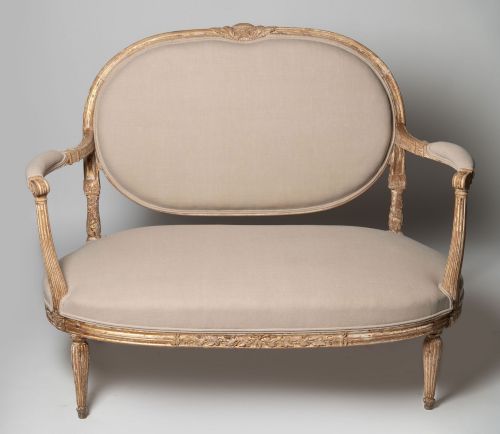
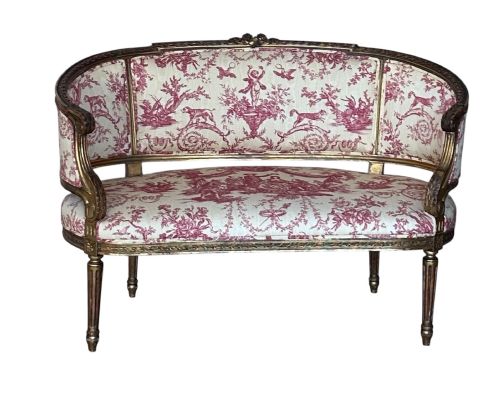


Gold Leaf French Canape
A gold leaf french canape brings gilded nineteenth-century seating into a room with grand proportions and carved wooden detail.
Gold Leaf French Canape
When you search for a gold leaf french canape, you are looking at large nineteenth-century salon seating designed in revival styles. These are substantial sofas and settee forms created to anchor formal reception rooms.
The pieces you meet on this page belong mainly to the nineteenth century, including specific dates such as eighteen-eighty and nineteen-ten. They arrive as individual sofas or as part of larger salon suites.
Makers drew directly upon historic French design vocabulary, producing work that mirrors eighteenth-century court furniture. Louis the Sixteenth and Louis the Fifteenth styles dominate the selection available here.
How they were made
Carved wooden frames form the structural core of these settees, utilising solid timbers such as beech. Artisans shaped these frames with elaborate decorative motifs before applying surface finishes.
Giltwood and gold leaf provide the luminous metallic exterior that defines the appearance of each piece. This historical gilding technique covers the timber foundation in thin sheets of precious metal.
Upholstery materials complete the construction, bringing traditional textiles into the design. Workshops utilised cotton, linen, and damask to cover the sprung seating areas.
Every gilded frame started as ordinary timber before an artisan coaxed out the gold leaf magic.
What varies in quality
The refinement of the wooden carving dictates the initial visual merit of a canape. Crisp, deeply chiselled ornamentation separates superior framing from softer, simpler moulding.
The application and preservation of the gold leaf influence the overall richness of the surface. Intact historic gilding with natural ageing demonstrates greater integrity than unsympathetically renewed finishes.
The scale and completeness of the piece also determine its standing within the range. Grand dimensions and surviving multi-piece salon suites represent the more ambitious end of nineteenth-century production.
The Gold Leaf French Canape Glossary
- Canapé
- A long decorative settee or sofa with an upholstered back and seat. These pieces emerged in French seating design to accommodate multiple sitters in formal reception spaces.
- Giltwood
- Timber that has been decorated with gold leaf or gold paint on a prepared surface. This material catches the light and provides the signature metallic sheen seen on French revival furniture.
- Damask
- A reversible patterned fabric traditionally woven on a jacquard loom. It frequently appears as the upholstery choice on formal nineteenth-century salon furniture.
- Louis XV Style
- A design movement characterised by asymmetric curves, natural scrollwork, and flowing organic lines. This aesthetic reflects the lightness and grace of mid-eighteenth-century French court taste.
- Louis XVI Revival
- A neoclassical style featuring straight tapered legs, geometric framing, and classical ornamentation. Nineteenth-century makers frequently adopted this vocabulary to project refined symmetry.
Gold Leaf French Canape: Frequently Asked Questions
What is a french canape?
A french canape is a traditional settee or sofa designed in historical French styles during the nineteenth century. These seating pieces feature exposed wooden frames and generous proportions intended for formal rooms.
Craftsmen built them to serve as both functional furniture and grand decorative statements within a salon or drawing room.
How do I style a giltwood sofa?
A giltwood sofa works best as a central focal point in a high-ceilinged room with neutral or complementary wall colours. Allow adequate floor space around the piece so the carved wooden frame remains fully visible.
Pair the sofa with simpler furnishings to let the gilded woodwork and traditional upholstery stand out without visual competition.
What is the difference between Louis styles?
Louis the Fifteenth style focuses on curved lines, cabriole legs, and flowing organic motifs. It avoids strict symmetry in favour of graceful, naturalistic movement.
Louis the Sixteenth style introduces straight lines, fluted columns, and geometric restraint inspired by classical antiquity. Both appear in nineteenth-century revivals on this page.
Are these sofas comfortable?
Nineteenth-century salon settees were built with sprung seating and padded backs to accommodate guests during extended social gatherings. They offer a firm, upright sit characteristic of formal historic furniture.
Modern comfort depends on the historical condition of the internal webbing and padding within each individual frame.